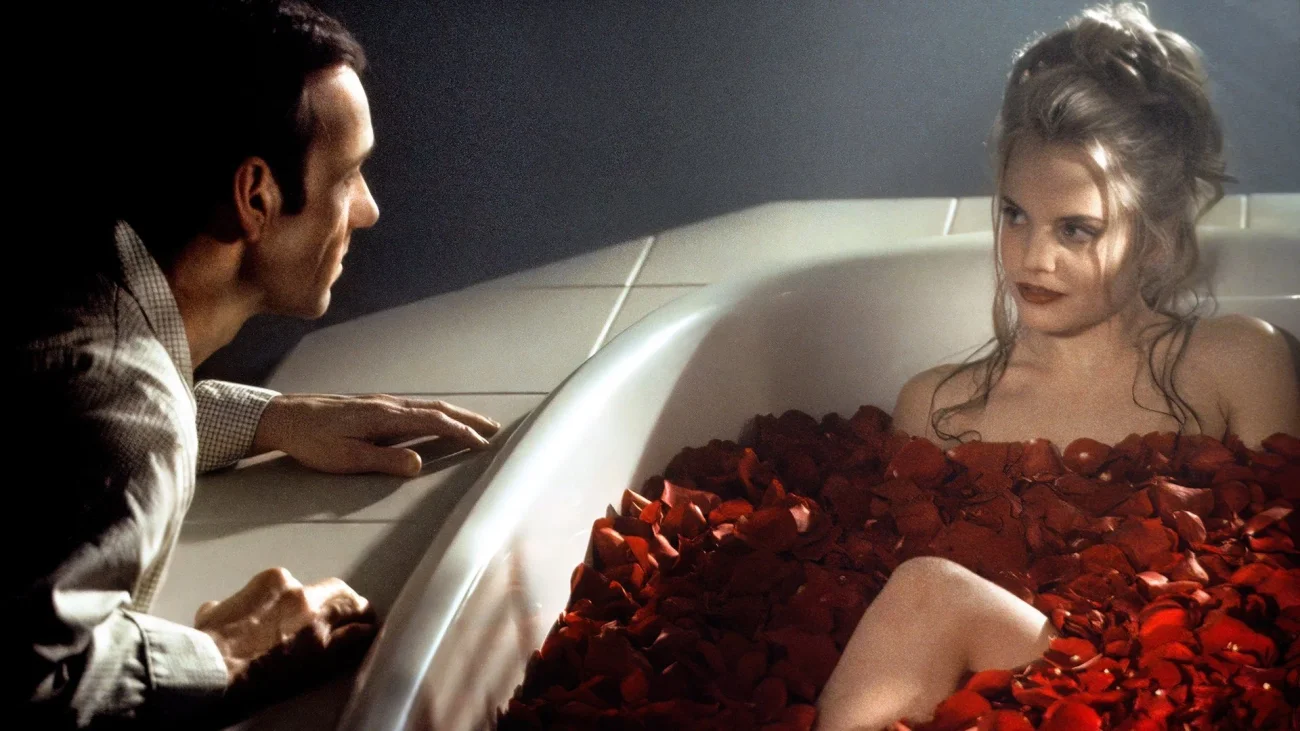
American Beauty (1999)
 Jay Wilde
The Hook
There is a shot in the trailer that tells you everything. A plastic bag, dancing in the wind on a sidewalk outside an ordinary suburban house. It tumbles and spirals with a grace that makes no sense, and as you watch it you feel something shift in your chest. You cannot look away. that's the entire thesis of American Beauty delivered in three seconds of debris, and the trailer knows it.
The rest of the trailer is a masterclass in provocation. Kevin Spacey's voiceover begins with the line "I'm 42 years old, and in less than a year I'll be dead," and immediately you are locked in. We see the Burnham household in all its suffocating beige perfection. Annette Bening's smile that never reaches her eyes. The kitchen countertops that gleam like a showroom. Then the slow turn. Lester's lustful gaze at his daughter's friend. The red rose petals cascading across a dream sequence. The fast cuts of suburban hypocrisy unraveling. Carolyn clutching a handgun at a shooting range while wearing a floral blouse. The trailer promises you a suburban nightmare and delivers something stranger and more beautiful than any nightmare could be.
Sam Mendes had never directed a feature film before American Beauty. He came from the London stage, where he had run the Donmar Warehouse and won a Tony for the revival of Cabaret on Broadway. DreamWorks offered him the script written by Alan Ball, fresh off his work creating the television series Six Feet Under, and Mendes later described his first reading as an experience where the script seemed to be about something different each time. "A mystery story, a kaleidoscopic journey through American suburbia, a series of love stories. It was about imprisonment, loneliness, beauty. It was funny. It was angry. It was sad." That multiplicity, that refusal to be just one thing, is exactly what makes the trailer so unsettling. You watch it and you think you know what the film is about, but you are wrong in the best possible way.
The production itself almost did not happen. Mendes and DreamWorks clashed over casting for Lester Burnham. The studio wanted John Travolta, who had just come off the comeback triumph of Pulp Fiction. Mendes wanted Spacey, who was known primarily as a character actor and was not considered a lead in major films. The standoff nearly killed the project before Mendes won the argument. The film was shot in just 39 days, modest even by 1999 standards, in a single residential neighbourhood in Sacramento, California. Every house on the street was rented. The cast and crew moved in and lived inside the world they were filming. That claustrophobia seeps into every frame.
The Movie
American Beauty opens with Lester Burnham telling us he is going to die, and then proceeds to show us the last year of his life in reverse order of caring. He doesn't care about his job, his marriage, his neighbourhood, or himself. He exists in a grey fog of suburban compliance, commuting through identical streets to an identical office where identical people perform identical tasks. The genius of the film is not that Lester escapes this fog. It is that his escape is so messy, so inappropriate, so deeply human that it becomes impossible to categorise as either liberation or destruction.
A defining moment in the film is the one nobody talks about in the same breath as the roses or the plastic bag. It is the moment where Lester catches Carolyn cheating through a drive-through window. She is in a car with her lover, ordering fast food, and Lester pulls up in the next lane. The camera holds on Bening's face as she realises what is happening, and in that single frozen expression you see the entire marriage collapse. No music. No dramatic dialogue. Just a woman's face going through denial, horror, shame, and rage in the space of about four seconds. Mendes holds the frame because he knows Bening doesn't need his help. She delivers the goods in a look.
Spacey's performance is a tightrope walk that could have gone so wrong in lesser hands. Lester is not a sympathetic character by any reasonable measure. He develops a sexual fixation on his daughter's teenage friend. He quits his job through blackmail. He slacks off, smokes weed with the neighbour's kid, and antagonises his wife. And yet Spacey, drawing on his extensive stage experience, plays him with such weary honesty that you root for him against your better judgment. His theatre background gives the performance a rhythmic precision, every line delivered with the weight of a man who has stopped pretending to care what anyone thinks. There's a moment where Lester finally confronts Carolyn about her infidelity, and instead of the explosion you expect, he just starts laughing. It is not a villain's laugh. It is the laugh of a man who has finally stopped pretending, and it is devastating because you realise he has not laughed genuinely in years.
Thora Birch and Wes Bentley, as the Burnham children Jane and Ricky, carry the film's philosophical weight with a lightness that keeps it from becoming pretentious. Bentley in particular owns every scene he appears in. Ricky is the character who sees the world differently, the one who films a plastic bag for fifteen minutes and calls it the most beautiful thing he has ever seen. In a lesser film this would be insufferable affectation. Bentley makes it feel like revelation. Birch matches Bentley's quiet intensity with a performance that grounds the film's more absurd elements. Her Jane is withdrawn but observant, a silent witness to the family's collapse who finds her own voice only when she is truly seen. That's what this film does best: it finds the extraordinary in the mundane, without ever feeling like it is trying to teach you a lesson.
What makes the film endure, though, is something harder to pin down than any single scene. American Beauty is fundamentally about looking, about the way its characters observe each other without ever truly connecting. Nearly every character is watching someone else through a barrier. Lester watches Angela through windows. Ricky watches Jane through a camera lens. Colonel Fitts watches Lester through the fence between their properties. Jane watches Ricky watching her. The film constructs a web of voyeurism in which every character believes they are the observer, never the observed. Mendes captures these dynamics with a specificity that borders on the clinical. The camera is always just slightly detached, always at a remove that reminds you you are not really seeing what you think you are seeing. It is a formal strategy that mirrors the emotional lives of the characters: they look but they do not see, and the tragedy of the film is that most of them never learn the difference. This visual detachment forces the audience to confront their own role as voyeurs, implicating us in the characters' unexamined lives. Released in 1999, before social media turned everyone into a voyeur, the film's critique feels even more urgent today.
There is an argument to be made that Lester's transformation is not liberation at all but simply another performance. He sheds the suit and the commute, but he replaces them with a new costume: the teenage fantasy of rebellion, the weed smoking, the fast food job worn like a badge of defiance rather than necessity. The film is sharp enough to know this, and it doesn't flinch from showing Lester at his worst. His fixation on Angela is uncomfortable precisely because Mendes refuses to aestheticise it away. The fantasy sequences with rose petals are not romantic. They are clinical and almost grotesque, and they are meant to be. The film forces you to sit with the unease of watching a middle-aged man behave in a way that you would not excuse if the camera were positioned three inches to the left. You are complicit, and the film knows it.
Carolyn, meanwhile, is the most underrated character in the film precisely because she is written as a villain the audience is not supposed to root for. But look closer. Her entire existence is constructed around the idea that control equals safety. She rehearses her breakdowns the way she rehearses her sales pitches. "I will not be a victim," she tells herself in the mirror, and the horror is not that she is practising strength but that she genuinely believes repetition will make it true. Bening plays this with a crack that runs right through the armour. You can see the exact moment where Carolyn realises her rehearsed affirmation is not working, and she starts crying instead. It is one of the most honest depictions of depression in 1990s cinema, precisely because it refuses to romanticise it. Carolyn doesn't have a breakdown that leads to healing. She has a breakdown that leads to an affair and a decision to sleep with her realtor. The film judges her no more harshly than it judges anyone else, and that might be the cruelest thing it does.
Mendes uses physical space to track emotional distance throughout the film. The production design creates a sense of scale that feels enormous and claustrophobic simultaneously. Long hallways separate characters in the same frame, and dinner table scenes are composed so the players seem seated at different tables entirely. As Lester begins his transformation, he physically occupies more space, moving with loose, predatory ease through rooms that felt too small earlier. Mendes achieves this not with dialogue but with choreography, a masterclass in visual storytelling that most viewers absorb subconsciously rather than noticing explicitly.
Angela is the character who gets the least respect from audiences and the most complicated script treatment. Mena Suvari plays her as a teenager who has learned to weaponise desirability because it is the only form of power she has access to. She breaks down and tells him she is ordinary, and in that moment she stops being the object of his fantasy and becomes a frightened child who has no idea what to do with the attention she attracted. Lester's response stands as the story's quietest heroism. He doesn't take advantage. He makes her a sandwich. He treats her with the tenderness of a father, not the hunger of a man in midlife crisis. It is the one moment where Lester looks before he is ready to die, and what he sees is a child who needs kindness. This moment makes the case that the highest form of love is looking at someone and choosing not to take.
The People
Sam Mendes has said in interviews that the role of Lester Burnham was written for Kevin Spacey before anyone else was considered, but the path to casting him was anything but straightforward. DreamWorks co-founder Jeffrey Katzenberg pushed hard for John Travolta, fresh off the commercial and critical triumph of Pulp Fiction. Mendes fought the studio and won, but the battle nearly cost him the film entirely. "There was a point where I thought the whole thing was going to collapse," Mendes later recalled. Spacey himself was not enthusiastic at first. He later admitted that he initially turned the role down because he did not want to play "another depressed middle-aged man," but changed his mind after reading Alan Ball's script a second time and realizing the character was, in his words, "funnier and angrier than I first thought." Annette Bening approached Carolyn Burnham as a woman who has built her entire identity around surface achievement. In interviews, she talked about the character's obsession with real estate and control as a defense mechanism against the chaos she feels inside. Bening has said that she based Carolyn partly on women she observed at open houses in Beverly Hills, women whose poise was "so perfect it felt like armor." Her performance earned her an Academy Award nomination, and many critics at the time argued she should have won. The scene where she discovers Lester's body is a masterwork of restrained devastation. Bening reportedly asked Mendes to shoot the moment with no dialogue, letting her face carry the grief. It is one of the most effective pieces of acting in the film.
Wes Bentley was a relative unknown when he was cast as Ricky Fitts, and his audition became the stuff of casting legend. Bentley has spoken about how he improvised the monologue about filming a plastic bag blowing in the wind, delivering it with such conviction that the casting directors went silent in the room. "I connected to Ricky's way of seeing things," Bentley told an interviewer years later. "I grew up in a small town and I used to just watch things. I understood that character completely." The plastic bag scene itself was inspired by a real event. Alan Ball, who wrote the screenplay, once saw a plastic bag dancing outside his window and was moved by it. He told Mendes it was "a moment where I felt the universe was trying to tell me something," and Mendes had the courage to put it on screen without irony. Bentley was subsequently typecast as the "mystical outsider" in early roles, a label he struggled to shed for years.
Chris Cooper, as Colonel Frank Fitts, delivers one of the most quietly harrowing performances in the film. His arc, a repressed military man whose rigid exterior conceals a lifetime of denied desire, could have been played as caricature. Cooper played it as tragedy. Mendes has spoken about how he and Cooper discussed the character's backstory at length, building a life history that never appears in the script but informed every scene. "Chris understood that Frank was a man imprisoned by his own identity," Mendes said in a retrospective interview. "He carried that weight into every take." Cooper visited Marine Corps bases to research the character's posture and speech patterns, ensuring his performance felt authentic to military audiences.
The on-set dynamics were shaped by Mendes's theatrical background. He was known for running long rehearsals before cameras rolled, sometimes spending an entire day on a single scene. This approach frustrated some of the crew, who were used to the faster pace of American film production, but the actors embraced it. Allison Janney, who plays Colonel Fitts's near-catatonic wife Barbara, has spoken about how Mendes encouraged her to find the character's silence rather than her words. "Sam told me Barbara is a woman who stopped talking decades ago," Janney recalled. "Everything she feels lives in her eyes." It is a tiny role on paper, but Janney makes it unforgettable.
Alan Ball wrote the screenplay after the death of his father, which he has described as a catalyst for examining the suburban American life his family had built. "I grew up in a house where everything looked perfect from the outside," Ball has said. "And inside, everything was falling apart." The screenplay was originally titled American Rose, but Ball changed the title after learning about the American Beauty rose, a variety that's striking from a distance but up close is riddled with imperfections. That tension between surface beauty and underlying decay runs through every scene of the film. The script was included on the 1998 Black List, an annual ranking of the most popular unproduced screenplays in Hollywood, which helped it gain traction with DreamWorks. Ball spent three years revising the script, cutting subplots and sharpening the dialogue to focus on the core Burnham family dynamic. The film explores profound themes of alienation, rediscovering joy in small moments, and the struggle for authentic connection in a superficial world. Each character represents a different response to the emptiness of modern suburban existence. Lester's transformation from passive observer to active participant in his own life serves as the film's central arc. The way he sheds his corporate persona and embraces his desires, however unconventional, speaks to the human need for authenticity. Carolyn's obsession with control and perfection reflects a different kind of imprisonment, one of her own making. The supporting characters, including the sympathetic neighbors and the enigmatic Jane, provide a rich tapestry of suburban life, each adding depth to the film's exploration of what it means to truly live. The American story is one of contrasts and contradictions, of light and darkness, of beauty and terror coexisting in the human soul. The film reminds us that life itself is an ongoing process of becoming, a continuous journey toward self-discovery and acceptance. These themes resonate across generations, speaking to the timeless struggle between societal expectations and personal truth. The film challenges us to look beyond surface appearances and find meaning in authentic experience. This American tale is ultimately about courage, vulnerability, and the transformative power of genuine human connection.
The Craft
Thomas Newman's score is one of the most distinctive in 1990s cinema, built around a spare, haunting piano motif that recurs throughout the film like a recurring thought. Newman, known for his work on films like The Shawshank Redemption and Road to Perdition, used a combination of piano, electric guitar, and subtle electronic textures to create a sound that feels both intimate and unsettling. The score never overwhelms the film. It hovers at the edges, like ambient noise from the next room, and in key moments it provides a counterpoint to the visual beauty that makes the image feel more complex. The opening sequence, with its slow aerial push over suburban rooftops, is scored with a simple piano figure that transforms the mundane into something almost dreamlike. It tells you that this world, which looks so ordinary, is about to become extraordinary.
Conrad L. Hall's cinematography won the Academy Award, and it is easy to see why. Hall, who was in his late sixties at the time, shot the film with a warmth and precision that makes every frame look like a photograph you might find in a gallery. His use of natural light, particularly in the scenes where Lester is at home, creates a golden glow that makes the Burnham house feel simultaneously inviting and suffocating. The dream sequences, where Lester fantasises about Angela surrounded by red rose petals, are shot with a dreamy soft focus that contrasts sharply with the crisp, almost clinical look of the daytime scenes. Hall has spoken about how he and Mendes agreed early on that the film should look beautiful even when depicting ugliness. "We wanted the audience to feel seduced by the images," Hall said, "just as Lester is seduced by what he thinks he wants."
The production design, overseen by Naomi Shohan, turned a real Sacramento neighbourhood into a character in its own right. Every house on the street was painted in muted, inoffensive tones. The Burnham home is a masterwork of studied blandness, all clean lines and neutral colours, a place where everything is arranged for maximum respectability and minimum personality. Mendes insisted that the set decoration reflect the emotional temperature of the scenes. When Lester begins his transformation, the props around him change too. His new Firebird, his fast food uniform, his beer cans. They are the props of a man stripping away pretence, and the design team tracked this progression meticulously.
The editing, by Tariq Anwar and Christopher Greenbury, handles one of the film's most audacious structural choices: the opening. The film begins with Lester already dead, his body being discovered, before rewinding to tell the story of how he got there. This could have felt like a cheap gimmick, but the editing keeps it seamless, cutting between Lester's voiceover and the present-tense narrative with a rhythm that makes the temporal shift feel natural. The pacing throughout is deliberately measured. Mendes and his editors hold shots longer than a Hollywood norm, trusting the performances and the compositions to carry the weight. It is a choice that rewards patience and gives the film a meditative quality that sets it apart from its contemporaries.
The rose petal imagery, designed by a team of practical effects artists who used thousands of real petals, remains one of the most iconic visual motifs in modern cinema. The petals were arranged on Mena Suvari's body for the fantasy sequences, and the team has spoken about the painstaking process of placing each one by hand. Some sequences took hours to set up for just a few seconds of screen time. The result is images that look effortless and organic, as if the petals simply chose to land there. It is the kind of craft work that audiences never see but always feel.
The Trivia
-
Sam Mendes was so nervous during the first day of shooting that he vomited in the bathroom between takes. He was directing his first feature film, working with a cast that included an Academy Award winner and a cast of seasoned professionals, and the pressure nearly overwhelmed him. Mendes has spoken about how Kevin Spacey quietly found him between takes and said, "Relax. We're all scared. That's how you know it matters."
-
The film was a pivotal release for DreamWorks, establishing the studio as a major player in prestige cinema after its early focus on animation and populist entertainment. Its success paved the way for future DreamWorks prestige films like Gladiator and A Beautiful Mind.
-
Kevin Spacey won the Academy Award for Best Actor, but he did not attend the ceremony. His absence sparked speculation about whether it was a deliberate snub or the result of a scheduling conflict. Spacey later said he was at home watching on television and that winning "felt like it happened to someone else."
-
The plastic bag scene was originally much shorter in Alan Ball's script. Wes Bentley improvised the monologue about beauty during the audition, and Mendes was so moved by it that he expanded the scene for the final film. The bag itself was a standard grocery bag that the props team released repeatedly until they captured the right footage.
-
DreamWorks launched a massive Oscar campaign for the film after the previous year's controversy, when Saving Private Ryan lost Best Picture to Shakespeare in Love. The campaign was aggressive and expensive by 1999 standards, and it paid off with five Academy Awards including Best Picture, Best Director, Best Actor, Best Original Screenplay, and Best Cinematography.
-
The rose petal imagery required a dedicated team of effects artists. The petals used in the fantasy sequences with Mena Suvari were real roses, and the team reportedly used over 5,000 petals across multiple takes. Some scenes took an entire day to set up for a few seconds of footage.
-
Annette Bening was widely considered a snub when she lost the Best Actress Oscar to Hilary Swank for Boys Don't Cry. Many critics and audience members felt Bening's performance as Carolyn Burnham was the more complete and emotionally complex work, and the loss remains one of the more debated Oscar outcomes of the era.
-
The film was shot in a real residential neighbourhood in Sacramento, California. The crew rented every house on the street and painted them in the muted tones the script required. Neighbours were compensated but had to live alongside a full film production for several weeks. Some residents later said the experience was surreal, living inside the world of the film.
-
Sam Mendes has spoken about how the film's ending was the subject of intense debate. Alan Ball's original script had a different killer, and the identity was changed during production. Mendes has never publicly confirmed who the original killer was, but he has said the change was made to increase the ambiguity and force the audience to confront their own assumptions.
-
The title change from American Rose to American Beauty was made late in the production. Ball discovered that the American Beauty rose, while striking from a distance, is actually riddled with imperfections up close. He felt the metaphor was perfect for a film about the gap between how things look and how they really are.
-
Thomas Newman composed the score in just three weeks, an unusually short timeframe for a film of this ambition. He has described the experience as intense but creatively liberating, saying the time pressure forced him to trust his instincts and avoid overthinking the music.
-
DreamWorks shifted its focus toward prestige cinema following American Beauty's awards sweep. Before American Beauty, DreamWorks was primarily known for animated films like The Prince of Egypt and populist entertainment. The film's five Oscars gave the studio the credibility to pursue more ambitious projects.
-
Wes Bentley struggled with substance abuse in the years following American Beauty, and his career trajectory was dramatically affected. He has spoken publicly about how the sudden fame and attention changed his life, and he has credited his eventual recovery with giving him a new perspective on the role that changed his life.
-
The scene where Lester catches Carolyn at the drive-through was shot in a single take. Bening's reaction was largely unscripted, and Mendes has said that the look on her face in that moment was one of the most honest pieces of acting he has ever directed.
-
The film's opening shot, a slow aerial push over suburban rooftops accompanied by Lester's voiceover announcing his death, was achieved using a helicopter-mounted camera. Mendes wanted the shot to feel like a slow descent into a world that looks peaceful from above but is roiling with hidden chaos underneath.
The Verdict
There are films that age well and films that age badly, and then there's American Beauty, which does something stranger. It ages differently depending on when you watch it. At seventeen you watch it and feel like you have discovered a secret about adulthood. At thirty you watch it and see the selfishness that the teenage you missed. At forty you watch it and feel the weight of Lester's exhaustion in your own bones. that's what great art does. It doesn't change. You do.
American Beauty is not a perfect film. Its view of suburban malaise is, by now, a well-worn cinematic territory. Its treatment of certain characters, particularly Colonel Fitts, can feel reductive in ways that modern audiences might rightly question. But the film's emotional intelligence, its refusal to offer easy answers, and its absolute commitment to the idea that beauty is not the absence of ugliness but its coexistence with ugliness give it a power that has not diminished.
Mendes went on to make Skyfall and 1917, both visually stunning films, but neither has the raw nerve of this debut. Ball went on to create True Blood and other projects, but nothing he wrote before or since has hit with this kind of precision. Spacey delivered what many consider the finest performance of his career, and Bening matched him beat for beat. Together they created something that looks like a suburban satire on the surface and is, beneath everything, a meditation on what it means to be alive and to pay attention to the time you have. There are images in this film that stay with you, the way a rose petal stays with you, the way a plastic bag dancing in the wind stays with you, long after the screen goes dark.
"It's hard to stay mad when there's so much beauty in the world."