Big Trouble in Little China (1986)
 Jay Wilde
The Hook
The trailer for Big Trouble in Little China makes a promise that's beautifully insane. Kurt Russell, moustache blazing, cowboy hat perched on his head, driving a big rig through the streets of San Francisco, heading into Chinatown, heading into trouble. The trailer doesn't bother explaining the plot, because the plot is not the point. The point is Kurt Russell being magnificent, and the trailer knows it.
What the trailer conveys brilliantly is the film's tonal cocktail: 80s action, martial arts, fantasy, comedy, and horror, all shaken together and served with a wink. The trailer shows you the flash, the lightning, the ancient magic lurking beneath the streets of San Francisco, and it does so with an energy that says, we know this is ridiculous, and we are going to have the absolute time of our lives with it. Jack Burton is not your typical action hero, and the trailer makes that clear. He thinks he is in charge, and the film keeps finding ways to prove him wrong.
The banter between Russell and Dennis Dun, visible even in the trailer's short runtime, establishes the film's central dynamic immediately. Jack Burton is the guy who thinks he is the star, while Wang Chi is the guy who is actually getting things done. This reversal of the traditional white leading man trope was unusual for 1986, and the trailer presents it with a lightness that disguises how subversive it actually is.
The trailer also showcases the visual spectacle that John Carpenter brings to the material. The supernatural elements, the glowing eyes, the lightning bolts, the ancient sorcery, all rendered with Carpenter's characteristic blend of practical effects and visual flair. The trailer hints at a world of fantasy that goes far beyond what you would expect from a film that begins with a truck driver in a cowboy hat, and that contrast between the mundane and the magical is one of the film's greatest pleasures.
The trailer's depiction of Jack Burton as an unlikely hero who believes himself to be in control while the narrative constantly reveals his profound lack of agency is a sophisticated comedic device that speaks to deeper themes of cultural displacement and self-delusion. This setup allows Carpenter to explore issues of authenticity and performance, both in terms of the characters' roles within the story and the film's own positioning within the action genre. The trailer, by presenting these contradictions so vividly, essentially provides a microcosm of the film's own approach: entertaining yet thoughtful, ridiculous yet committed, surface-level fun with undercurrents of genuine thematic exploration.
What makes Big Trouble in Little China particularly resonant is how it uses genre conventions to articulate concerns about masculinity, power, and cultural ownership in 1980s America. Jack Burton's exaggerated bravado and constant need to be the center of attention can be read as a parody of hypermasculine tropes that dominated action cinema at the time. Yet the film avoids simply dismissing these traits, instead showing how even such a caricatured figure can demonstrate genuine growth and vulnerability. Wang Chi, by contrast, represents a different model of masculinity: one rooted in skill, responsibility, and quiet competence rather than performative dominance. The film's willingness to explore these dynamics within a commercial framework was relatively rare for its time.
The film's engagement with themes of fate, destiny, and the struggle against seemingly insurmountable forces elevates it beyond standard genre fare. David Lo Pan's curse and the ancient rituals surrounding it introduce a sense of cosmic order that contrasts sharply with Jack's chaotic, ego-driven worldview. This thematic layering ensures that the film's entertainment value never comes at the expense of intellectual engagement. Even the most outrageous supernatural occurrences feel grounded in a coherent mythology that gives them weight and significance. Carpenter's background in science fiction and horror proves essential here, as he seamlessly blends existential questions with pulse-pounding set pieces.
The supporting cast further enriches the film's exploration of cultural collision and adaptation. Dennis Dun's Wang Chi is not merely a sidekick but a fully realized character whose competence and strategic thinking drive much of the plot. The relationship between Jack and Wang evolves from initial friction to a grudging mutual respect, reflecting the film's nuanced approach to cross-cultural dynamics. Other characters, such as the eccentric restaurateur who provides crucial information, add texture and authenticity to the San Francisco setting, making the Chinatown locale feel lived-in and richly detailed rather than a generic backdrop for action.
The Movie
Jack Burton is a truck driver who prides himself on his reflexes. He plays a game where he throws a knife in the air and catches it, which tells you everything you need to know about his self-image. When his truck gets stolen in San Francisco's Chinatown, he goes after it and stumbles into a supernatural conflict involving an ancient sorcerer, three warrior lords, and a woman whose eyes glow. This is not what Jack signed up for, but his truck is down there somewhere, and nobody takes Jack Burton's truck.
What makes Big Trouble in Little China work as brilliantly as it does is John Carpenter's understanding that the best pulp entertainment takes its absurdity seriously. The film never winks at the audience. It never acknowledges that what is happening is ridiculous. The sorcerers are genuinely menacing, the stakes are genuinely high, and Jack Burton is genuinely out of his depth, even though he never realises it. This commitment to playing the material straight, while letting the audience enjoy the gap between what Jack thinks is happening and what is actually happening, is the film's central comic engine and it runs perfectly.
The Chinatown setting is one of the film's most valuable assets. Carpenter transforms the neighbourhood into a hidden world, a place where ancient Chinese mythology exists just beneath the surface of modern San Francisco, waiting to erupt. The underground lair of David Lo Pan, with its incense and altars and ancient machinery, feels like a place that has existed for centuries, a pocket of old-world magic surviving in the heart of a modern American city. This world-building gives the film a depth that most 80s action films lack, turning what could have been a simple rescue story into something richer and stranger.
Jack Burton's characterisation is one of the most interesting things about the film, and it was a deliberate choice by Carpenter and Russell. Burton is positioned as the traditional action lead in every sense: he is the lead character, the white American, the one the marketing is built around. But he is not the one driving the narrative forward. Wang Chi is. Wang is the one with the personal stakes, the martial arts skills, and the plan. Jack is the sidekick who thinks he is the lead, and the film mines this misunderstanding for both comedy and commentary. This structural subversion was radical for 1986, and it still feels fresh today.
The fight sequences are staged with a precision and creativity that puts many dedicated martial arts films to shame. Carpenter, who was a lifelong fan of the genre, shoots the action with a clarity and energy that makes every punch, kick, and supernatural blast feel consequential. The alley fight, where Jack, Wang, and their allies take on Lo Pan's warriors, is a masterclass in action choreography, building from a tense standoff through a series of escalating confrontations to a climax that involves lightning bolts, glowing eyes, and a knife thrown with pinpoint accuracy.
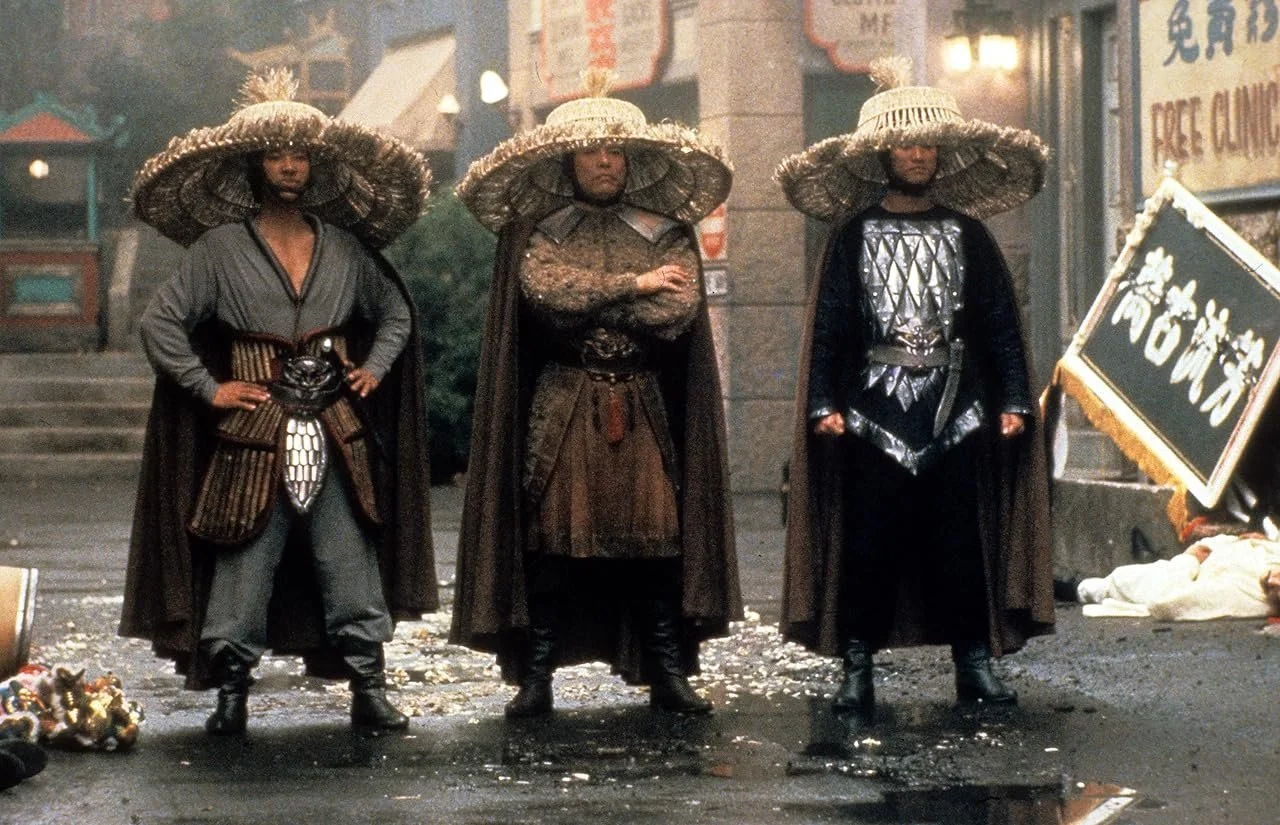
The supernatural elements are integrated into the action with a seamlessness that's one of the film's most impressive achievements. The magic doesn't feel bolted on or decorative. It is woven into the fabric of the story, an essential part of the world that Carpenter has created. Lo Pan's sorcery, the three storms, Gracie Law's transformation, all feel like natural extensions of the mythology rather than special effects sequences designed to impress the audience. This integration of fantasy and action is the film's defining characteristic, and it is what separates Big Trouble in Little China from the dozens of imitators it inspired.
There is a structural ambition to the film that has rarely been acknowledged in genre criticism. Every scene operates on two registers simultaneously, and both registers are being played completely straight. On the surface, you have an 80s action adventure with martial arts and special effects. Underneath, you have a story about a man who thinks he understands the world because he has seen it from the cab of a truck, only to discover that the world is infinitely stranger and more ancient than anything his headlights could illuminate. Jack Burton is not just a comic figure. He is a portrait of American confidence meeting the limits of American knowledge, and the film treats both his swagger and his ignorance with equal affection. Carpenter is not mocking Burton. He is letting Burton be exactly who he is, and the audience is trusted to draw whatever conclusions they like.
The three storms, Rain, Thunder, and Lightning, serve as more than boss fights in a video game progression. Each one represents a different aspect of Lo Pan's power, and each presents a different kind of threat that forces Jack and Wang to adapt rather than simply punch harder. Rain is a duel of skill. Thunder is a test of survival. Lightning is something else entirely, a confrontation with forces that operate beyond the rules of conventional combat. This escalation is carefully structured, and Carpenter stages each encounter with distinct visual and tonal signatures that keep the middle act from feeling repetitive. Most action films of this era would simply throw more enemies on screen. Carpenter throws different kinds of danger at his characters, and the result feels purposeful rather than padded.
What rewards repeated viewings is the film's visual grammar, which Carpenter establishes early and then plays against with increasing sophistication. Carpenter uses colour temperature as a shorthand for moral geography, without ever needing to explain it. The world above ground is amber and neon and alive. The world below is green and gold and dead, preserved in amber like the ancient sorcerer who inhabits it. This visual storytelling is so consistent that you can track your emotional response to each scene before you consciously register what is happening on screen.
The comedy, too, is doing more work than it gets credit for. The famous line about reflexes is funny because it is delivered with absolute conviction by a man who has no reflexes whatsoever. But it is also tragic, in a gentle way, because what Jack Burton is really saying is that he believes repetition equals mastery, that if you just keep doing the same thing with enough confidence, eventually the world will bend to accommodate you. The film's answer, delivered scene after scene, is that the world has other plans. And that's why the comedy never becomes cynical. Carpenter's film is ultimately hopeful about the possibility of people who are out of their depth finding their way through anyway, even if they never quite understand what happened.
The People
Kurt Russell was at the peak of his powers when he made Big Trouble in Little China, and his performance as Jack Burton is one of the greatest things he has ever done. Russell plays Burton as a man who is absolutely convinced of his own competence despite all evidence to the contrary, a swaggering, self-assured cowboy who has wandered into a world that operates on rules he doesn't understand and will never bother to learn. The genius of Russell's performance is that he never plays Burton as stupid. Burton is confident, resourceful, and brave. He is also completely, spectacularly wrong about almost everything, and Russell conveys this gap between self-perception and reality with a subtlety that the film's reputation as pure popcorn entertainment might cause you to miss.
Russell has spoken in interviews about how he and Carpenter developed the character together, deliberately constructing Burton as a commentary on the 1980s action star archetype. The moustache, the sunglasses, the cowboy hat, all of these were conscious choices designed to create a character who looked like he should be leading the charge and then demonstrated, through his actions, that appearance and capability are very different things. Russell's commitment to this concept is total, and his performance has the rare quality of improving with each viewing as the audience becomes more attuned to the gap between what Burton says and what is actually happening.
Dennis Dun's Wang Chi is, in many ways, the real hero of the film, and Dun plays him with a warmth and charisma that makes the character impossible not to root for. Wang is smarter, faster, and more skilled than Jack, and he carries the emotional weight of the story, as his fiancée is the woman who has been kidnapped by Lo Pan. Dun brings an effortless likability to the role that makes Wang's competence feel natural rather than showy, and his scenes with Russell have the relaxed, improvised quality of two friends genuinely enjoying each other's company. This chemistry is the film's most valuable asset, and it is the reason the dynamic between the two characters works so beautifully.
Kim Cattrall's Gracie Law is a character who could have been a simple damsel in distress, but Cattrall brings an intelligence and a stubbornness to the role that gives her genuine agency within the story. Gracie is not waiting to be rescued. She is diving headfirst into danger because she cares about the people of Chinatown and she refuses to stand on the sidelines. Cattrall's natural charisma and comic timing make Gracie a perfect match for the film's tonal register, and her scenes with Russell crackle with the energy of two performers who are clearly having the time of their lives.
James Hong's David Lo Pan is one of the great movie villains of the 1980s, a character who is simultaneously ancient and pathetic, terrifying and strangely sympathetic. Hong brings decades of experience and a theatrical authority to the role that makes Lo Pan feel like a figure from genuine mythology rather than a standard action movie antagonist. His scenes are the film's most visually striking, and his ability to shift between the two versions of Lo Pan, the withered old man and the powerful sorcerer, adds a dimension to the character that elevates him far above the usual one-dimensional villain.
John Carpenter directed Big Trouble in Little China at the peak of his career, and his confidence and skill are visible in every frame. Carpenter's approach to the material was characterised by a commitment to fun that never descended into laziness, a willingness to take the fantasy elements seriously while never losing sight of the comedy. His direction of the action sequences is particularly impressive, demonstrating a spatial awareness and a visual clarity that many action directors lack. Carpenter's love of the material is evident throughout, and that affection is what makes the film feel like a celebration rather than an exploitation of its genre influences.
The film's treatment of Kurt Russell's character represents a fascinating evolution in the protagonist archetype. Unlike the clean-cut, morally unambiguous heroes that dominated 1980s action cinema, Jack Burton is a walking contradiction: a man who is simultaneously heroic and ridiculous, capable of genuine courage and astonishing foolishness. This complexity reflects a growing sophistication in how Hollywood was beginning to approach its leading men, recognizing that audiences respond to characters who feel like actual human beings rather than idealized constructs. Russell's performance captures this balance perfectly, shifting effortlessly between swagger and vulnerability in a way that makes Burton feel like a real person rather than a character type.
Dennis Dun's portrayal of Wang Chi elevates the film beyond its comedic premise by providing genuine emotional depth to the story. As the film's de facto hero, Wang carries the narrative weight of his fiancée's abduction with a quiet determination that contrasts beautifully with Jack's loud bravado. Dun's performance is particularly noteworthy for its authenticity and restraint, qualities that were relatively rare in Hollywood action films of the era, particularly those featuring Asian leads. The chemistry between Russell and Dun forms the film's emotional core, and their scenes together crackle with a genuine rapport that makes their partnership believable and compelling.
Kim Cattrall's performance as Gracie Law is often overlooked in discussions of the film, but her contribution is significant. Gracie represents a departure from the typical female character archetype that dominated 1980s action cinema. Rather than serving as a passive damsel or a love interest, Gracie is an active participant in the story, driven by her own motivations and capable of taking initiative when the situation demands it. Cattrall brings a blend of toughness and vulnerability to the role that makes Gracie feel like a fully realized person rather than a narrative device, and her scenes with Russell crackle with an energy that suggests these performers were having genuine fun creating their characters.
James Hong's performance as David Lo Pan stands as one of his most memorable roles, and perhaps one of the most nuanced villain performances of the 1980s. Hong brings a theatrical gravity to the role that transforms what could have been a standard action antagonist into a figure of genuine pathos and menace. His ability to shift between the frail, ancient version of Lo Pan and the powerful sorcerer is masterful, creating a character who feels simultaneously otherworldly and deeply human. The tragic dimension of Lo Pan's curse and his desperate need to marry a woman with "the right chi" adds a layer of complexity to the character that elevates him far above typical genre villains. Carpenter's approach to the material was characterized by a commitment to fun that never descended into laziness, a willingness to take the fantasy elements seriously while never losing sight of the comedy. His direction of the action sequences is particularly impressive, demonstrating a spatial awareness and visual clarity that many action directors lack. The character of Master Wang, played with gravitas by Victor Wong, serves as a bridge between the modern world and ancient magic. His scenes with Jack Burton, while brief, carry significant thematic weight as they represent the clash between old-world wisdom and new-world bravado. The film's depiction of San Francisco's Chinatown is remarkably authentic, capturing the neighborhood's labyrinthine streets and cultural institutions with a documentary-like precision that enhances the film's immersive quality.
Big Trouble in Little China also engages with themes of destiny and agency in ways that were uncommon for action films of the mid-1980s. The film asks whether individuals can truly escape their predetermined roles, or whether they are bound by the expectations of others. Jack's journey from self-delusion to reluctant heroism suggests that growth is possible even for the most unlikely individuals. This thematic depth, woven into what could have been a simple adventure story, is what elevates the film beyond its genre trappings.
The film's relationship with Chinese mythology is respectful yet accessible, avoiding both exoticization and oversimplification. The ancient sorcerer Lo Pan and the three elemental storms, Earth, Thunder, and Lightning, draw from genuine folk traditions while being adapted for cinematic storytelling. Carpenter's decision to present these elements with seriousness rather than irony allows the film to explore questions about cultural heritage and authenticity in ways that remain relevant today.
The Craft
Carpenter's visual style in Big Trouble in Little China is characterised by a confidence and an energy that keeps the film moving at a breathless pace. The camera is always in the right place, the compositions are always clear, and the pacing is calibrated to maintain momentum without sacrificing the character moments that give the action its emotional weight. Carpenter shoots Chinatown as a place of hidden wonders, all neon signs and shadowy alleys and ancient temples concealed behind modern storefronts, creating a visual world that feels simultaneously real and fantastical.
The practical effects, supervised by a team of some of the best effects artists in the business, give the film a physicality that CGI still cannot match. Lo Pan's magic, the three storms' elemental powers, the transformations and apparitions, all achieved through a combination of puppetry, pyrotechnics, and optical effects. The effects are not flawless, but their imperfections add to the film's charm rather than detracting from it, giving the fantasy elements a handmade quality that makes them feel more real, not less. Carpenter's decision to use practical effects rather than relying on the emerging technology of the mid-1980s was a deliberate one, and it is one of the reasons the film has aged so gracefully.
The action sequences are staged with a clarity and precision that's characteristic of Carpenter's best work. The alley fight, the airport climax, the confrontation in Lo Pan's lair, each sequence is designed to showcase the performers' skills while advancing the narrative and maintaining the film's distinctive tonal balance. Carpenter uses wide shots to capture the full scope of the action, cutting to closer angles only when a specific moment needs emphasis. This approach keeps the audience oriented within the space and prevents the disorientation that can result from the rapid-fire editing that became fashionable in action films of the era.
The score, composed by Carpenter himself, is a driving, synthesiser-heavy piece of work that matches the film's energy perfectly. Carpenter's scores are always characterised by their simplicity and their propulsive rhythms, and the Big Trouble in Little China score is one of his best, combining the electronic textures that are his trademark with occasional Asian instrumentation that reinforces the film's cultural setting. The music never overwhelms the action, but it provides a constant, underlying energy that keeps the audience engaged throughout.
The sound design creates an immersive auditory environment that places the audience inside the hidden world of Chinatown. The clash of swords, the crackle of magical energy, the roar of the three storms, all rendered with a clarity and power that adds physical weight to the fantasy. The contrast between the mundane sounds of San Francisco traffic and the supernatural sounds of Lo Pan's lair reinforces the film's central thematic tension between the everyday world and the hidden world beneath it.
The editing maintains a pace that never flags, moving between action, comedy, and character moments with a fluidity that keeps the narrative feeling fresh and unpredictable. The cuts are sharp during the action sequences, matching the intensity of the combat, while the dialogue scenes are allowed to breathe, giving the performances room to develop without feeling rushed. This editorial balance is one of the film's most important assets, as it prevents the two-hour runtime from feeling either rushed or bloated.
The film's technical achievements extend beyond visual style to encompass a meticulously curated soundtrack that elevates every scene. Carpenter's score weaves together synthesizer motifs with traditional Asian instrumentation, creating a sonic landscape that feels both futuristic and culturally rooted. This musical approach mirrors the film's thematic concerns: bridging the mundane and the magical, the contemporary and the ancient. The sound design further enhances this fusion, with every clash of swords and burst of magical energy meticulously crafted to feel both visceral and otherworldly. These technical elements work in concert to create a fully immersive experience that respects genre conventions while pushing boundaries of what 1980s action cinema could achieve artistically.
The Trivia
-
The Trivia
-
Big Trouble in Little China was written by Gary Goldman and David Z Weinstein, with later revisions by W.D. Richter, who was brought in to restructure the script significantly. The original version was a more straightforward period adventure set in the 1800s, with a protagonist who was a more conventional action lead. Richter and Carpenter reimagined the film as a contemporary story set in 1980s San Francisco, transforming the protagonist into the seemingly competent but actually bumbling Jack Burton. This structural reimagining was crucial to the film's identity and its enduring appeal.
-
The film was produced by a collaboration between 20th Century Fox and Carpenter's own production company, and it was marketed primarily as an action-comedy vehicle for Kurt Russell The marketing campaign emphasised the film's adventure elements and its star's charisma, but it did not fully convey the film's subversive approach to the action hero archetype. This disconnect between marketing and content left audiences expecting a conventional Kurt Russell action film confronted with something much stranger and more interesting.
-
The production used real Chinatown locations in San Francisco, combined with sets constructed at the studio, to create the film's distinctive visual world The combination of authentic locations and studio sets gave Carpenter the flexibility to shoot both the public and hidden dimensions of Chinatown, moving between the familiar streets and shops and the underground lairs and temples that exist only in the film's mythology. This approach to world-building, grounded in real locations but expanded through imagination, is one of the reasons the film's Chinatown feels like a genuine place rather than a movie set.
-
Kurt Russell's preparation for the role included extensive work on the physical comedy and action sequences, as well as the development of the character's distinctive mannerisms and speech patterns The moustache, which became the character's most recognisable feature, was Russell's own addition to the costume, and it became so closely associated with the role that it has achieved a kind of legendary status among fans. Russell has spoken in interviews about how the moustache helped him find the character, providing a visual anchor for the swaggering, self-assured persona that Jack Burton projects to the world.
-
The film's relationship to Chinese mythology and culture is more respectful than many critics initially recognised Carpenter and his writers drew on genuine Chinese folklore and religious traditions in creating the world of the film, and they consulted with cultural advisors to ensure that the representations were accurate and respectful. The casting of Asian actors in significant roles, including James Hong, Dennis Dun, and Victor Wong, reflected a commitment to authenticity that was unusual for Hollywood films of the era and that contributed to the film's enduring popularity among Asian audiences.
-
The three storms, Rain, Thunder, and Lightning, have become iconic characters in the genre, their visual design and elemental powers drawing on Chinese mythology while adding Carpenter's own brand of 80s action flair The actors who played the storms, Peter Kwong, Carter Wong, and James Pax, trained extensively in martial arts to perform their own fight sequences, and their commitment to the physical demands of the roles is visible on screen. Each storm has a distinct personality and fighting style, which adds variety to the action sequences and gives the audience multiple opponents to root against.
-
Big Trouble in Little China struggled to find its audience in theatres upon initial release. The film opened against other major releases, and Carpenter has attributed the film's difficulties to the marketing campaign's failure to convey the film's unique tonal qualities. However, the film found a devoted audience on home video, becoming one of the most rented films of the late 1980s and establishing a cult following that has only grown stronger with time.
-
The film's cult status has inspired numerous attempts at sequels, reboots, and adaptations over the years Dwayne Johnson's production company acquired the rights to the property in 2018 with the intention of producing a reboot, though the project has not yet materialised. The enduring interest in revisiting the property is a testament to the film's lasting appeal and the belief among filmmakers and audiences alike that there's something in Big Trouble in Little China that deserves to be experienced by new generations.
-
John Carpenter has spoken in interviews about Big Trouble in Little China with a combination of affection and frustration, expressing pride in the film's quality while lamenting the studio's handling of its release Carpenter has described the film as one of his most personal and enjoyable projects, and his enthusiasm for the material is evident in every frame. The film's reception was a significant disappointment for Carpenter, but its subsequent critical and cultural rehabilitation has validated his vision and confirmed the film's status as one of the finest genre films of the 1980s.
The Verdict
Big Trouble in Little China is one of those rare films that gets better every time you watch it. The first time, you come for the action and the spectacle. The second time, you come for the comedy and the performances. The third time, you come because you have realised that this film has become part of your personality, a reference point that shapes how you think about fun, about loyalty, about the difference between genuine heroism and self-delusion.
Kurt Russell's Jack Burton is one of the great screen creations, a man who struts through a world of ancient magic and martial arts mastery convinced that he is the most dangerous person in the room. The joy of the film is watching reality gently, patiently correct him, without him ever quite catching on. He never learns. He never grows. And that's exactly the point. Jack Burton is perfect as he is, and the film knows it.
John Carpenter made a film that works on every level simultaneously. It is an action film. It is a fantasy. It is a comedy. It is a love letter to the martial arts films that Carpenter grew up watching. And underneath all of that, it is a sly commentary on the way Hollywood casts its heroes, a film that puts a Chinese man at the centre of the story and lets the white cowboy think he is in charge. that's a magic trick worth celebrating.
The film's meta-commentary on heroism is particularly sharp. Jack Burton's delusion of grandeur serves as a potent metaphor for the American dream: the belief that confidence and bravado can substitute for actual competence. The film exposes the hollowness of this fantasy while somehow still making it deeply entertaining. Carpenter refuses to take a purely satirical stance; instead, he finds genuine warmth in Burton's ridiculousness, allowing the character to retain a certain dignity even as he's repeatedly proven wrong. This balance prevents the film from becoming merely didactic or preachy.
Visually, the film represents a peak in Carpenter's collaborative relationship with cinematographer Donald Peterman. The framing emphasizes Jack's isolation within vast spaces, using wide shots that dwarf the character while highlighting his central position. This visual tension mirrors the thematic tension between self-importance and actual importance. The color palette shifts subtly between mundane reality and heightened fantasy, with the latter rendered in warmer, more saturated tones that emphasize the film's embrace of fantasy over strict realism.
Big Trouble in Little China also succeeds as a character study of friendship under pressure. The bond between Jack and Wang is tested repeatedly, yet it never breaks. Their loyalty to one another, despite Jack's blustering and Wang's growing frustration, feels earned and authentic. This relationship provides the film with its most human element, grounding the more fantastic scenarios in genuine emotional stakes. Carpenter understands that even in the most outlandish adventures, it is the connections between people that provide true meaning.
The film's treatment of Chinese mythology is respectful yet accessible, avoiding both exoticization and oversimplification. Carpenter and his writers drew on genuine Chinese folklore, consulting cultural advisors to ensure representations were accurate. The casting of Asian actors in significant roles reflected a commitment to authenticity unusual for Hollywood in the 1980s, contributing to the film's enduring popularity.
"It's all in the reflexes."