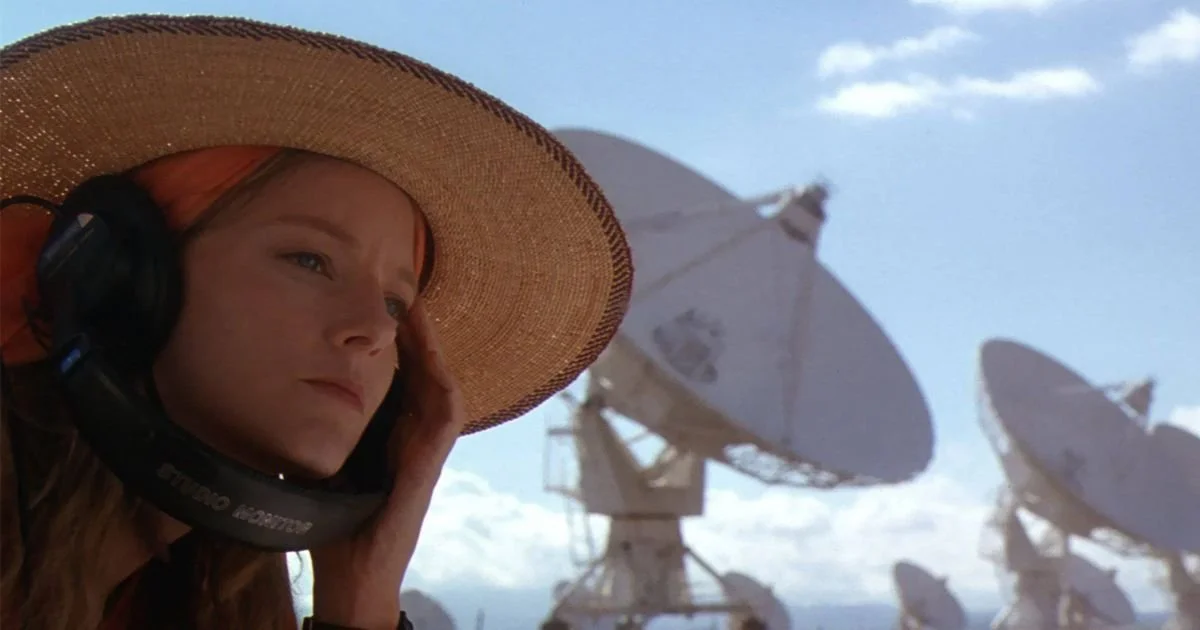
Contact (1997)
 Jay Wilde
The Hook
The trailer for Contact opens with radio telescopes turning slowly toward the sky, their dishes moving in unison like a congregation responding to a call. there's no dialogue at first. Just the sound of static, then a pulse, then a pattern. When Jodie Foster's voice finally arrives, it is quiet, almost reverent: "Are we alone?" The question hangs in the air, lingering long after the trailer ends. The trailer builds through glimpses of government hearings, a massive machine, wormhole sequences of swirling light and colour, and ends on a single image of Foster standing on a beach she has never visited but somehow recognizes. It is one of the great sci-fi trailers precisely because it sells wonder rather than spectacle.
This opening sequence is masterful in its restraint. The absence of music initially creates a sense of cosmic loneliness, making the arrival of Foster's voice feel like a whisper from another realm. The slow pan across the radio telescope array establishes the scale of human ambition, we are not just looking up, we are reaching out with sophisticated technology. The static and pulse aren't just sound design; they represent the language of the universe itself, something we're trying desperately to decipher. When the trailer shifts to government hearings, it immediately introduces the conflict between institutional power and scientific curiosity, setting up the film's central tension.
What makes this trailer so effective is how it balances the intimate with the cosmic. Foster's quiet delivery of "Are we alone?" feels intensely personal, yet the imagery surrounding her speaks to humanity's grandest questions. The wormhole sequences, with their swirling lights and impossible geometries, don't just look beautiful, they represent the threshold between the knowable and the unknowable. By the time we see Foster on that mysterious beach, the trailer has done something remarkable: it has made us feel both the insignificance of our planet and the profound importance of human curiosity.
The genius of this trailer lies in what it doesn't show. There are no explosions, no alien spacecraft landing, no dramatic confrontations. Instead, it focuses on the emotional journey of discovery, the moment when science, faith, and the unknown collide. The beach scene, with its implication of a paternal alien figure, suggests that this isn't just about making contact with extraterrestrial life, but about reconciling our earthly existence with something greater. This is why Contact remains so compelling decades later: it understands that the most profound questions don't need elaborate answers to be deeply moving.
The trailer also serves as an excellent introduction to the film's themes of patience and persistence. The slow movements of the telescopes, the measured pace of the voiceover, the gradual building of tension, all of these elements prepare us for a film that values contemplation over action. When the trailer finally shows the massive machine that will transport Ellie across space, it feels earned because we've been given time to understand what this journey means. This isn't a film about instant gratification; it's about the long, difficult path to understanding, and the trailer perfectly encapsulates that philosophy.
The Movie
Contact is, on its surface, a first contact story. Dr. Ellie Arroway works for the SETI program at the Arecibo Observatory in Puerto Rico, scanning radio frequencies from distant stars for signs of intelligent life. Her funding gets cut. Her colleagues move on. Then late one night at the Very Large Array in New Mexico, her equipment picks up a signal from the star Vega. It contains prime numbers. Then a video transmission of Adolf Hitler opening the 1936 Berlin Olympics. Then 63,000 pages of encoded blueprints for a machine that can transport a single human being across interstellar distances.
What follows is less a plot than a philosophical argument staged on a blockbuster canvas. Who gets to go? The government wants control. A Christian philosopher named Palmer Joss (Matthew McConaughey) questions whether Arroway's atheism disqualifies her from representing humanity. A religious terrorist destroys the first machine in a suicide bombing. A reclusive billionaire named S.R. Hadden (John Hurt), who has set up a dying-man's laboratory aboard the Mir space station, secretly funds a second one in Japan. Through all of it, Arroway fights for the right to answer a question that may have no provable answer: are we alone?
Contact’s greatest strength is its refusal to simplify the divide between science and faith. Adapted from Carl Sagan’s novel, the story sticks to a core paradox: the most evidence-driven character in the film eventually asks the world to accept an experience she cannot prove. That tension frustrates viewers who want clear answers, but it is exactly the point. Sagan, a lifelong atheist, built the narrative around the idea that seeking meaning is human, even when proof is impossible. Zemeckis leans into that discomfort, framing the film as a meditation on connection rather than a traditional sci-fi spectacle. It is not about aliens; it is about the human need to feel part of something larger than ourselves.
Jodie Foster's performance as Ellie Arroway is nothing short of masterful. She carries the entire film with a combination of intellectual rigor and emotional vulnerability that few actors could achieve. Foster makes Arroway's scientific precision feel like a defense mechanism against the pain of losing her parents young. When she watches the Hitler transmission and realizes the implications, the shock on her face isn't just wonder it's when her entire worldview cracks open. Foster spent weeks with real SETI scientists at Arecibo, learning their language and passion. That authenticity shows in every scene, especially during congressional hearings where you see the gears turning she's calculating how to make them understand something they've never considered. Foster doesn't play a scientist who happens to be a woman; she plays one whose gender has shaped every interaction of her career, every dismissal she's endured.
Robert Zemeckis's direction is deliberate and precise. Fresh off his Best Picture Oscar for Forrest Gump, he could have made Contact as effects-heavy spectacle. Instead, he treats the science with respect. The early Arecibo scenes use documentary-like realism handheld cameras, natural lighting, equipment hum to feel the grinding work of discovery. When the signal arrives, the camera lingers on Arroway's face, not the blinking lights. The discovery is in her eyes widening, her breath catching. Zemeckis understands Contact is an intimate story about one woman's relationship with the unknown, filmed on an expansive scale that never overwhelms the personal narrative. The machine journey feels earned because we've spent time with the slog.
Don Burgess's cinematography captures this duality. Earthbound scenes have warm, golden quality New Mexico desert, soft monitor glow, harsh hearing room fluorescents. The machine journey’s visual centerpiece, a kaleidoscopic tunnel of light and organic shapes, remains striking decades later. The design team studied theoretical physics and neural pathways to create something both scientifically plausible and spiritually transcendent. It's not just an effect; it's a statement about how perception shifts when we confront the unknown.
Alan Silvestri's score is subtler than his usual bombast. His Arroway theme is a questioning melody on piano and strings searching, not heroic. The music swells only for the journey, then disappears during philosophical debates. When Arroway and Palmer discuss faith on a balcony, only ambient sound remains ocean, wind. That silence says these conversations happen beyond orchestrated emotion, in real time between real people.
What separates Contact from every other first contact film is its refusal to provide easy answers. The machine isn't a spaceship landing on the White House lawn; it's a contraption from alien blueprints that looks like a cathedral. Its rotating rings and spherical pod suggest advanced yet deeply spiritual technology. The terrorists who destroy the first machine aren't cartoon villains they genuinely believe humanity isn't ready. The film doesn't endorse their violence but takes their concerns seriously. Most blockbusters frame opposition as ignorance or evil. Contact frames it as a different kind of truth.
James Woods' NSA Director Michael Kitz embodies institutional skepticism without cartoonish mustache-twirling. His arc from outright dismissal to grudging respect is subtle but clear. Tom Skerritt's Drumlin represents the establishment scientist who wants credit more than truth his machine ride bid isn't courage but ambition. John Hurt's S.R. Hadden is fascinating: a reclusive billionaire funding the mission as an existential gamble, not for humanity's sake. He operates from a lab aboard the Mir space station, using his resources to make the second machine possible. Angela Bassett, in few scenes as a White House staffer, provides grounded pragmatism.
The Hitler transmission is narrative genius. The first TV signal strong enough to escape Earth's atmosphere, broadcast during the Berlin Olympics, becomes humanity's calling card. It forces us to confront what we're sending out there not our best, but propaganda from our darkest hour. The aliens respond to that. What does that say about them? About us? The implication hangs: we reached with war; they answered with science. Maybe they saw something in that collective human moment something beautiful and terrible and decided we were worth knowing.
The film's deliberate pace is essential. This isn't a 90-minute thrill ride; it's a slow burn of ideas. The committee hearings, often dismissed as tedious, are actually where the film's heart lies. We watch Arroway defend not just her discovery but her right to discovery. We watch politicians reduce profound questions to budget items. We watch faith and science debate not as abstractions but as lived experience Palmer quoting Scripture, Arroway citing data. When the machine journey finally arrives, it feels earned.
And then that ending. Arroway returns with no proof. The committee denies her funding. She's left with an unshareable truth that transforms her yet changes nothing materially. It's the ultimate subversion of blockbuster expectations: Arroway wins the journey but loses the battle. Yet her final monologue isn't bitter; it's hopeful. She's built foundations for future inquiry, inspired a new generation. The film suggests the seeking matters more than the finding. That message could feel naive, but Foster sells it. We believe her because we've seen her cost. We believe her because we, like her, have unprovable but real experiences.
Contact remains stubbornly human. Where 2001 transforms Bowman into something beyond human, Contact leaves Arroway physically unchanged. The aliens offer knowledge, not apotheosis. It's a film believing in progress not as inevitable but as hard-won. That's why it endures. Nearly thirty years later, in an age of algorithmically generated content and diminishing attention spans, Contact's commitment to depth, to ideas, to slow accumulation of understanding, feels more radical than ever.
The machine itself is key. Sagan's concept was deliberately non-anthropomorphic. The aliens don't physically appear; their technology arrives as pure information. Their choice to communicate via the first TV broadcast the Hitler Olympics is either physics coincidence or deeply ironic statement about human nature. The machine, a global-cooperation construct, is less transportation device than psychological threshold a literal machine built from ideas proving intelligence can manifest without body. When Arroway steps into the pod, she's not just traveling through space; she's crossing a threshold between the known and the unknowable. The tunnel imagery balances scientific accuracy with spiritual resonance, reflecting the film’s core theme of intersecting disciplines.
Arroway's personal history matters. Orphaned young, raised by a father encouraging scientific curiosity, she carries that loss. The alien appears as her father because it understands her need closure, connection, a bridge between known and unknowable. The film suggests aliens studied humanity not through transmissions but through dreams, archetypes, our collective unconscious. They appear not as themselves but as reflection of what we already carry. Contact is about recognizing what was always there, not meeting the other.
The visual effects, while dated, remain conceptually brilliant. The team at Sony Imageworks, Weta, and ILM prioritized emotional truth over strict realism, crafting visuals that feel both scientifically plausible and spiritually resonant. It's one of few film representations of interstellar travel that feels genuinely alien not starfield with streaking lines but complete reality reorganization. Sound design by Gary Rydstrom is equally crucial: space's absence, machine hum, distorted voices at thresholds all contribute to entering a realm beyond human senses.
What makes Contact truly great is its refusal to flinch from its own ideas' cost. Arroway's journey costs her relationships, reputation, career. She gains an unshareable truth. The film suggests enlightenment might be lonely and unverifiable. In that sense, it's more Buddhist than Christian contact as internal awakening, not external event. Palmer's faith tests too; he must accept his God might work through incomprehensible means. The film doesn't synthesize science and religion; it puts them in a room and makes them listen. That alone makes it exceptional among Hollywood's treatments of these themes.
Screenwriters James Hart and Michael Goldenberg (based on Sagan's novel) achieve remarkable clarity. Every debate, every exposition, is character-grounded. The famous line 'If we're alone in the universe, it's an awful waste of space' gets a twist it's not just about life elsewhere but whether humanity is worthy of contact. Are we ready? Have we evolved enough? Does our treatment of planet, each other, knowledge itself qualify us for galactic community membership? These aren't rhetorical; they're challenges to the audience. This film refuses to let viewers engage passively. It demands you pick a side, then acknowledges both might be right.
The film's courage lies in its discomfort. It asks us to live with uncertainty, to value the quest over the answer, to respect both evidence and yearning without forcing resolution. That's rare in any era, let alone a $90 million studio release. That willingness to sit with ambiguity proves the filmmakers know the biggest questions don't yield clean answers. That's why it remains essential viewing a film unafraid to be ambiguous, unafraid to demand something from its audience, unafraid to believe that wonder itself is worth pursuing even when proof remains elusive.
The People
Jodie Foster delivers one of the finest performances of her career as Ellie Arroway, a character she pursued with fierce determination and meticulous preparation. Foster has said, "Ellie is not a symbol. She is a woman who has spent her life being told that her curiosity is naive, and she refuses to accept it. That stubbornness is what I connected to." This stubborn curiosity defined not only her character but also Foster's approach to the role, she spent months studying with real SETI scientists at Arecibo, learning the technical jargon and scientific methodology so she could deliver the dialogue with natural authenticity. Her performance is a masterclass in subtlety, conveying volumes through micro-expressions and quiet determination rather than overt emotion.
Matthew McConaughey brings an easy, affable charm to Palmer Joss, the Christian philosopher who challenges Arroway's strictly rational worldview. Their scenes together crackle with intellectual energy and a palpable emotional tension, as two intelligent people who cannot quite reconcile their fundamentally different understandings of the universe but find themselves irresistibly drawn to each other either. McConaughey has said of the role, "Palmer is not a villain and he is not a fool. He is a man asking real questions about what technology is doing to our ability to feel awe and to maintain our spiritual connection in an increasingly scientific world." His portrayal brought depth to a character who could have easily been a simple antagonist, instead making him a complex voice of conscience.
John Hurt is memorable as S.R. Hadden, the reclusive billionaire who operates from the Mir space station, funding Arroway's mission from the shadows. Hurt plays Hadden with a distinctive wry, fatalistic humor, a man who possesses all the money in the world and is using it to purchase the one thing money truly cannot guarantee: an answer to humanity's fundamental questions. His performance suggests a man who has seen everything and remains strangely detached, yet deeply invested in the outcome. In a career spanning decades, Hurt brings a gravitas and world-weariness to Hadden that makes the character's ultimate fate all the more poignant. James Woods brings a coiled intensity to NSA Director Michael Kitz, portraying institutional skepticism without descending into cartoonish mustache-twirling. Woods has a gift for finding the humanity in even the most antagonistic roles, and here he provides a nuanced portrait of a man bound by duty yet capable of moments of unexpected compassion. Tom Skerritt provides steady authority as Drumlin, the SETI director who ultimately takes credit for Arroway's groundbreaking discovery despite his initial doubts. Skerritt's portrayal captures the subtle conflict between scientific ambition and institutional responsibility.
The supporting cast is equally impressive in their ability to bring authenticity to their roles. Angela Bassett appears in crucial White House scenes as a grounded pragmatist who provides a necessary counterpoint to the loftier scientific ideals represented by Arroway. Her performance is a masterclass in restraint, conveying strength and resolve without resorting to melodrama. David Morse's portrayal of the alien in the form of Arroway's deceased father walks an impossibly difficult line, he must be both familiar and alien, comforting and unsettling, personal and otherworldly. Morse's performance is haunting, bringing a sense of heartbreaking familiarity to a character who exists only in a simulation. The casting of these supporting players, along with the thoughtful work of cinematographer Don Burgess and composer Alan Silvestri, demonstrates how every element of this production came together with careful intention and artistic vision. Each performance adds another layer to the film's exploration of science, faith, and what it means to be human in an indifferent universe.
The most profound connection to the film's legacy belongs to Carl Sagan, who wrote the original novel and co-wrote the treatment before his death. Sagan was deeply involved in the project's early stages, shaping the scientific foundation and philosophical questions at the heart of the story. He died of myelodysplasia on December 20, 1997, just six months after the film's July release, never seeing it become the cultural touchstone it remains today. The beach sequence, where an alien takes the form of his daughter's deceased father, carries a weight that no amount of visual effects could manufacture, it's a moment of pure emotional truth. This sequence is a film about profound loss, about a daughter searching for someone who is gone, and about an author who did not live to see how his work would resonate with audiences. The scene exemplifies what makes Contact so special: it finds the human heart within the science fiction framework.
The ensemble cast works together like a finely tuned machine, each actor bringing their own interpretation to their role while respecting the film's overarching themes. Angela Bassett appears in crucial White House scenes as a grounded pragmatist who provides a necessary counterpoint to the lofty scientific ideals. Her performance brings weight and authority to the political scenes, grounding the film's lofty concepts in human reality. David Morse's portrayal of the alien in the form of Arroway's father walks an impossibly difficult line, he must be both familiar and alien, comforting and unsettling, personal and otherworldly. His performance walks a tightrope between the comforting and the uncanny, making the audience question what consciousness truly means.
The film's technical departments deserve special recognition for their contributions to the storytelling. Editor Anne V. Coates weaves together the film's various narrative threads with precision, allowing the emotional beats to land with impact while maintaining the film's thoughtful pace. Production designer John Myhre created a world that feels lived-in and authentic, from the modest SETI facilities to the awe-inspiring interior of the machine. Costume designer Ruth Myers ensures that every character's clothing reflects their personality and station, from Arroway's practical field clothes to the formal wear of the government officials.
The film's themes of perseverance and faith resonate deeply in our contemporary moment. In an age of quick fixes and instant gratification, Contact reminds us that some of the most important questions require patience, dedication, and years of work. The film's commitment to scientific accuracy, despite its fantastical premise, shows respect for its audience's intelligence. This intellectual rigor, combined with its emotional accessibility, is what makes Contact endure as a landmark science fiction film that continues to speak to new generations of viewers.
The Craft
Robert Zemeckis, fresh off his Best Picture Oscar for Forrest Gump, brought a blockbuster sensibility to material that could easily have been a quiet, cerebral exercise. He marshaled significant resources for a story that ends not with an explosion but with a plea for belief. Zemeckis marshaled visual effects teams from Sony Pictures Imageworks, Weta, and Industrial Light & Magic to create the wormhole sequences, which remain visually stunning decades later. The machine's design, all rotating rings and cathedral-like scale, became an instant icon of science fiction cinema.
The film's production was a marvel of technical coordination across multiple visual effects houses. Weta Workshop in New Zealand created the physical miniatures and practical effects for the machine's interior, while Sony Pictures Imageworks handled the complex digital compositing. Industrial Light & Magic contributed cutting-edge CGI techniques that were still relatively new territory in 1997. The integration of these different approaches created a seamless visual experience that held up remarkably well, even as digital effects technology has advanced exponentially.
Don Burgess's cinematography gives the film a warm, grounded quality in its terrestrial scenes, then unleashes full visual spectacle during the space travel sequences. The contrast is deliberate. Zemeckis wanted the audience to feel rooted in a recognizable world before launching them into the unknown. He used traditional film techniques, careful lighting, measured camera movement, and deliberate pacing to create intimacy, then unleashed the full power of digital effects when the characters entered the machine. Alan Silvestri's score supports this transition, moving from intimate, emotional cues during the earthly sequences to sweeping, majestic passages during the journey to Vega. The score's minimalism in terrestrial scenes makes the grandeur of the space sequences feel all the more transcendent.
The film's sound design deserves special mention. The radio signals from Vega, rendered as a series of prime numbers followed by the unsettling video transmission of Hitler, are among the most effective uses of sound in 1990s cinema. The gradual build from static to pattern to meaning mirrors the audience's own journey from skepticism to wonder. Sound designer Gary Rydstrom created an aural landscape that makes the scientific concepts feel tangible, the hum of equipment, the tension in silence, the otherworldly quality of the alien signal. These choices ground the film's more fantastical elements in sensory reality.
The editing by Anne V. Coates is equally noteworthy. She balances the film's intellectual concepts with emotional accessibility, allowing scenes to breathe while maintaining narrative momentum. The transition from the slow-burn investigation to the spectacular machine sequence is handled with masterful precision. The film's length is justified by its ambition, giving the audience time to absorb its complex ideas while remaining emotionally engaged throughout.
The production design team, led by John Myhre, created a world that feels lived-in and authentic. From the cluttered, book-filled home of Ellie Arroway to the clinical precision of the SETI facility, every detail serves the story. The machine itself, with its rotating rings and cathedral-like scale, represents the fusion of engineering and spirituality, humanity reaching for the divine through technology. Costumer Ruth Myers ensures that every outfit reflects character and period, from Arroway's practical field clothes to the formal wear of government officials.
The film's legacy extends beyond its initial release, influencing a generation of science fiction filmmakers who seek to balance intellectual rigor with emotional accessibility. It proved that thoughtful, scientifically-grounded storytelling could succeed both artistically and commercially.
The film's exploration of gender dynamics in science remains remarkably prescient. In an industry still struggling with representation, Contact's central protagonist, a brilliant, driven female scientist, offered a powerful counter-narrative to the typical male-dominated genre. This aspect of the film has only gained importance in contemporary discussions about diversity and representation in media.
Sound design represents another area where the film went beyond conventional approaches. Gary Rydstrom's work created an aural landscape that makes the scientific concepts feel tangible. The hum of equipment, the tension in silence, the otherworldly quality of the alien signal, all these choices ground the film's more fantastical elements in sensory reality.
Editing also played a crucial role in shaping the film's impact. Anne V. Coates' work balances the film's intellectual concepts with emotional accessibility, allowing scenes to breathe while maintaining narrative momentum. The deliberate pacing allows for character development that is rare in modern blockbuster cinema.
The Trivia
-
Carl Sagan conceived Contact as a film treatment in 1979, before expanding it into his 1985 novel when development stalled. He and Ann Druyan, who later became his wife, wrote the treatment together.
-
George Miller was originally attached to direct and had begun pre-production with Jodie Foster and Ralph Fiennes cast. The studio fired him over creative differences, and the machine Miller designed was scrapped entirely.
-
The beach sequence was filmed at Shell Beach in Point Reyes, California. The alien's appearance as Ellie's deceased father was based on Sagan's own experience of loss and longing.
-
The Very Large Array in New Mexico, where much of the film was shot, consists of 27 radio antennas, each weighing 230 tons. The real scientists at the facility were consulted throughout production.
-
Sagan died on December 20, 1997, just six months after the film's July release. He never saw the completed film's cultural impact.
-
The film's visual effects for the wormhole and machine sequences were developed over more than a year, combining practical and CGI elements to create a scientifically plausible yet spiritually resonant experience. The team consulted with astrophysicists to ensure the wormhole's depiction aligned with current theoretical physics. The result was a sequence that felt both spectacular and grounded, avoiding the typical sci-fi tropes of the era.
-
Jodie Foster was not the first choice for Ellie Arrowow. The role was initially offered to other actresses before Foster, who had been attached to the project early on, confirmed her participation.
-
The video transmission of Hitler opening the 1936 Berlin Olympics was the first television signal strong enough to escape Earth's atmosphere, making it the first image an alien civilization would theoretically receive. Sagan included this detail to highlight the double-edged nature of scientific progress: the same technology that connects us can also reveal our darkest chapters. The scene serves as a reminder that first impressions, even cosmic ones, are not always accurate.
-
The machine's destruction by a religious terrorist reflects real-world tensions between scientific inquiry and fundamentalist ideology that Sagan explored throughout his career. Sagan often wrote about the conflict between faith and reason, arguing that the two need not be mutually exclusive. The film's inclusion of this attack underscores the fragility of scientific progress in the face of ideological opposition.
-
The film's production design, featuring a cathedral-like machine built from mathematical principles, represents a radical departure from typical sci-fi aesthetics of the era. Production designer Ed Verreaux drew on sacred geometry and Renaissance architecture to create a structure that felt both alien and familiar. The machine's design was intended to evoke a sense of awe, mirroring the transcendental experience Ellie has during her journey.
-
Robert Zemeckis used a combination of practical effects and CGI to create the wormhole sequence, which took over a year to develop. Zemeckis wanted the sequence to feel like nothing audiences had seen before, blending scientific accuracy with visual poetry. The team used pioneering rendering techniques that pushed the boundaries of CGI in the late 1990s, setting a new standard for sci-fi visuals.
-
The film was nominated for an Academy Award for Best Sound Editing and won a Saturn Award for Best Science Fiction Film. The sound design team spent months crafting the otherworldly audio of the wormhole and alien transmission, using a mix of synthesized and natural sounds. The Saturn Award recognition cemented the film's status as a landmark of thoughtful, scientifically grounded science fiction.
-
The film is dedicated "For Carl" in the closing credits, honoring Sagan's lifelong commitment to public science communication and the search for extraterrestrial intelligence. Sagan co-wrote the screenplay with his wife Ann Druyan, adapting his own 1985 novel for the screen. His death six months after the film's release meant he never saw the full cultural impact of his final major project.
-
The film's legacy extends beyond its initial release, influencing a generation of science fiction filmmakers who seek to balance intellectual rigor with emotional accessibility. Directors like Denis Villeneuve (Arrival) have cited Contact as a key influence, particularly its ability to make complex scientific concepts feel deeply personal. The film's blend of hard science and human emotion remains a template for thoughtful sci-fi decades later.
-
The film's exploration of gender dynamics in science remains remarkably prescient. Ellie Arroway, as a woman in a male-dominated field, faces skepticism and doubt that resonate with real-world experiences of female scientists. Foster's portrayal of Ellie's quiet determination helped pave the way for more complex female leads in science fiction.
The Verdict
Contact is a flawed film. Its second act drags through committee hearings and political maneuvering that slow the momentum to a crawl. Some of the supporting characters, particularly Jake Busey's religious terrorist and James Woods' National Security Advisor, are sketched rather than drawn. But these imperfections don't diminish the film's core achievement: it takes big ideas seriously.
But it gets the things that matter exactly right. It treats science as a noble pursuit rather than a plot device. It takes faith seriously without endorsing it uncritically. It centers a woman scientist and lets her be the smartest person in every room without apology. And it has the courage to leave us with a question rather than an answer, trusting the audience to sit with the discomfort of not knowing. Foster's Arroway, pleading with a skeptical committee to believe something she cannot prove, is one of the great performances in American science fiction. Nearly three decades later, that plea has only grown more resonant. The film's willingness to sit with ambiguity rather than provide easy answers reflects a mature understanding of how real science actually works, incremental, uncertain, and profoundly human. This approach to storytelling, where the journey matters more than the destination, has influenced countless science fiction works that followed.
The way the story resolves, while frustrating to some viewers who want concrete answers, is ultimately its greatest strength. It mirrors the open-ended nature of scientific inquiry itself, some questions may never have definitive answers, but that doesn't diminish their importance. This refusal to provide easy comfort is a radical act in an entertainment landscape increasingly dominated by formulaic franchise storytelling. Contact trusts its audience to sit with complexity, to hold contradictory ideas simultaneously, and to find meaning in the questions themselves rather than in manufactured solutions. This intellectual and emotional generosity is what elevates the film from entertainment to art.
The film's final message, that the search itself is what gives life meaning, not the discovery, resonates deeply in our contemporary moment of instant gratification and algorithmic certainty. In an age where every question seems to have a quick answer, Contact reminds us that some of the most profound truths resist easy explanation. The film suggests that faith and science are not enemies but complementary approaches to understanding our place in the cosmos. This nuanced perspective has only grown more relevant as our world becomes increasingly polarized.
"I wish that everyone, if only for one moment, could feel that awe and humility and hope."