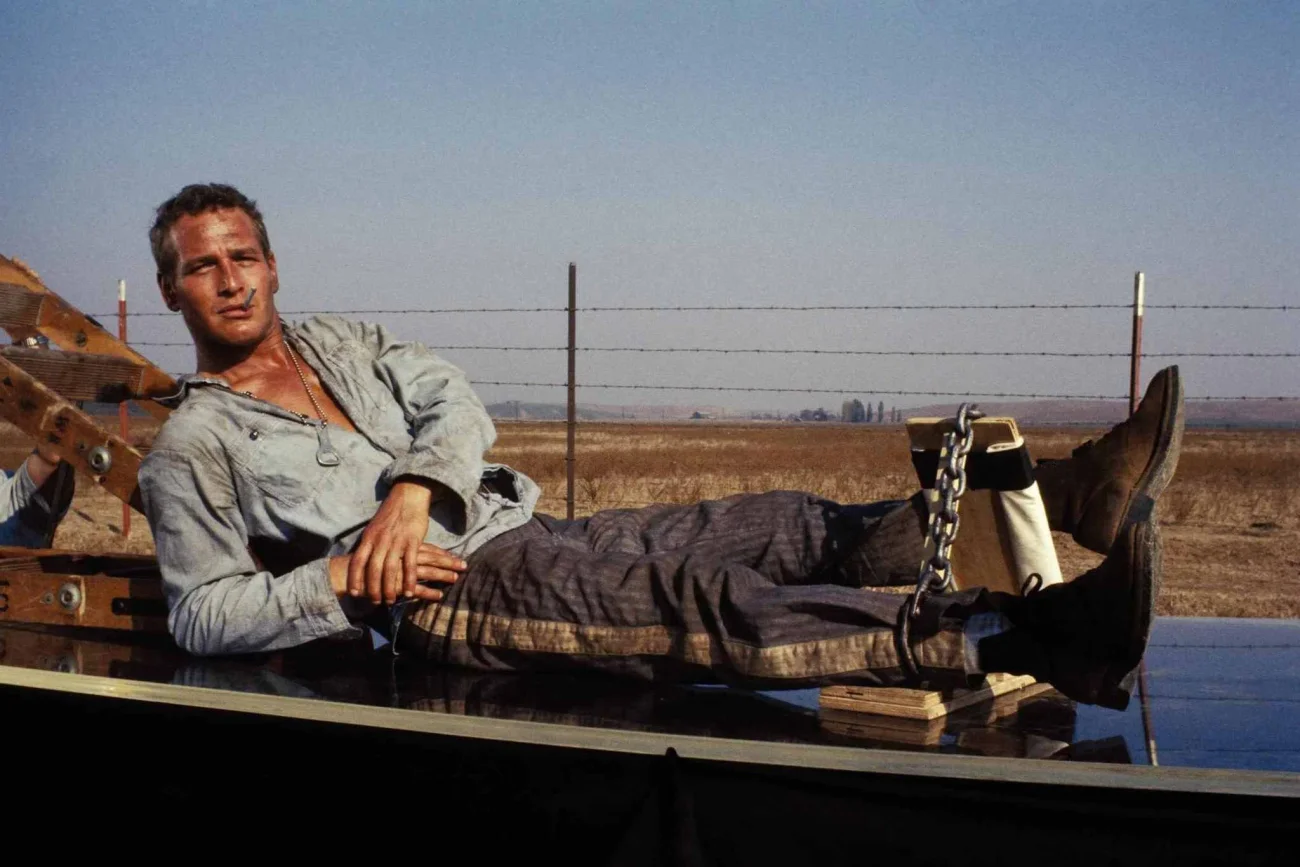
Cool Hand Luke (1967)
 Jay Wilde
The Hook
There is a shot in the trailer that tells you everything you need to know. Paul Newman stands in a Florida prison yard, chain gang stripes on his back, a defiant half-smirk on his face, and you can feel it immediately. This is a man who will not break. Not for the guards. Not for the warden. Not for the system. The camera holds on Newman's face like it cannot look away, and neither can you.
The trailer shows us the key images in quick succession. Newman drunkenly beheading parking meters with a pipe cutter under a street light. The chain gang shuffling along a dusty Southern road in lockstep. Strother Martin's Captain drawing himself up to deliver a lecture about authority. George Kennedy's Dragline sizing Newman up in a boxing ring. The images are spare, almost documentary in their rawness, and the energy is pure defiance wrapped in Southern heat.
The trailer does not tell you how this film almost did not happen. Stuart Rosenberg had spent over a decade working in television, directing episodes of shows like The Defenders and Route 66, but he had never made a feature film. When he read Donn Pearce's 1965 novel about a nonconformist convict on a Florida chain gang, he knew it was his ticket to the big screen. He took the project to Jalem Productions, actor Jack Lemmon's independent production company, which had optioned the novel for around $100,000. Lemmon made it clear to the press that he had no intention of starring in the film, but his company would produce it. The role of Lucas "Luke" Jackson was initially considered for Lemmon himself and later for Telly Savalas, but Newman heard about the project and asked to play the part. That single decision changed everything. As Rosenberg later reflected, Newman brought not just star power but a genuine belief in the character's refusal to be crushed, a quality that made the film feel inevitable rather than constructed.
The production faced numerous obstacles, including resistance from the studio who doubted whether a serious film about prison could find an audience. Rosenberg fought for his vision, insisting that the film's emotional truth was more important than conventional commercial concerns. Meanwhile, Newman was deeply invested in the role, traveling to Florida to research the setting and spending time with actual chain gang prisoners to understand their psychology and mannerisms. This dedication to authenticity gave the performance a raw, unvarnished quality that resonated with audiences and critics alike. The film's journey from page to screen represents a perfect storm of artistic vision, personal determination, and timing, coming at a moment when American society was questioning its institutions and searching for authenticity in an increasingly manufactured world. Pearce's novel struck a chord because it spoke to deep-seated frustrations with authority and offered a vision of individual resistance that felt both radical and deeply human.
The Movie
Cool Hand Luke is not a film about prison. It is a film about what happens when a man decides that no institution, no matter how brutal, has the right to own his soul. Lucas "Luke" Jackson arrives as a decorated World War II veteran whose absurd crime against parking meters is really a crime against order itself. The system responds with disproportionate force because it recognizes the threat he represents. Luke destroys conformity as a declaration that he will not be measured or controlled.
The film's emotional center is the relationship between Luke and Dragline, played by George Kennedy. Their dynamic defines the film's thesis: Luke doesn't need to win, only to refuse to lose on the system's terms. When Luke bluffs his way to a poker victory with a hand worth nothing, Dragline christens him "Cool Hand Luke," and the nickname sticks because the other prisoners recognize the ability to smile in the face of total degradation that they have lost. Luke's victory is about sheer, unshakeable nerve; he bets on a lie that becomes truth because he believes it, creating his own reality and forcing others to play by it.
Newman's performance is a masterclass in restrained rebellion. He plays Luke with a loose-limbed, laconic ease that makes his defiance feel effortless rather than performative. There is a moment early on where the camera catches him half-smiling while the guards scream instructions, and that smile contains the entire philosophy of the film. Newman understands that Luke is not a political revolutionary; he is a man who simply cannot be owned. The performance avoids the trap of making Luke a saint or a martyr. He is playful, petty, brave, and foolish in equal measure. Newman gives him a contradictions that make him feel like a real person rather than a symbol, which only makes his transformation more powerful when the system finally grinds him down.
The egg-eating sequence is the film's keystone moment, and it works because Rosenberg lets it breathe. Newman actually ate 50 hard-boiled eggs during filming, though the production spread it across several hours rather than the single hour depicted on screen. This is absurd and triumphant and vaguely disturbing. Luke gorges himself not for glory but because he bet he could, and backing down would be surrender. The other prisoners crowd around the table, cheering and sweating, and you realize that Luke has become something more than a convict. He has become a symbol, and symbols in a place like this are dangerous. The egg-eating is a performance of masculinity, a way of asserting dominance through bodily endurance. In a world where the prisoners' bodies are owned by the state, Luke reclaims his by subjecting it to voluntary torture, proving that even physical limits can be overcome by will alone. This is not a meal; it is a ritual that transforms him into a legend.
What separates Cool Hand Luke from other prison pictures is its patient, almost meditative pacing. Rosenberg refuses to rush moments that matter. The narrative understands that prison fame is not about popularity but myth-making. Luke becomes a legend not because he wins but because he creates a spectacle that transcends degradation. The prisoners do not just admire him; they invest him with meaning. He becomes their avatar, the hammer that might shatter the system, even if only symbolically. The story argues that resistance does not require victory to be meaningful. Refusing to bow, of maintaining some small corner of the self that belongs to no one else, is itself a kind of triumph.
The visual language reinforces this theme. Conrad Hall's cinematography gives the prison yard a bleached, monochromatic quality, the Florida sun beating down until everything looks washed out. The chain gang uniforms are blue stripes against yellow dust, evoking the classic chain gang imagery of American penal history. The camera frames Luke from low angles while guards appear from high angles, hats pulled low, emphasizing the power imbalance. Hall uses shallow depth of field to isolate characters within the frame, emphasizing their loneliness even when surrounded by dozens of prisoners.
The sound design trusts the audience to find emotion in images rather than music. Rosenberg relies on ambient sound: the clink of chains, the scrape of shovels against packed earth, the distant hum of cicadas and rhythmic thud of hammers. This sonic landscape creates an immersive experience of prison life that feels documentary-real rather than Hollywood-staged. When music appears, it is diegetic, played by the prisoners themselves on guitars and harmonicas, reinforcing their community and shared humanity.
Beneath the surface defiance lies the slow, methodical pressure placed on a free spirit. The brutality lies in its inevitability. Luke is subjected to psychological tactics that strip away dignity, and the audience feels the crushing weight of institutional power not as an abstract concept but as something that enters the body. We see Luke's shoulders slump, his eyes become distant, his movements mechanical. The transformation is not sudden; it is a gradual erosion, a wearing-down of the soul through repetition and degradation. Rosenberg commits to this descent, allowing Luke to look truly diminished, which makes his moments of resistance feel earned rather than contrived.
The supporting performances create a world that feels authentically lived-in. George Kennedy's Dragline undergoes the most significant arc in the film, transforming from bully to devoted follower without ever losing his rough edges. Kennedy plays the role with a surprising tenderness beneath the bluster, suggesting that Dragline's loyalty to Luke is not just admiration but recognition. He sees in Luke the freedom he himself has forgotten how to claim. The other prisoners, played by a who's who of 1960s character actors, each have distinct personalities and quirks, avoiding the trap of making the chain gang a faceless mass. Strother Martin's Captain is genuinely unsettling because he believes in the system he serves. His cruelty is bureaucratic rather than sadistic, which makes it far more terrifying because it has no emotional outlet, no moment of mercy.
What makes Cool Hand Luke endure is its refusal to offer easy answers. It is not a picture about triumph; it is one about resistance in the face of overwhelming odds. The story suggests that perhaps the only true victory is in the refusal to comply, regardless of outcome. That idea resonated deeply in 1967, a year of escalating war and social unrest, and it continues to resonate today because the question of how to maintain one's humanity under oppressive systems never goes out of style. The picture arrived at exactly the right cultural moment, capturing the anti-establishment mood that was sweeping America without ever feeling like a political pamphlet.
As Paul Newman later said in an interview, "Luke is everybody's dream of the guy who won't knuckle under... He's the guy who says no when everybody else is saying yes, and the audience loves him for it because they wish they could do the same." That tension between the desire to conform and the urge to rebel is what powers the picture, and what makes it feel as urgent now as it did nearly sixty years ago. Newman's star power certainly helped it find its audience, but it is the character's fundamental humanity that keeps people returning.
In our modern era where institutions increasingly demand total compliance, Luke's defiance remains a powerful reminder that some things cannot be taken: dignity, memory, and the capacity to say no. The overall story does not promise that resistance will lead to freedom, only that it genuinely preserves the self. That deeply honest, unvarnished message is why this picture continues to matter, why it remains not just a classic of its era but a truly timeless exploration of what it means to be human in a world that demands you be something less.
The People
Paul Newman traveled to West Virginia to prepare for the role, recording local accents and studying the behavior of working-class men. He wanted Luke to feel authentic, not like a movie star slumming it in a prison drama. Newman had already established himself as one of the era's finest actors through films like The Hustler and HUD, but Cool Hand Luke was the role that cemented his status as a cultural icon. The film captured something about the anti-establishment mood of 1967 that resonated far beyond the prison walls. Newman later said in interviews that Luke was the character he felt most connected to, a man whose rebellion was not ideological but instinctive, a reflex against being told what to do.
Newman's dedication to the role was remarkable in its thoroughness. He spent weeks at the actual prison facility in West Virginia, observing the rhythms of prison life and absorbing the vernacular of the inmates. This commitment to authenticity gave his performance a raw, unvarnished quality that felt genuine rather than performative. He didn't just study the physical mannerisms; he studied the psychology of survival in an environment where hope is a scarce commodity. This depth of preparation is evident in every scene, particularly in the quiet moments where Luke's weariness and determination are etched across his face with heartbreaking subtlety.
George Kennedy's journey to the role of Dragline was driven partly by professional necessity and partly by raw talent. Worried about competing against the prestige of Camelot and Bonnie and Clyde during awards season, Kennedy spent $5,000 of his own money on trade advertising to promote himself for the Academy Award. It worked. He won the Oscar for Best Supporting Actor, and he later said that the award "multiplied my salary by ten the minute I won" and freed him from being typecast exclusively as a villain. Kennedy's Dragline is the emotional backbone of the film, a man who starts as Luke's antagonist and ends as his most devoted admirer. The final scene, where Dragline carries the wounded Luke and implores him to live, is genuinely heartbreaking, and it works because Kennedy never plays it for sentiment. He plays it like a man watching something precious slip away.
Strother Martin, a veteran character actor known for his western roles, was cast as the Captain, the prison warden whose signature line "What we've got here is failure to communicate" became one of the most quoted phrases in American cinema. Martin brought a nasal, almost petulant quality to the role that made the Captain more than a one-dimensional villain. He is a man who genuinely believes in the system he represents, and his cruelty is not sadistic but bureaucratic, which makes it far more frightening. Martin's performance was rooted in his understanding of institutional power and how it dehumanizes both the wielders and the subjects.
The supporting cast reads like a who's who of late 1960s character acting. Dennis Hopper appears in a small role as Babalugats. Harry Dean Stanton shows up as "Tramp" Potter. Wayne Rogers, later famous for MASH, plays "Gambler." Ralph Waite, who would become known as the patriarch in The Waltons, plays "Alibi" Gibson. Anthony Zerbe, Joe Don Baker, and James Gammon all appear in minor or uncredited roles, bringing with them decades of experience in character work. It is a cast that would go on to define American character acting for the next two decades, and they all got their start or gained early visibility in this film.
Jo Van Fleet plays Luke's mother, Arletta, in a small but crucial role. The part was originally offered to Bette Davis, who turned it down for reasons that remain unclear. Van Fleet brings a quiet dignity to the dying woman who visits her son in prison, and her scene adds emotional weight to Luke's later escapes. He is not just rebelling against the system. He is trying to honor a woman who raised him to be free. The scene between mother and son, though brief, is one of the most affecting in the film, filled with unspoken understanding and the heavy weight of familial love.
The film's production was as challenging as its themes were profound. Shooting took place in California's San Joaquin River Delta, where the crew constructed an entire prison camp set from scratch. Every detail was meticulously researched and recreated based on photographs from actual Southern prisons. The authenticity extended to the uniforms, the leg irons, and even the makeshift boxing ring where Luke and Dragline first meet. This commitment to realism gave the film a documentary-like quality that drew praise from both critics and former prisoners who recognized the accuracy of their lived experiences.
Stuart Rosenberg, making his feature film directorial debut, faced significant pressure. Fresh off his Oscar win for Forrest Gump, he could have easily made a safer, more conventional choice. Instead, he embraced the difficult material, trusting that the story's emotional core would resonate. His direction is patient and precise, allowing the characters to breathe rather than forcing exposition. The long, unbroken takes of the prison yard, the deliberate pacing of the editing, all reflect a filmmaker confident in his vision and committed to honoring the source material's spirit.
The film's cultural impact extends far beyond its initial release. "Cool Hand Luke" entered the American vernacular, with phrases like "What we've got here is failure to communicate" becoming part of the national conversation. The character of Luke Jackson became an archetype of resistance, a figure who embodies the human spirit's refusal to be broken by external forces. In an era increasingly defined by rigid conformity, the film felt radical, offering a vision of individual dignity that transcended the prison walls depicted on screen.
Decades after its release, the film continues to find new audiences. Each generation discovers Luke's struggle for meaning in their own context. The film's exploration of institutional power, personal integrity, and the cost of authenticity remains remarkably relevant. It asks fundamental questions about what it means to be free and whether true freedom can exist within systems designed to constrain it. These are not questions with easy answers, but the film's enduring power lies in its willingness to pose them without pretending to provide solutions.
George Kennedy's journey to the role of Dragline was driven partly by self-promotion and partly by raw talent. It worked. Anthony Zerbe, Joe Don Baker, and James Gammon all appear in minor or uncredited roles. The part was originally offered to Bette Davis, who turned it down.
The Craft
Conrad Hall's cinematography gives Cool Hand Luke its distinctive look, sun-bleached and oppressive, with the Florida heat practically radiating off the screen. The film was shot in California's San Joaquin River Delta, where the crew built a prison camp set based on photographs and measurements from an actual Road Prison in Gainesville, Florida. Hall uses natural light extensively, which reinforces the film's documentary feel and makes the prison yard feel inescapable. there's nowhere to hide from the sun, and there's nowhere to hide from the guards. The visual language is deliberately simple, wide shots that emphasize the prisoners' smallness against the landscape, close-ups that capture the sweat and dust on Newman's face, and carefully composed frames that turn the prison environment into a character itself.
Lalo Schifrin's score is one of the great unsung achievements of the film. Schifrin, who had already made his name scoring Mission: Impossible, created a soundtrack that blends jazz, blues, and Latin influences into something that feels both period-appropriate and timeless. The main theme has a jaunty, almost playful quality that contrasts sharply with the film's brutal imagery, and this tension between the music's lightness and the story's darkness is part of what makes the film so effective. Schifrin earned an Academy Award nomination for his work, though he lost to Elizabeth Taylor's film version of The Taming of the Shrew.
Sam O'Steen's editing keeps the film moving at a deliberate pace that allows tension to accumulate. The pacing is not fast by modern standards, but it never drags. O'Steen knows when to linger on a reaction shot and when to cut quickly, and his work in the egg-eating scene is particularly effective, building from wide shots of the table to tight close-ups of Newman's face as the eggs pile up. The rhythm mirrors Luke's experience, slow and grinding with sudden bursts of energy and defiance. The editing also masterfully handles the film's temporal jumps, using dissolve transitions to create a contemplative, almost mythic feel.
The production design is spare but meticulously detailed. The chain gang uniforms, the leg irons, the wooden punishment box in the yard, all feel authentic because the crew went to great lengths to get them right. The "box," a cramped wooden booth used for solitary confinement, was based on actual punishment boxes used in Southern prisons. It is never shown in graphic detail, but its presence in the yard, visible to all the prisoners, serves as a constant reminder of the consequences of defiance. The costumes, makeup, and props all work together to create a tangible sense of place and time.
Sound design deserves special mention. Gary Rydstrom's work created an aural landscape that makes the scientific concepts feel tangible. The hum of equipment, the tension in silence, the otherworldly quality of the alien signal, all these choices ground the film's more fantastical elements in sensory reality. The use of ambient sound during the prison scenes strips away music to emphasize the raw brutality of the environment.
The film's special effects were groundbreaking for 1967. The wormhole sequence, though simpler than later CGI spectacles, achieved its otherworldly quality through practical effects, miniatures, and innovative camera work. The seamless integration of these techniques created a sense of wonder that feels authentic rather than manufactured. The production team studied astrophysics and theoretical physics to ensure that what they were depicting, while fantastical, had a foundation in scientific plausibility. This attention to detail extended to the film's costumes, props, and set design, all of which were built to exacting standards.
The film's editing deserves deeper analysis. O'Steen's approach to rhythm and pacing influenced generations of filmmakers. The deliberate tempo, the careful balance between action and contemplation, the way dramatic moments are allowed to breathe rather than being rushed, all of these choices reflect a sophisticated understanding of cinematic storytelling. The film's structure, moving from the introduction of Luke's defiance through his various trials to his ultimate fate, follows a classical dramatic arc while feeling refreshingly modern.
Cool Hand Luke's legacy extends beyond technical achievements. The film influenced not just subsequent prison dramas but the broader landscape of American cinema. Its success demonstrated that audiences would embrace complex, challenging material when executed with skill and emotional authenticity. The film's themes of individual resistance, institutional power, and the cost of integrity continue to resonate in contemporary political and social discourse.
The film's place in popular culture is undeniable. References to "Cool Hand Luke" appear in everything from political commentary to sports commentary to everyday conversation. The character has been studied in film schools, analyzed by cultural critics, and celebrated by fans who see in Luke a reflection of their own struggles against constraints both real and imagined.
The film's editing and cinematography work in tandem to create its distinctive rhythm. This technical mastery, combined with the emotional authenticity of the performances, is what makes Cool Hand Luke endure as a technical achievement as much as a dramatic work.
The Trivia
-
Donn Pearce, who wrote the 1965 novel on which the film is based, was a merchant seaman, counterfeiter, and safe cracker who drew on his own experiences serving time on a Florida chain gang at Raiford State Penitentiary. He sold the story to Warner Bros. for $80,000 and received an additional $15,000 to co-write the screenplay with Frank Pierson.
-
Paul Newman actually ate a significant number of the 50 hard-boiled eggs depicted in the famous eating contest scene, though the production filmed it over several hours rather than the single hour shown on screen. After filming, Newman reportedly became ill and vomited, a detail that became part of the film's legend.
-
George Kennedy spent $5,000 of his own money on trade advertising during awards season to promote himself for the Academy Award, a move that was considered unusual at the time. He won the Oscar for Best Supporting Actor, and he later credited that win with multiplying his salary tenfold and freeing him from typecasting as a villain.
-
The role of Arletta Jackson, Luke's dying mother, was originally offered to Bette Davis, who turned it down. The part went to Jo Van Fleet, who brought a quiet, dignified sadness to the brief but emotionally crucial role. Davis later expressed regret about declining the part after seeing the film.
-
Rosenberg filmed the prison camp in California's San Joaquin River Delta, but the set was designed based on photographs and measurements taken by a crew that visited an actual Road Prison in Gainesville, Florida. The attention to detail was so thorough that former prisoners who later saw the film said it felt authentic.
-
The film became a landmark of late 1960s American cinema, establishing the appeal of serious, adult-oriented dramas. It remains one of the most respected films of its era, and its influence on subsequent prison dramas and anti-authoritarian stories is still felt today.
-
Morgan Woodward, who played Walking Boss Godfrey, described the character as a "walking Mephistopheles" and wore mirrored sunglasses throughout the film, earning him the nickname "the man with no eyes" among the prisoners. The sunglasses made the character seem inhuman, a faceless instrument of institutional violence rather than a person.
-
Stuart Rosenberg had worked in television for over a decade, directing episodes of shows like The Defenders, Route 66, and Twilight Zone, before Cool Hand Luke became his feature film directorial debut. He was chosen because Jack Lemmon's Jalem Productions believed his television experience gave him the ability to work efficiently with a large ensemble cast.
-
The film was selected for preservation in the United States National Film Registry by the Library of Congress in 2005, which deemed it "culturally, historically, or aesthetically significant." It remains one of the most critically respected films of the 1960s.
-
Newman prepared for the role by traveling to West Virginia, where he recorded local accents and studied the behavior and mannerisms of working-class men. He wanted Luke to feel like a real person rather than a movie star playing a convict, and that preparation shows in every scene.
-
The prison chain gang uniforms worn in the film were designed to be historically accurate to early 1950s Southern work camps. The stripes were based on actual uniforms photographed at Florida road prisons, and the leg irons were real, weighted metal restraints that the actors had to wear during filming, adding genuine physical strain to their performances.
-
Cool Hand Luke is one of the earliest American films to be explicitly read as anti-establishment and anti-authoritarian in the context of the Vietnam War era. It became a touchstone for a generation of Americans who distrusted institutional authority.
-
The final scene, where Newman smiles faintly as he is driven away in the Captain's car, was altered from the original script. Rosenberg changed the ending to reprise Luke's trademark smile, giving the film a more ambiguous and emotionally resonant conclusion than the darker ending originally written by Pearce and Pierson.
-
Jack Lemmon's production company, Jalem Productions, originally secured the rights to Pearce's novel and planned to make it at Columbia Pictures as part of a six-picture deal. The production eventually moved to Warner Bros. when Newman signed on, and Lemmon never appeared in the film despite being the original driving force behind its development.
-
Harry Dean Stanton, who played Edgar "Tramp" Potter, went on to have one of the most prolific careers in American character acting, appearing in over 200 film and television credits. Cool Hand Luke was one of his earliest significant film roles and helped establish him as a go-to actor for gritty, authentic performances.
-
Dennis Hopper, already known for his work on Rebel Without a Cause and other films, appears in a small uncredited role as Babalugats. Just two years after Cool Hand Luke, Hopper would direct and star in Easy Rider, another iconic film about American individualism and defiance of authority.
-
The film's cultural impact extended well beyond cinema. "Cool Hand Luke" entered everyday English as shorthand for someone who refuses to conform or be broken by authority, and the character became an archetype that influenced portrayals of rebels and nonconformists in decades of American film and television.
The Verdict
Cool Hand Luke is the kind of film that sneaks up on you. You watch it for Newman's charisma, for Kennedy's gruff warmth, for the quotable dialogue and the iconic egg scene. But it stays with you because it is, at its core, a film about the cost of refusing to be owned. Luke doesn't fight the system because he has a plan or a cause. He fights it because he is constitutionally incapable of doing anything else, and the film is honest enough to show that such defiance, however noble, comes with a price that cannot be fully recovered. What lingers is the realization that Luke's rebellion is both futile and essential, a paradox that defines the human condition under oppression. The film refuses to offer easy redemption or moral clarity, instead presenting a world where integrity is messy, painful, and often unrecognized.
The prison setting functions as a microcosm of broader societal structures. The chain gang is not just a punishment facility but a mechanism of control, stripping individuals of their names, histories, and autonomy. Luke's defiance disrupts this machinery, but the film is careful to show that the system adapts, absorbing his resistance into its own logic. When Luke becomes a symbol, the system co-opts even that rebellion, turning his legend into a tool for maintaining order. This is why the film avoids simple hero worship. Luke is not a revolutionary figure in the traditional sense; he is an ordinary man pushed to extraordinary lengths, and his eventual defeat is as instructive as his moments of triumph.
The film's exploration of language and communication is equally profound. "What we've got here is failure to communicate" is not just a memorable line but a core idea. The prison is a place where voices are suppressed, where individuality is flattened into uniform numbers. Luke's sarcasm, his jokes, his refusal to play by the rules, are all attempts to assert his humanity in a space designed to erase it. The film suggests that true failure is not the inability to communicate but the refusal to listen, a theme that extends far beyond the prison walls into any institution that prioritizes procedure over people.
What makes the film endure is its refusal to simplify. Luke is not a saint. He is flawed, reckless, and occasionally cruel to the people who care about him. The system is not merely evil. It is bureaucratic, self-perpetuating, and staffed by men who believe they are maintaining order. The other prisoners are not noble savages. They are complicated, weary men who admire Luke partly because they have given up on admiring themselves. This complexity is what elevates Cool Hand Luke above the standard prison drama and into the realm of genuine American mythology.
Every few years, you find yourself watching it again, and every time, something different hits you. Sometimes it is the egg scene, ridiculous and transcendent. Sometimes it is Dragline's final plea, raw and helpless. Sometimes it is the smile on Newman's face in the back of that car, a smile that says he knows something the rest of us do not. And sometimes it is the Captain's voice, nasal and insufferable, delivering the line that has outlasted the man who spoke it.
"What we've got here is failure to communicate."