Dark City (1998)
 Jay Wilde
The Hook
There's a moment in the Dark City trailer where the camera sweeps over a skyline that should not exist, all amber light and impossible angles, and Rufus Sewell's voice cuts through the murk: "You know the secret, don't you?" It is not a question. It is a dare. From that first frame, Proyas grabs you by the collar and drags you somewhere where nothing is fixed, not the buildings, not the clocks, not even your own name. The trailer doesn't explain the plot; it does something better. It makes you feel the wrongness of all around, the itch at the back of your skull that something fundamental has been tampered with.
Watch the way the images stack. A man waking in a bathtub with blood on his hands. A woman's face frozen in a scream. Trenchcoated figures drifting through rain-slicked streets like undertakers at a parade. Jennifer Connelly singing in a smoky lounge while the walls behind her seem to breathe. Then the hook: buildings warping, streets folding, a city reshaping itself like a living organism in the grip of a fever dream. The trailer promises noir, promises sci-fi, promises horror, but what it really promises is unease, the delicious kind that draws you forward in your seat.
What the trailer doesn't tell you is that Dark City almost did not get made the way Proyas intended. New Line Cinema, the studio behind the film, looked at the finished cut and panicked. The story was too cerebral. The pacing too deliberate. The ending too ambiguous. They demanded an opening voice-over from Sewell that explained the premise in plain terms, spoon-feeding the audience what the film wanted them to discover on their own. Proyas fought it and lost, at least for the theatrical release. The 2008 Director's Cut finally stripped that narration away, restoring the film to the slow-burn mystery it was always meant to be.
There is a cruel irony here. The studio forced an explanation onto a film about the tyranny of implanted memories, about the violence of having someone else decide what you know and when you know it. Proyas has said that the studio's interference felt like a meta-commentary on his own film, as if the Strangers had reached through the screen and meddled with his creation. That tension, between what the filmmaker intended and what the money demanded, runs through the DNA of Dark City. It is a film born from compromise that somehow transcended it, a compromised vision that became uncompromising in its final form.
The production itself was an act of architectural obsession. Proyas and production designer Patrick Tatopoulos built every inch of the city on soundstages at Fox Studios Australia. No real locations. No exterior shots. Every cobblestone, every fire escape, every puddle reflecting neon was fabricated. They wanted a world that felt assembled rather than grown, a city that looked like it had been constructed by minds that had only a theoretical understanding of human habitation. The result is one of the most visually distinctive films ever made, a place you can practically smell: wet concrete, cold metal, stale cigarette smoke, and something underneath it all, something chemical and alien.
The Movie
John Murdoch wakes up in a hotel bathtub, memory gone, a bloody knife on the floor, a murdered woman in the next room. That disorientation is the doorway into Dark City, and we step into it alongside him, confused, hunted, and blind to the rules of this world. From that first moment, Alex Proyas signals that we are not in for a conventional sci-fi thriller; we are in for a descent into a dream logic where architecture shifts, time freezes, and identity is a costume someone else chooses.
Dark City's brilliance lies in how it translates its central philosophical question (what makes us who we are?) into every aspect of its craft. The answer it proposes is both simple and radical: you are not your memories; you are the capacity to choose. Murdoch's journey from blank slate to self-authored individual is the backbone of the narrative, and every visual and narrative decision reinforces that arc.
That world itself deserves attention: no practical locations were used; everything was built on soundstages, resulting in a place that feels simultaneously familiar and impossibly strange. The streets are a collage of 1940s noir, German Expressionist shadows, and futuristic dystopia. there's no sun, only an eternal twilight that bleeds amber through every window. This isn't just aesthetic; it's the externalization of a mind that has been hollowed out and refilled. The claustrophobic sets, the looming buildings that seem to crouch over the characters, the way the camera glides through alleys with a quiet menace, all of it reflects the psychological prison Murdoch inhabits before he wakes up.
Yet the environment itself is more than a metaphor; it functions as a machine. Every night at midnight, the Strangers halt time and physically rearrange the architecture, then inject the populace with new memories. This ritual is Dark City's central set piece, and it's executed with a terrifying calm. The Strangers move like sleepwalkers, their trenchcoats billowing as they float through the air, manipulating structures as if they were made of putty. The practical effects, achieved with miniatures and in-camera tricks, have a tactile weight that CGI often lacks. You can feel the strain on the rail car that winds through the underground lair, hear the creak of metal as buildings slide into new configurations. there's a brutalist beauty in how these transformations happen: it is not destroyed so much as remade, over and over, a Sisyphean cycle that mirrors the Strangers' own futile search for individuality.
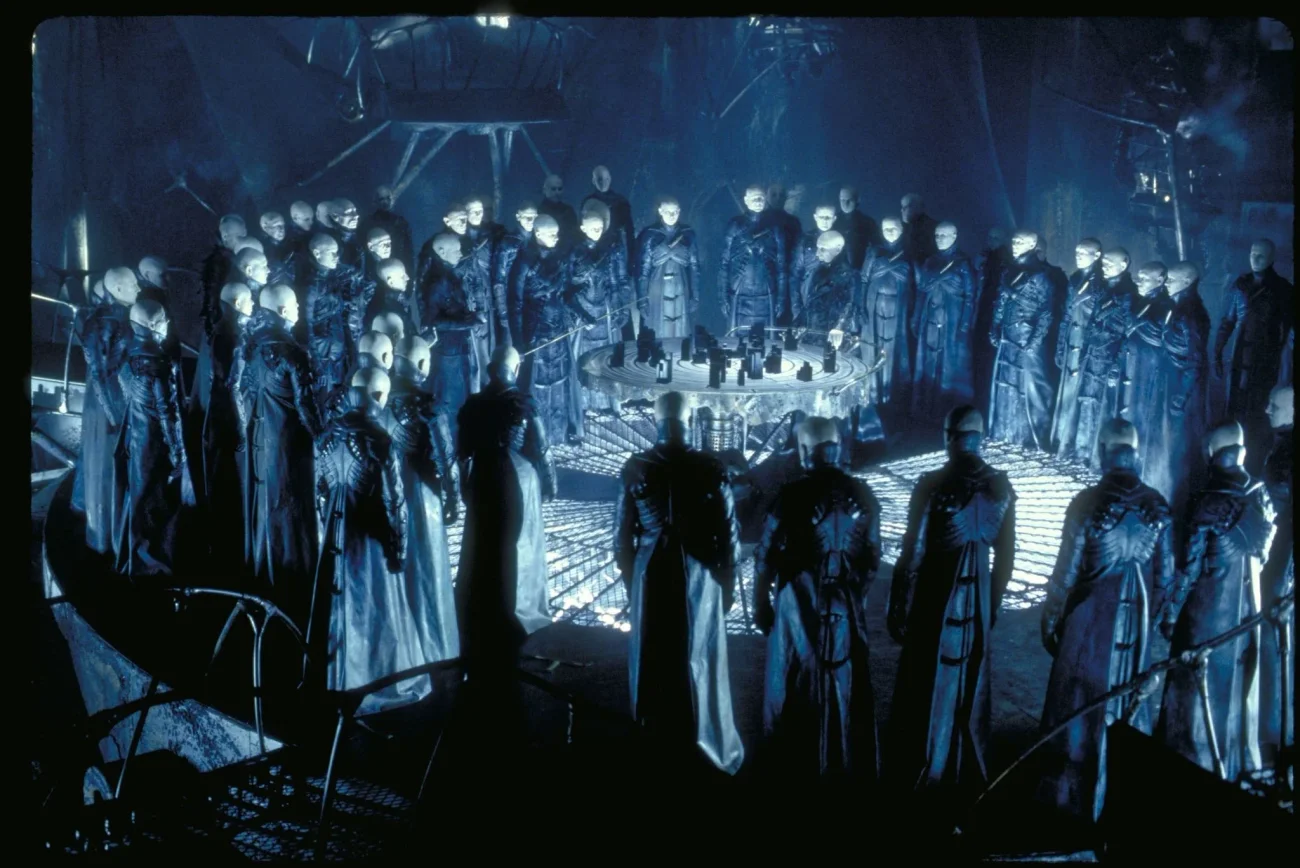
The Strangers themselves are a marvel of design. Pale, bald, dressed in long coats, they move with an eerie synchronicity that underscores their hive mind. They are not monsters; they are scientists, and this causes them to be more unsettling. Their mission, to understand humanity by dissecting and reassembling it, is perversely rational. They see humans as lab rats, and the entire world as their maze. Yet there's a tragedy to them: their race is dying, and they believe the secret to survival lies in the quality they lack: individual consciousness. That desperation humanizes them, even as we root against them. Kiefer Sutherland's Dr. Schreber, their collaborator, embodies the conflict between scientific curiosity and moral compromise. His stammering, twitching performance is a portrait of a man who knows he is aiding something monstrous but feels powerless to stop it.
The noir aesthetic is not mere homage; it is essential to the film's philosophical inquiry. Noir traditionally concerns men undone by their own choices, trapped in fatalistic narratives they cannot escape. Dark City takes this a step further: what if the narrative itself were manufactured? What if the shadows were not metaphorical but literal, imposed by beings who understand lighting but not morality? The flooding amber light, the impossibly tall buildings that lean over the streets like interrogators, the way every shadow seems to have been placed by design, it all serves to ask: in a world built by others, can you ever truly be yourself? This visual philosophy extends to the smallest details: the clock with no numbers, the spiral motifs etched into walls, the recurring image of eyes watching. Proyas understands that for a film about manufactured reality, every visual element must feel both familiar and wrong, like a memory you're not sure is yours.
Murdoch's anomaly status is what drives the plot. Because he woke before his memory imprint, he retains a kernel of unprogrammed self. That kernel allows him to develop "tuning," the reality-bending ability the Strangers possess but use mechanically. Murdoch's tuning is intuitive, emotional, tied to his will. When he first uses it, it's less a controlled power and more a frantic burst of survival instinct. As he gains mastery, tuning becomes an extension of his identity. He reshapes the world to match his desires. This power escalation parallels his psychological journey from victim to agent.
Rufus Sewell's performance is the anchor that carries the film's emotional core. He plays Murdoch with a constant undercurrent of both fear and fury. The character could have been a blank slate, but Sewell injects him with a rawness that renders his confusion palpable and his growing resolve inspiring. You see the moment when Murdoch stops running and starts fighting; it's not a loud declaration but a quiet shift in his eyes. William Hurt's Inspector Bumstead provides the necessary balance: a man of evidence and procedure who gradually accepts that the evidence points to something beyond his worldview. Their partnership, built on mutual skepticism that blossoms into trust, is the movie's emotional core. Bumstead is the audience surrogate, the one who demands proof, and when he finally sees the truth, his reaction is one of awe, not terror.
The score by Trevor Jones perfectly complements the film's hybrid identity, blending brooding orchestral strings with sterile electronic pulses that mirror the Strangers' cold logic. The main theme, a haunting piano melody that recurs throughout, underscores Murdoch's emotional journey, shifting from mournful to triumphant as he gains agency. Jones avoids the bombastic action scores typical of late-90s sci-fi, instead opting for a subdued, atmospheric sound that heightens the film's dreamlike qualities. It's a score that lingers long after the credits roll, much like the film's central questions about identity and self-determination. Notably, Jones incorporates snippets of diegetic music from the film's noir-inspired sets, blurring the line between the world's constructed reality and its emotional core.
As a slow burn, its structure works beautifully. It lingers in Murdoch's disorientation, letting us feel the weight of not knowing. Visual clues like the clock with no numbers, the recurring spiral motif, and the woman on the poster who looks exactly like Emma deepen the mystery without rushing the pace. By the time Murdoch and Bumstead break through the wall and gaze upon the stars, the revelation feels earned, not contrived. That moment, which lays bare the film's space station setting, is one of cinema's great "oh wow" reveals, not because it's shocking but because it reframes everything we've seen. Suddenly, the perpetual darkness makes sense; the Strangers' technology makes sense; even the noir aesthetic fits perfectly, as if this entire world were a dying race's attempt to recreate a bygone era.
Upon release, Dark City was overlooked. Critics were divided; some praised its visuals but dismissed its story as convoluted. Over time, it has been re-evaluated and is now considered a cult classic. Over time, Dark City has been re-evaluated and is now considered a cult classic, frequently among the top science fiction films of the 1990s.
Dark City's influence has been undeniable. The Matrix, released a year later, borrowed heavily from its visual language and central conceit. The rooftop chase, the leather coats, the bending of reality all echo Proyas's film. Yet Dark City remains distinct; it is more philosophical, less action-oriented, more concerned with the nature of self than with revolutionary warfare.
These themes feel especially prescient today. In an age of deepfakes and algorithmic curation, Dark City's exploration of memory manipulation resonates more than ever. It asks: if someone could rewrite your past, would you still be you?
Dark City is a film that demands multiple viewings. Each watch reveals new details: a background sign, a fleeting expression, a visual motif that previous viewings missed. It is that rare genre film that combines intellectual depth with emotional resonance, that respects its audience's intelligence while delivering thrills. It is a love letter to the power of human individuality, wrapped in the guise of a noir nightmare.
The People
Rufus Sewell was not supposed to be a movie star. By 1998, he had carved out a respectable career in British theatre and television, respected but not famous, talented but not bankable. That anonymity is precisely what makes him perfect as John Murdoch. there's no baggage, no audience expectation, no star persona standing between you and the character. When Murdoch wakes up in that bathtub, confused and covered in blood, Sewell plays it with a rawness that causes you to feel the disorientation in your own body. His eyes dart. His hands shake. He is a man trying to assemble a self from fragments, and Sewell makes that process feel genuinely terrifying rather than merely plot-functional.
Sewell has said in interviews that he was drawn to the script because it treated the audience as intelligent. He did not want to play a hero who gradually discovers he has superpowers and then uses them to defeat the bad guys. He wanted to play a man who is genuinely afraid of what he is becoming, who uses his abilities reluctantly and imperfectly, and who wins not through strength but through the stubborn refusal to accept someone else's version of his life. That nuance is all Sewell. The moment when Murdoch stops running and starts fighting is not a loud declaration or a swelling score; it is a quiet shift in his eyes, a decision made in silence. You can see it happen, and it is more powerful than any explosion.
William Hurt brings a different kind of weight to Inspector Bumstead. Hurt was already an established name, an Oscar winner for Kiss of the Spider Woman, and his presence lends the film a gravitas it might otherwise lack. Bumstead is the audience surrogate, the rational man demanding proof in a world that defies rationality. Hurt plays him with a weary patience, a man who has seen enough human darkness to believe in it but not enough to accept anything beyond it. His gradual acceptance of the impossible is one of the film's most satisfying arcs. Hurt was originally offered the role of Dr. Schreber before being moved to Bumstead, and the film is genuinely better for the switch. His grounded, rain-soaked presence anchors the more fantastical elements, giving the audience permission to believe because he believes.
Kiefer Sutherland is the film's most surprising performance. His Dr. Schreber is a twitching, stammering collaborator, a man who helps the Strangers conduct their experiments while quietly despising himself for it. The stammer is not a gimmick; it is a physical manifestation of Schreber's moral paralysis. He cannot speak clearly because he cannot reconcile what he is doing with who he wants to be. Sutherland has spoken about the film with genuine reverence, calling it something that "approaches what I consider to be cinema, which is the highest form of filmmaking." When he first received the script, he assumed it had been sent by mistake and that they actually wanted his father, Donald Sutherland, a far bigger star at the time. The assumption tells you something about Sutherland's humility, but also about the kind of film Dark City is: it doesn't need a household name. It needs the right face, the right voice, the right nervous energy. Sutherland provides all three.
Jennifer Connelly is underused as Emma Murdoch, but her presence serves a thematic purpose that transcends screen time. She is the emotional anchor that Murdoch cannot fully remember but is instinctively drawn to, the proof that identity is not just memory but something deeper, something that persists even when the surface is wiped clean. Connelly brings a quiet gravity to the role, and her scenes with Sewell crackle with the tension of two people who should know each other but do not. Their final scene together, walking toward a newly created Shell Beach as strangers beginning again, is the film's most quietly devastating moment. It is a love story told through absence, through the gap between what was and what might be again.
Richard O'Brien, famous as Riff Raff from The Rocky Horror Show, plays Mr. Hand, one of the Strangers and the most personally invested in understanding Murdoch. Proyas wrote the role with O'Brien in mind, envisioning "strange, bald-looking men with an ethereal, androgynous quality." O'Brien brings an unsettling calm to the part, a creature wearing a human face like a borrowed coat. His fascination with Murdoch borders on obsessive, and there's something almost poignant in the way he absorbs Murdoch's memories, hoping to find in them some fragment of what it means to be human. O'Brien understood the assignment completely: Mr. Hand is not a villain but a mirror, reflecting the film's central question back at the audience. What do you become when you live someone else's life?
Ian Richardson rounds out the principal cast as Mr. Book, the leader of the Strangers. Richardson, known for his role as Francis Urquhart in the original House of Cards, brings a cold authority to the part. Where O'Brien's Mr. Hand is curious, Richardson's Mr. Book is imperious, a being who views humanity with the detached interest of a scientist studying bacteria. The contrast between the two performances gives the Strangers a dynamic that elevates them beyond generic antagonists.
Alex Proyas himself deserves mention as the architect of the whole vision. The Egyptian-born Australian director had already proven his visual flair with The Crow in 1994, a film steeped in gothic atmosphere and practical effects wizardry. Dark City was his passion project, a story he had been developing since the early 1990s, and his commitment to building every element from scratch (sets, props, visual language) gave the film a cohesion that few genre pictures achieve. Proyas fought to keep the project grounded in practical filmmaking, insisting on real sets and in-camera effects even when the industry was pushing hard toward digital solutions. He has described the film as his attempt to make something that "stirred the imagination" in the way that Metropolis and Blade Runner had stirred his, treating the speculative premise with the same seriousness that Lang and Scott brought to their dystopian visions. The personal investment shows in every frame, from the rain-slicked streets to the delicate performances he drew from his cast. By most accounts, he succeeded.
The Craft
Alex Proyas built Dark City from the ground up. No practical locations were used. Every street, every building, every shadow was constructed on sets at Fox Studios Australia. Production designer Patrick Tatopoulos, who collaborated with Proyas on The Crow, began drawing concepts for the world in 1994, four years before the film was released. The ambition was staggering: create a city that feels real enough to inhabit but wrong enough to unsettle, a place assembled from the collective unconscious of urban memory rather than any single geography.
The city is a deliberate patchwork. Tatopoulos described it as "a city built of pieces of cities. A corner from one place, another from some place else. So you do not really know where you are. A piece will look like a street in London, but a portion of the architecture looks like New York, but the bottom of the architecture looks again like a European city." That disorientation is not accidental; it is the point. The city is supposed to feel like a memory of a city rather than a city itself, a composite assembled by beings who have studied human civilization from the outside. Every brick is a quotation, every alley a pastiche, and the cumulative effect is a place that's simultaneously everything and nowhere.
The Strangers' underground lair was a fifty-foot amphitheater built on a fairground in Sydney, towering over the thirty-six-foot average set height. A giant face sculpture concealed a spiraling clock mechanism that became one of the film's most iconic images. The production used inexpensive techniques to achieve expensive-looking results, stretching canvas onto welded metal frames to simulate stone and concrete. A single rail car was filmed repeatedly through the same corridor with interchangeable set pieces to create the illusion of a long journey through different rooms. It is a testament to the artistry involved that these tricks remain invisible even on repeat viewings.
Cinematographer Dariusz Wolski, who later shot the Pirates of the Caribbean films, bathed the entire film in amber and shadow. The visual palette is relentless, oppressive, and beautiful. there's no sunlight in this city, and you feel the absence in every frame. Wolski shot much of the film through glass, mirrors, and water, creating layers of reflection that fragment the image and reinforce the theme of distorted perception. The camera frequently glides rather than cuts, giving the film a dreamlike fluidity that matches Murdoch's disorientation. The use of chiaroscuro lighting, deep blacks bleeding into warm amber, recalls both classic noir and the paintings of Edward Hopper, lonely figures trapped in pools of artificial light.
Trevor Jones composed the score, and it walks a fine line between orchestral grandeur and electronic unease. The main theme is sweeping, almost romantic, a counterpoint to the visual bleakness. But underneath the strings, there are synthesizer textures that hum and pulse like the city's machinery. Jones has said he wanted the music to feel like "the memory of a score," something beautiful but slightly wrong, slightly out of reach. The result is a soundtrack that works on two levels: as emotional underscore and as a reflection of the film's central conceit. When the city reshapes itself, the music shifts from warm brass to cold electronics, mirroring the transition from human warmth to alien control.
The practical effects deserve special attention. The city transformation sequences, where buildings fold and streets rearrange, were achieved primarily through miniatures, forced perspective, and in-camera tricks. The Strangers' telekinetic abilities were realized through a combination of wire work and hidden mechanisms. The decision to rely on practical effects rather than CGI was both aesthetic and budgetary; the twenty-seven million dollar budget could not support extensive digital work in 1998. But the limitation became a strength. The practical effects have a tactile weight that period CGI rarely achieved. You can feel the strain on the rail car, hear the creak of metal as buildings slide into new configurations. there's a physicality to these sequences that grounds the fantastical premise in something you can almost touch.
The film was influenced by Fritz Lang's Metropolis, Kafka, Orwell, The Twilight Zone, and classic film noir of the 1940s. Proyas originally conceived the story around a detective who goes insane trying to solve a case where the facts do not add up, before shifting focus to the man being hunted instead. That evolution from detective story to identity thriller is evident in the film's structure, which withholds information as aggressively as it reveals it. The editing by Dov Hoenig keeps the audience perpetually off-balance, cutting between perspectives and timelines with a rhythm that mimics Murdoch's fractured consciousness. Dark City has been celebrated by critics and filmmakers alike as a visionary achievement that "stirred the imagination like Metropolis and 2001: A Space Odyssey," with its advocacy and enduring influence helping keep the film in the cultural conversation during years when mainstream attention had moved on to flashier blockbusters.
The Trivia
-
After Dark City wrapped, the Wachowskis purchased pieces of the set and props to use in The Matrix, which went into production the following year. The rooftop chase sequences, the leather trenchcoats, the bending of physical laws, the themes of waking up from manufactured reality. Dark City walked so The Matrix could run.
-
New Line Cinema forced Proyas to add an explanatory voice-over to the theatrical release, concerned audiences would not follow the plot. The 2008 Director's Cut removes that narration and adds roughly eleven minutes of footage. Proyas described the Director's Cut as returning the film to "a more leisurely and thoughtful pace it was meant to be."
-
The character of Dr. Schreber is named after Daniel Paul Schreber, a German judge whose 1903 autobiographical memoir, Memoirs of My Nervous Illness, detailed his experience with paranoid psychosis. The book is a real historical document, and the film borrows several elements from it.
-
Ben Kingsley was one of the original choices to play Dr. Schreber before Sutherland was cast. William Hurt was originally offered the Schreber role before being moved to Bumstead.
-
The film found its real audience on home video and cable television, where it gained cult classic status throughout the late 1990s and early 2000s. Late-night viewers discovered the film's mind-bending premise and philosophical depth, turning it into a word-of-mouth phenomenon that the theatrical release never achieved. This grassroots following eventually forced studios to reconsider the film, leading to the 2008 Director's Cut restoration.
-
The "smoking man" at the Shangri-La tower who bumps into Murdoch is director Alex Proyas himself, making a brief but deliberate cameo as one of the Strangers in disguise. This subtle nod to his own involvement mirrors the way Hitchcock used to appear in his films, signaling the director's omnipresent hand in crafting this reality. The brief appearance serves as a reminder that the world we are seeing is literally constructed by a singular artistic vision.
-
Richard O'Brien's casting as Mr. Hand was no accident. Proyas wrote the part specifically for him after envisioning "strange, bald-looking men with an ethereal, androgynous quality." O'Brien had famously played a similar character, Riff Raff, in The Rocky Horror Show.
-
The film's visual influence extends well beyond The Matrix. Christopher Nolan has cited Dark City as an influence on Inception, particularly the concept of a constructed reality that can be reshaped by will. The rotating hallway fight in Inception owes a conceptual debt to Dark City's folding streets.
-
The Shell Beach motif recurs throughout the film as a postcard, a memory, and finally a destination. Production designer Tatopoulos revealed that the Shell Beach postcard Murdoch carries was designed to look like a real vacation advertisement from the 1950s, printed on period-appropriate card stock. It is one of the few props in the film that's deliberately anachronistic, a clue that the city is an assembly of borrowed eras.
-
The Strangers were originally designed to look more overtly alien, with elongated features and inhuman proportions. Proyas scaled back the design, opting instead for pale, bald figures in long coats. The reasoning was simple: the less alien they looked, the more unsettling they became. Monsters you can almost mistake for human are scarier than monsters you cannot.
-
Dark City has been celebrated by critics and filmmakers as a visionary achievement that fundamentally influenced how science fiction cinema approaches memory and identity. Its exploration of constructed reality has been cited as a direct influence on numerous subsequent sci-fi films, from Inception to Total Recall, and it remains a touchstone for discussions about fabricated worlds. The film's legacy continues to grow as new generations discover its prescient treatment of themes that feel increasingly relevant in an age of digital identity and curated online personas.
The Verdict
Dark City is a film about identity, memory, and the terrifying possibility that everything you know about yourself was planted there by someone else. It asks whether humanity is defined by experience or by choice, and whether it matters which, as long as you are the one making the choices. That question is not rhetorical. The film genuinely wrestles with it, and it doesn't pretend the answer is easy.
It is also a film that looks like nothing else before or since. Tatopoulos and Proyas created a visual language that borrows from noir, German Expressionism, and science fiction, then blends them into something entirely original. Every frame is composed like a painting. Every shadow has a purpose. The city is not a backdrop; it is a character, and it evolves alongside Murdoch as he discovers who he really is. When the sun finally breaks through, the warmth feels earned in a way that few cinematic payoffs manage.
The film is not perfect. The first act occasionally stalls under the weight of its own mystery, and the plot requires you to accept certain logical gaps that the film hand-waves away with atmosphere. Jennifer Connelly's character deserved more development. Sutherland's stammer borders on caricature in his first scene before settling into something more nuanced. But these are minor complaints about a film that dared to be genuinely weird, genuinely philosophical, and genuinely beautiful in an era that rewarded none of those things.
What endures is the feeling. Not the plot twists, not the special effects, not even the performances, though all of these are excellent. What endures is the quiet devastation of the final moments, the image of two people who loved each other walking toward a beach that did not exist five minutes ago, starting over with nothing but the hope that what they had was real enough to rebuild. It is a film that trusts its audience to sit with ambiguity, to accept that not every question needs an answer, and that sometimes the most honest thing a story can do is leave a door open.
If you have never seen it, watch the Director's Cut. If you have seen it, watch it again. It rewards patience, attention, and the willingness to let a film be strange without demanding that it explain itself. In a landscape of science fiction that spells everything out, Dark City remains defiantly, beautifully opaque.
"The world is a machine. You are not."