Dirty Dancing (1987)
 Jay Wilde
The Hook
There's a moment in the trailer where Baby Houseman, her arms wrapped around Johnny Castle like they're the only two people on earth, and you realise that this isn't just about dancing. It's about what happens when someone breaks through all your carefully constructed walls just by refusing to let you build them in the first place. The music swells, the camera pulls back from their clasped hands moving across polished wooden floors, and suddenly you're not watching a film; you're remembering that summer of 1987 when Dirty Dancing came out and made every teenager who saw it believe for the first time that love could be revolutionary.
The trailer shows you exactly what you need to know about this film without giving away any secrets. You see Baby, nineteen years old with her head full of college essays and daddy's expectations, arriving at Kellerman's resort with her family in that pristine summer of 1963. The Catskills mountains rise around her like a fortress wall, beautiful but confining. Then there's Johnny, a working class man with confidence, wearing his black t-shirt like armour, already knowing all the moves Baby is about to learn. The two worlds collide when she watches him dance with Penny and something shifts in her eyes; not desire yet, but recognition of someone who doesn't need permission to exist.
What makes the trailer so compelling isn't just the romance or even the incredible dancing sequences, though Kenny Ortega's choreography creates some of the most memorable cinematic moments in film history. It's the way the film builds tension around something that feels impossible: a relationship between people from such different backgrounds that their families would never accept it. The trailer hints at Baby's father Max's disapproval, her sister Lisa's judgment, and all those unspoken rules about who should be together. But it also promises you'll find yourself cheering when two young people decide they know better than everyone else what matters to them.
The story behind Dirty Dancing is almost as compelling as the film itself. This wasn't supposed to be a movie musical in the traditional sense, and the script went through significant changes before Emile Ardolino signed on to direct. The original draft focused more heavily on the class divide between Baby and Johnny, making it darker and less of a romance story. Producer Linda Gottlieb fought to keep the emotional core intact, insisting that audiences needed to fall in love with both characters equally rather than seeing this as a simple rebellion tale.
Patrick Swayze was not the first choice for Johnny Castle either. The studio initially wanted someone with more dance credentials already established on screen, but Ardolino saw something different in Swayze's audition; a raw vulnerability beneath the confidence that made Johnny feel real rather than just a romantic fantasy figure. Jennifer Grey has said about working with him: "Patrick brought this intensity to Johnny." The famous lift at the end of the film required weeks of rehearsal between Swayze and Grey before they could execute it safely.
What makes Dirty Dancing endure isn't just its perfect romance or its iconic dance sequences. It's about that moment when you realise that growing up sometimes means defying your parents, questioning everything you've been told is right, and finding people who make you feel like the best version of yourself. The film came out at a time when young audiences were hungry for stories that treated their emotions as serious rather than dismissible teenage drama.
Dirty Dancing proved that romantic films could be both emotionally resonant and artistically ambitious. It won an Academy Award for Best Original Score and spawned countless imitators trying to capture its particular blend of nostalgia, romance, and coming-of-age drama. But none quite managed to replicate the alchemy that made this film special; the way it treats love as something worth fighting for while acknowledging that the fight itself changes you.
The Movie
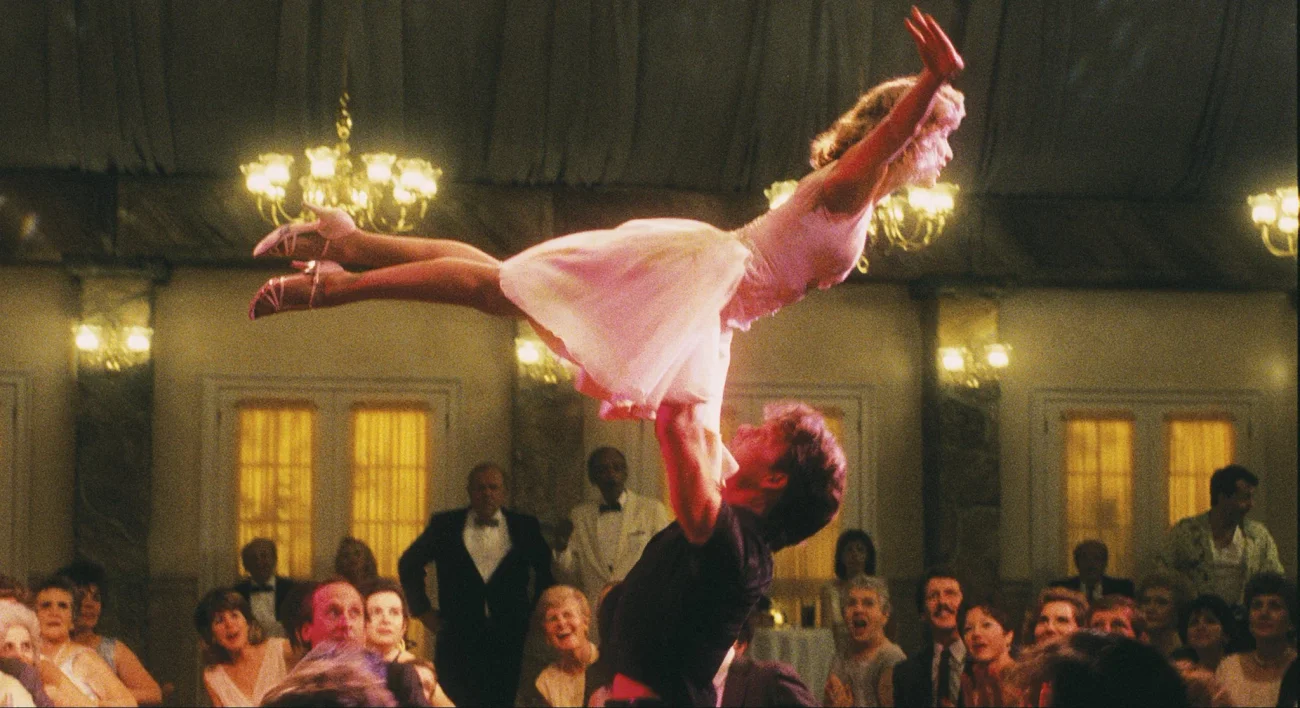
The closing number is Dirty Dancing's most emotionally triumphant set piece. Johnny, who has been fired from the resort and has nothing left to lose, returns for the final dance and performs a routine with Baby that's simultaneously a dance, a declaration, and a rebellion. The closing number is staged with a precision and an emotional commitment that makes every lift, every dip, every synchronized step feel earned rather than merely performed. Patrick Swayze and Jennifer Grey's chemistry, which has been building throughout the runtime, reaches its peak in this moment, and the final lift, Baby held aloft, arms spread, trusting Johnny completely, is the story's defining image. Bill Medley and Jennifer Warnes's "(I've Had) The Time of My Life" provides the number with its musical foundation and became one of the most successful songs of the decade.
The core of Dirty Dancing's appeal lies in how it frames partnered dance as a language of trust rather than performance. Johnny's role as teacher is less about imparting steps and more about breaking down Baby's ingrained hesitation to take up space, physically and emotionally. The intimacy of their early lessons isn't about romance at first, it's about learning to anticipate another person's movement, to let go of control, to trust that the person across from you won't let you fall. This dynamic mirrors the broader class tension of the film: Baby is used to being told where to stand, how to move, what's appropriate, while Johnny navigates a world where his body is his livelihood, his art, and his only leverage against a system that devalues him. Their dance lessons become a microcosm of the film's central argument: that intimacy requires vulnerability, and vulnerability requires safety, something neither character has experienced in their respective worlds before meeting each other.
The film's use of pop music as emotional shorthand avoids the trap of nostalgic manipulation. Each track is tied to a specific emotional beat, never overwhelming the moment, always serving the character's internal state. The choreography mirrors this restraint, progressing from awkward distance to seamless synchronicity as the relationship develops, never showing off for the sake of spectacle.
A subplot involving staff member Penny grounds the romance in a harsher reality, reminding the audience that the 1963 setting isn't just a backdrop for dance numbers. It adds necessary weight to Baby's journey, showing that her growing independence isn't just about romance, but about recognising the humanity of people her family deems beneath them. The stakes extend beyond romantic feelings into questions of class, resource inequality, and the unspoken rules that govern who deserves help and who doesn't in 1963 America.
Dirty Dancing operates on multiple levels simultaneously: as a romance, as a coming-of-age story, as a class drama, and as a dance film. This multi-layered approach is why the film resonates with audiences across generations, from those who saw it in theatres in 1987 to new viewers discovering it on streaming platforms today. What elevates it beyond its formulaic premise is the understanding that bodies tell stories words cannot. Johnny's dance instruction is not just about steps; it is about teaching Baby to trust her instincts, to listen to her body's desires in a world that tells women to suppress them. The choreography becomes a language of intimacy, each lift and dip a sentence in a conversation about vulnerability and control.
The film's setting in the summer of 1963 is carefully chosen. This is a moment before the cultural earthquakes of the mid-1960s: before Beatlemania, before the Civil Rights Act's full implementation, before the escalation of Vietnam. The Catskills represent a vanishing America, a world of borscht belt humour and insular Jewish culture insulated from the upheaval to come. This temporal specificity grounds the class tensions; Baby's parents belong to an older generation where social boundaries were more rigidly enforced and less questioned. Resort guests like the Housemans live in a bubble of privilege where staff are invisible until they become inconvenient, a dynamic that makes Baby's choice to side with Johnny a bold gesture of empathy. The film's soundtrack spanning 1960s pop and contemporary 1980s rock creates a temporal bridge that speaks to both period and present. This duality gives the film a timeless quality: it is anchored in a specific historical moment yet feels emotionally immediate. The generational tensions between Baby and her parents mirror the larger cultural shifts of 1963, a year when the old assumptions were beginning to crack. The film captures that liminal moment: the last summer of an era, the first stirrings of change that would redefine American culture for decades. The film's enduring popularity stems from this precise timing, it arrived when audiences were ready to look back at the early sixties with both nostalgia and clear eyes. The generational tensions between Baby and her parents mirror the larger cultural shifts of 1963.
Kenny Ortega's choreography is not just impressive dancing; it is a physical argument for the relationship's authenticity. Ortega, who brought musical theatre precision to the project after working on Broadway productions, ensures every movement serves the story rather than showboating for spectacle. The choreography progresses from technically correct to emotionally resonant, mirroring Johnny and Baby's journey. The early lessons focus on form Baby's posture, the basic steps and the physical distance between them is palpable. As trust builds, the dances incorporate more body contact, more sustained eye contact, more moments where their movements must anticipate each other. This visual language of growing intimacy communicates what dialogue cannot. The final performance's imperfections Johnny's anger, Baby's determination make the triumph feel earned. The film insists that great dance emerges from genuine connection, not just technical perfection.
The music operates as the film's emotional bloodstream. The soundtrack's record-breaking success (32 million copies) sometimes overshadows how deliberately each song is deployed. "Be My Baby" accompanies the Houseman sisters' youthful frivolity, its upbeat rhythm masking the underlying tension of Baby's growing dissatisfaction with her privileged but stifling life. "Some Kind of Wonderful" underscores the staff's camaraderie, a moment of joy where class boundaries blur on the dance floor. "Where Did Our Love Go" plays during moments of growing tension between Johnny and Baby, its melancholy melody underscoring the impossibility of their relationship in the eyes of their respective worlds. The original songs serve as externalised internal monologues: "Hungry Eyes" gives voice to the characters' unacknowledged desire; "(I've Had) The Time of My Life" becomes the anthem of a summer that transformed them. The film's sound design blends diegetic sources the resort's speakers, the club's jukebox with non-diegetic scoring, creating a soundscape that feels both organic and heightened. Music in Dirty Dancing is not background; it is a character, a confidante, a witness to the characters' transformations, and a bridge between the audience and the characters' internal lives.
The visual style keeps the emotional highs tethered to a grounded, lived-in reality. Ardolino, a documentarian and Broadway director, brings a realism that avoids glamour, giving equal dignity to staff spaces and guest suites in a subtle visual reinforcement of the film's class critique. Jeff Jur's cinematography favours natural light, handheld intimacy, and long takes that allow the choreography to breathe. The physical spaces feel lived-in the sweat on the dance floor, the steam in the practice rooms, the clutter of the staff quarters. The camera observes rather than intrudes, creating a sense that we are watching real moments unfold. The colour palette visually maps the emotional landscape: the Houseman areas are cool and muted, representing propriety and restraint; the dance spaces are warm and golden, representing passion and authenticity. When Johnny and Baby share their first kiss, the camera holds at a respectful distance, trusting the interaction without exploitation. This visual restraint makes the more heightened emotional beats feel earned rather than manipulated. Ardolino's background in documentary filmmaking gives the film an authenticity that elevates it beyond typical romantic dramas.
The People
Patrick Swayze's Johnny Castle is the performance that made Swayze a star and established him as one of the most physically compelling screen presences of the 1980s. Swayze, who was a trained dancer and martial artist, brings to Johnny a physical grace and a sexual charisma that makes the character simultaneously appealing and believable.
The actor spent weeks in intensive dance rehearsals before filming began, working with choreographer Kenny Ortega to develop Johnny's distinctive movement vocabulary. Swayze's background in ballet gave him technical precision, while his experience in martial arts contributed to the powerful, controlled movements that define many of the film's most memorable sequences. His dance sequences are the film's most technically impressive achievements, and his ability to convey genuine emotion through physical performance makes Johnny a character who transcends the film's apparent simplicity. Swayze's portrayal gave Johnny both strength and vulnerability, making him appealing to audiences across generations. Swayze's delivery of the line "Nobody puts Baby in a corner", which has become one of the most quoted lines in cinema history, demonstrates his ability to transform a simple phrase into a cultural moment.
Jennifer Grey's Baby is the film's emotional anchor and the character whose journey, from sheltered innocence to confident independence, provides the film's narrative and thematic structure. Grey plays Baby with a naturalness and an emotional honesty that makes her transformation feel genuine rather than manufactured.
Grey has spoken candidly in retrospectives about how challenging it was to portray someone learning to trust their own instincts while navigating parental pressure. The actor underwent extensive dance training before filming, which she describes as both physically exhausting and emotionally liberating. She noted that the physical work helped her understand Baby's transformation from someone unused to moving with confidence into a dancer who commands space. Her scenes with Swayze, which involve dancing, romance, and genuine human connection, are the film's most emotionally nuanced, and her ability to convey vulnerability, determination, and growing confidence through physical performance makes Baby the film's most complex character.
Jerry Orbach's Jake Houseman, Baby's father, provides the film with its most authoritative adult presence. Orbach plays Jake as a man whose moral convictions are tested by his daughter's behaviour and whose ultimate acceptance of Baby's choices represents the film's emotional resolution. His scenes with Grey, particularly the confrontation and the final reconciliation, are the film's most dramatically complex.
Orbach brought something deeply personal to the role that came from decades of theatre experience. He has described in reunion interviews how he approached Jake not as a villain but as a man trying his best to protect his daughters while navigating a changing world he doesn't fully understand. The actor's background with Broadway and television gave him a particular comfort with the film's dialogue-heavy scenes, allowing him to find natural rhythm even during emotionally charged moments.
Cynthia Rhodes's Penny provides the film with its most sympathetic working-class character. Rhodes plays Penny as a woman whose talent and whose courage are matched by her vulnerability and her desperation, and her subplot, involving the abortion and her relationship with the resort's male guests, provides the film with its most serious dramatic weight.
Kelly Bishop's Marjorie Houseman, Baby's mother, provides the film with its most perceptive adult presence. Bishop plays Marjorie as a woman who understands more than her husband about what her daughter needs and wants. In interviews decades later, Bishop has spoken about how she brought her own experiences as a mother to the role, finding moments where Marjorie clearly sees Baby's unhappiness but lacks the language to express it.
Jack Weston as Max Kellerman provides the film with its most comic relief while simultaneously grounding the resort's management in realistic business concerns. Weston plays the bumptious owner whose primary motivation is keeping his summer business profitable, and his dynamic with the Houseman family creates much of the film's lighter moments.
The chemistry between Patrick Swayze and Jennifer Grey was not immediately apparent at the start of filming. Grey has described in convention interviews how the two actors had to deliberately build trust through their extensive dance rehearsals before they could portray the growing intimacy between Johnny and Baby. This deliberate process, she noted, resulted in a screen relationship that feels earned rather than manufactured.
Eleanor Bergstein, who wrote the screenplay based on her own childhood experiences, has said in numerous interviews that she always envisioned Johnny Castle as someone with genuine dance talent rather than just a romantic figure. The casting of Swayze fulfilled her original conception perfectly, bringing both technical skill and emotional depth to the role.
What surprised many critics at the time was how the supporting cast elevated material that could have been routine character work. Cynthia Rhodes brought a warmth to Penny that made her more than just Baby's friend; she became a fully realised young woman whose ambitions and frustrations resonated with audiences. Kelly Bishop, while appearing in fewer scenes than her husband Jerry Orbach, managed to create a mother character who felt authentic rather than stereotypical.
The ensemble work on Dirty Dancing represents something that doesn't always appear in romantic dramas of its era. Each supporting actor brings distinct personality traits that make the resort feel like a real community rather than just background for the central romance. The casting process itself was meticulous, with Ardolino and Bergstein holding extensive auditions to ensure each role, from resort guests to staff members, felt inhabited by performers who understood the film's delicate balance of class critique and romantic optimism.
Patrick Swayze has said in various retrospectives that working with Emile Ardolino gave him confidence as an actor who could carry emotional weight alongside his physical performances. The director's documentary background meant he valued authenticity over perfection, which allowed actors to bring their own interpretations to their characters rather than following rigid direction.
Jennifer Grey describes the experience of filming Dirty Dancing as transformative not just for her career but for her understanding of what she wanted from future roles. She has mentioned in interviews that the physical demands of dance training helped her develop a discipline that influenced how she approached subsequent performances.
The Craft
Emile Ardolino's direction is Dirty Dancing's most consistent strength. Ardolino, who was primarily known as a documentary filmmaker and a Broadway director, demonstrates in Dirty Dancing a visual style and a tonal balance that makes the film simultaneously intimate and grand. His ability to generate genuine romantic tension through dance sequences, which require physical proximity, emotional vulnerability, and precise choreography, is the film's most essential directorial achievement. Ardolino's management of the film's emotional arc, from innocence to experience, from obedience to rebellion, from friendship to love, gives the film its distinctive quality and its lasting emotional power.
The screenplay by Eleanor Bergstein is the film's most underrated achievement. Bergstein, who drew heavily on her own childhood experiences in a Catskills resort, creates a screenplay that's simultaneously personal and universal, managing the film's multiple storylines, Baby's romance, Penny's crisis, the class dynamics of the resort, the social upheaval of 1963, with a clarity and a emotional intelligence that's consistently impressive. Bergstein's dialogue, which ranges from witty social observation to passionate emotional expression, is consistently sharp and dramatically effective.
The production design by Joseph P. Lucky creates a world that feels lived-in rather than stylised for camera. The resort's various spaces, including the dining hall where families gather, the staff quarters where the workers live, and the practice rooms where Johnny teaches Baby, each serve distinct narrative functions while maintaining visual consistency throughout.
The cinematography by Jeff Jur creates a visual palette that's warm, intimate, and perfectly suited to the film's romantic and period requirements. Jur's work, which uses a combination of natural light, warm interior photography, and carefully managed depth of field, gives Dirty Dancing a visual quality that's simultaneously nostalgic and immediate. His camera work captures both the intimacy of the dancefloor and the grandeur of the resort setting.
The editing by Richard Suderman maintains a rhythm that serves both the dance sequences and the dramatic moments. The film's pacing allows viewers to absorb emotional beats without feeling rushed while keeping momentum during the more energetic musical numbers.
The choreography by Kenny Ortega is the film's most technically impressive achievement. Ortega, who would later choreograph High School Musical and direct Hocus Pocus 2, creates dance sequences that are simultaneously spectacular, intimate, and emotionally revealing, using the vocabulary of partnered dancing to express the romantic and sexual tension that the screenplay's dialogue cannot directly address.
The film's sound design integrates diegetic sources from the resort's speakers with non-diegetic scoring to create an immersive audio environment. This blending allows music to function as narrative element rather than mere accompaniment throughout.
The film's visual effects, though minimal by modern standards, required careful planning for the outdoor dance sequences during golden hour lighting conditions that created specific technical challenges for the cinematography crew. The natural lighting approach gave the film an authentic period feel that enhanced the romantic atmosphere.
The soundtrack is the film's most culturally significant element. The combination of 1960s pop, "Do You Love Me," "Love Is Strange," "Hungry Eyes", and the original "(I've Had) The Time of My Life" created one of the most successful film soundtracks of the 1980s, selling over 32 million copies worldwide and becoming the best-selling soundtrack of the decade.
Matt Sullivan's original score work provides emotional underscoring that enhances rather than overwhelms the diegetic music performances. His compositions during dramatic moments create continuity between the various songs that drive the narrative forward.
The costume design by Marik Coscia establishes clear visual distinctions between characters from different social classes. Baby's transition from conservative summer resort attire to more casual clothing reflects her character's growing independence and willingness to cross boundaries that had previously seemed insurmountable.
The Trivia
-
Dirty Dancing gained a dedicated following through word-of-mouth, eventually becoming a defining romantic film of its era. The film's grassroots popularity surprised studio executives who had low expectations for its commercial performance.
-
The film was initially given a limited release due to the studio's skepticism about its commercial potential. Strong word-of-mouth and repeat viewings led to an expanded release that turned the film into one of the year's biggest hits.
-
Patrick Swayze was 35 years old during filming, making him significantly older than his character Johnny Castle, who is implied to be in his twenties. This age gap added an interesting dynamic to the romance, as Swayze brought a mature presence to what could have been a typical young lover role.
-
Jennifer Grey was 27 during filming and had previously appeared in Ferris Bueller's Day Off and The Cotton Club. Her performance in Dirty Dancing launched a career that would include Red Dawn and The Wind.
-
Patrick Swayze and Jennifer Grey reportedly did not get along during filming, which contributed to the genuine on-screen tension between their characters. Their off-screen friction ironically enhanced the authenticity of their characters' rocky relationship journey.
-
The "Nobody puts Baby in a corner" line was reportedly improvised by Swayze, though this has been disputed by other sources. Regardless of its origin, the line became one of the most quoted moments in romantic film history.
-
The famous final lift was not performed by Grey and Swayze in the final take; a stunt double was used for some of the more complex sequences. The iconic lift required precise timing and trust, which the actors developed through weeks of grueling rehearsal.
-
The film was shot primarily at two locations in Virginia, Mountain Lake Lodge and the nearby town of Luray, which doubled for the Catskills resort. The natural beauty of the Virginia mountains provided an authentic backdrop that enhanced the film's romantic atmosphere.
-
The soundtrack, released in 1987, sold over 32 million copies worldwide and became the best-selling soundtrack album of all time, a record it held until The Bodyguard in 1992. The album's success demonstrated the powerful connection between music and memory in popular culture.
-
The film's choreographer, Kenny Ortega, was 27 during filming and would go on to choreograph and direct some of the most successful musical films of the following decades. His work on Dirty Dancing launched a career that would define dance cinema for a generation.
-
The film was nominated for one Academy Award, Best Original Song for "(I've Had) The Time of My Life", and won. The award validated the film's integration of music and narrative, proving that a romantic drama could achieve both critical recognition and massive commercial appeal.
-
A stage musical adaptation of Dirty Dancing toured internationally from 2004 and played London's West End from 2006 to 2011. The production brought the beloved story to new audiences and proved the film's enduring appeal across different media formats.
-
The film's cultural impact extended far beyond its theatrical release, and it has remained one of the most regularly viewed and beloved films of the 1980s. Its themes of class, romance, and personal growth continue to resonate with new generations of viewers discovering it through streaming platforms.
The Verdict
Dirty Dancing is a film that does something no amount of cleverness can manufacture: it makes you believe that two people from different worlds can fall in love through the medium of dance. Emile Ardolino's direction is masterful; his ability to generate genuine romantic tension through dance sequences is the film's most essential achievement, and his management of the film's emotional arc, from innocence to experience, from obedience to rebellion, gives the film its distinctive quality and its lasting emotional power. The film's enduring appeal lies in its emotional authenticity.
Patrick Swayze's Johnny is one of the great screen romantic presences, physically magnetic, emotionally vulnerable, and capable of making simple movements feel like declarations of love. Jennifer Grey's Baby provides the film with its emotional anchor; her transformation from sheltered innocence to confident independence is the film's true story. The choreography by Kenny Ortega is spectacular, the soundtrack is one of the finest in cinema history, and the screenplay by Eleanor Bergstein provides the film with its thematic foundation and its emotional honesty.
Dirty Dancing endures not because it avoids formula but because it executes that formula with genuine heart and authentic performances from every member of the cast. The film's exploration of class differences feels lived-in rather than theoretical; Baby's journey toward self-discovery resonates because it emerges naturally from her experiences at Kellerman's resort. What makes Dirty Dancing a timeless classic is its understanding that growing up sometimes means defying your parents and finding people who make you feel like the best version of yourself.
Dirty Dancing is not a film that requires critical analysis to appreciate. It requires only a willingness to be moved by two people dancing, two worlds colliding, and the discovery that sometimes the best way to find yourself is to lose yourself in someone else's arms.
"Nobody puts Baby in a corner."