Drive (2011)
 Jay Wilde
The Hook
There is a moment in the Drive trailer where Ryan Gosling sits behind the wheel of a car, wearing a satin jacket with a golden scorpion on the back, and says nothing. He doesn't need to. The camera holds on his face, his eyes fixed on something in the distance, and you understand everything about this character in that silence. He is a man who lives in the spaces between words, who communicates through the angle of a steering wheel and the pressure of a foot on an accelerator. The trailer for Drive is one of the great pieces of modern marketing because it understands exactly what the film understands, that restraint is more terrifying than spectacle.
The trailer lays out the premise with a deceptive simplicity. A Hollywood stunt driver works days as a mechanic and double, and moonlights as a getaway driver for criminals. He has rules. He doesn't carry a gun. He doesn't know the names of the people he drives for. He drives for exactly five minutes and then he is gone. The trailer shows us Gosling's Driver, nameless throughout the entire film, picking up criminals outside a heist, threading through LAPD traffic with a calm that borders on supernatural, and depositing his passengers at a safe distance before vanishing into the night. It looks like a cool action film. It is not a cool action film. It is a fairy tale about a man who tries to be good and discovers that goodness, in his world, requires more violence than villainy ever did.
What the trailer hints at, and what the film delivers with devastating precision, is a romance built on silences and glances. Gosling meets his neighbour Irene, played by Carey Mulligan, and her young son Benicio. there's a scene in the trailer where the three of them sit together in a diner, and the Driver's face softens into something almost human. It lasts about four seconds. Those four seconds contain the entire emotional architecture of the film, because everything that follows is about what happens when a man built for violence tries to make room for tenderness.
Nicolas Winding Refn won the Best Director award at the 2011 Cannes Film Festival for this film, and watching the trailer you can see why. Every shot is composed with the patience of a painting. The colours glow like neon signs reflected in wet asphalt. The music, by Cliff Martinez, pulses underneath the images like a heartbeat. The trailer opens with that now-iconic synthesiser score, all throbbing bass and shimmering high notes, and it immediately establishes a world that feels simultaneously nostalgic and alien. Drive sounds like no other film made that decade, and it looks like no other film made that decade, and that's entirely the point.
The Movie
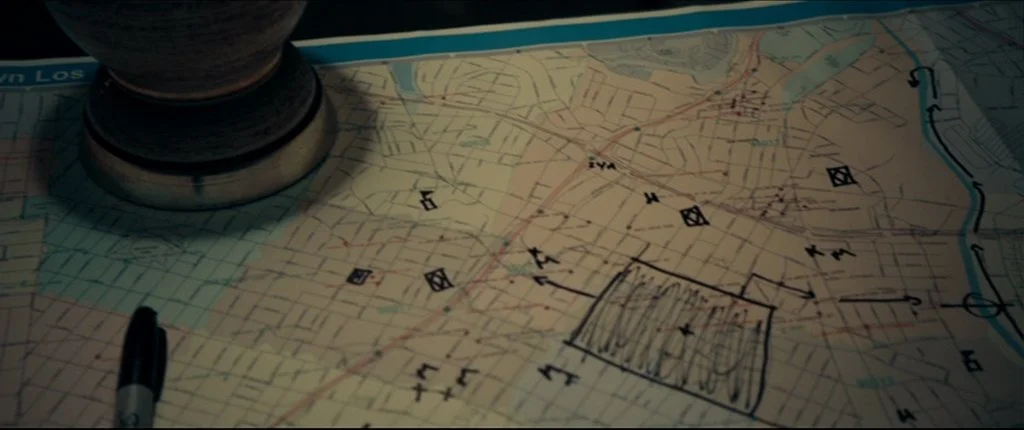
Drive opens with a job. The Driver, credited only as "The Driver," sits in a car outside a building in downtown Los Angeles, waiting. A scanner crackles with police frequencies. A stopwatch ticks. When the criminals emerge from a jewelry store robbery, the Driver executes a series of evasive turns through the city grid with a precision that feels more like choreography than escape. Within sixty seconds, the audience understands the central contract of the film. This is a man who is extraordinarily good at one thing, and the film will not insult your intelligence by explaining why that matters.
The Driver lives by a strict code: five minutes exactly, no guns, no names. These rules are his moral buffer in a lawless world. But the film reveals this code as self-deception. When he breaks his own rules to help Standard, the buffer shatters, exposing that the rules were never about purity they were about denial, and denial cannot survive real human consequence.
The film establishes the Driver's world with an economy that borders on brutal. He works as a stunt driver for Bryan Cranston's Shannon, a well-meaning mechanic who manages his jobs and dreams of putting the Driver into stock car racing. He lives alone in a sparse apartment. He measures time in five-minute increments. Then he meets Irene, his new neighbour, and the walls begin to crack. There is a moment where the Driver takes Irene and Benicio on a drive through Los Angeles at night, and the city transforms. The streetlights become a constellation. The buildings dissolve into streaks of colour. It is one of the most beautiful driving moments in cinema, and it contains no car chases, no explosions, no danger at all. Just a man, a woman, and a child moving through a city that briefly, impossibly, feels safe.
This is the emotional core the glimpse of what the Driver wants but cannot have. The warm, golden glow of that drive stands in stark contrast to the film's darker themes. We see Benicio's wonder and Irene's softness, and we understand what's at stake. That knowledge colours every subsequent choice.
The film pivots when Irene's husband Standard, played by Oscar Isaac in a performance that turns what could be a thankless role into something quietly devastating, is released from prison. Standard owes protection money to an Albanian gang, and the debt has followed him home. The Driver, who has been building something fragile with Irene, offers to help. He will drive Standard and a woman named Blanche, played by Christina Hendricks with a volatility that burns through her few scenes, through a pawn shop robbery that will clear the debt. It is supposed to be simple. Nothing in this film is simple.
Standard is a desperate man buying his way back into his family, and the heist is his only way out. The tragic irony: he needs the one person who can execute it perfectly, the Driver, who sees it as redemption. Standard treats it as business; the Driver treats it as love. That disconnect makes the disaster inevitable. Both men are operating on different assumptions, and the film uses that irony to build mounting tension.
The heist goes wrong, as things often do in Refn's films, suddenly and brutally. Standard is caught in the crossfire. Blanche reveals that the take is one million dollars, not the forty thousand Standard owed. The Driver finds himself holding a bag of money that half the criminal underworld of Los Angeles wants, and the people he was trying to protect are now in danger. What follows is a tense, paranoid struggle. The Driver is stalked by hitmen, confronted by shifting loyalties, and forced to confront that his two lives cannot coexist.
Refn builds paranoia slowly. Blanche's volatility signals a world turned unpredictable. Her actions in the parking garage mirror Bernie's later calm efficiency, acting as a practical solution, not an outburst. The Driver transforms from facilitator to predator. The film argues that violence rewires you permanently; once lines are crossed, they cannot be uncrossed. His attempts to protect Irene only endanger her, a classic thriller trope turned existential.
One key scene stands out as the film's emotional centrepiece. The Driver and Irene enter an elevator with a hired killer. The threat is recognised immediately. In a single, agonising moment, he turns to Irene and kisses her. It is slow and tender and heartbreaking because both characters know what is about to happen. Then the hitman is met with sudden, unrelenting force, a ferocity that feels less like self-defence than a monster finally unleashed. Irene's face, frozen in shock, mirrors the audience's. The man she was falling in love with doesn't exist. This man, the one with emptiness in his eyes, is who he really is. The kiss was a goodbye.
What follows is pure tension. Irene's face freezes in recognition the man she knew was a fiction. Shot from her perspective, the violence unfolds with sudden, unrelenting force. There is no triumph, only grim necessity. The kiss was his love letter and his farewell, an acknowledgment that he is about to become something she cannot love. That scene denies catharsis; this is not a hero moment but a surrender to nature. The scorpion stings the ferryman, and both drown. Irene's silent horror lingers longer than any scream.
The story moves with unrelenting, inevitable momentum. Shannon's role as friend and father figure ends when Bernie Rose, played by Albert Brooks in a career-redefining performance, removes him from the story. Brooks plays Bernie as a man who acts not with rage but with a weary professionalism that makes him more frightening than any scenery-chewing villain. He carries a straight razor the way other men carry pens. When he slashes Shannon's forearm, he does it with the casualness of a man signing a check. The reaction is calculated and unforgiving. He confronts Nino, played by Ron Perlman as a mobster who desperately wants to be something he is not, in the Pacific Ocean. He corners Bernie in a parking structure and takes a knife to the stomach before driving it into the mobster's chest. The money sits untouched. Material gain was never the motivation. He wanted the five-minute drive to last forever.
That line is the film's emotional thesis. His existence is reduced to those minutes of perfect control, of being the best, of living in a bubble where only the route matters. The money represents compromise, the world that created Bernie and Nino. His rejection of it is not practicality but a statement: his goal was never wealth, only that perfection. The tragedy is that such bubbles cannot survive reality. The central conflict is not about money but about restoring integrity. But it's impossible. The moment he confronts Bernie, he becomes what he despised. The scorpion's nature is to sting; his nature is to drive and act, not by choice but by instinct. Refn's folk tale is not about choice but inevitability.
The story closes with Irene knocking on the apartment door of the man she once knew. No answer. She walks away. Inside, a wounded man sits behind the wheel, engine running, his fate uncertain. There is no resolution, no last-minute rescue, no credits scene offering comfort. There is only a man driving into the night, and the knowledge that the scorpion on his back was a warning all along.
The film refuses easy resolution because that would betray its philosophy. Wounded and alone, the engine idles as a life drifts without resolution. Irene walks away not from indifference but from understanding: love cannot rewrite someone's nature. The film argues that people are defined by their actions, and no tenderness can rewrite that code. It is a bleak, unflinching view of human nature. The scorpion stings not from malice but necessity; his nature is to drive and act, not by choice but by instinct. The film's courage lies in refusing to soften that conclusion.
The People
Nicolas Winding Refn is a Danish filmmaker who built his reputation on the Pusher trilogy, a series of gritty Danish crime films that established him as a director unafraid of violence and moral ambiguity. By the time Drive came along, Refn had made Valhalla Rising and Bronson, and he was looking for a project that could reach a wider audience without sacrificing his instincts. When Ryan Gosling, who was given the power to choose his director as part of his deal, called Refn and offered him the script, Refn took it on immediately. "I read the script and I said, 'I don't want to make a movie about a driver,'" Refn later recalled. "I want to make a movie about a man who thinks he's the driver of a movie." That distinction, between a character and a character who believes he is in a movie, is the engine that drives everything in the film.
Gosling was instrumental in the film's creation from the earliest stages. Producer Marc Platt had Gosling on a short list of actors he wanted to work with, and when Gosling signed on for Drive, he was given the unusual privilege of selecting the director. Gosling has described the character as a man who has seen too many movies and has begun to confuse his own life for a film. "The only way to make sense of this is that this is a guy that's seen too many movies, and he's started to confuse his life for a film," Gosling explained. That reading explains the Driver's silence, his scorpion jacket, his ritualistic five-minute rules. He is performing a role he invented for himself, and the tragedy of the film is what happens when reality refuses to follow his script.
Refn's casting process is unconventional by any standard. He doesn't watch audition tapes and doesn't hold traditional auditions. Instead, he meets with actors, talks to them, and if the chemistry feels right, he casts them on the spot. Carey Mulligan was his choice for Irene, despite the fact that Mulligan was not Refn's first thought for the role. The character in the original script was named Irina and was written as Hispanic. When Mulligan was cast, the character became Irene, and Refn rewrote the role to suit Mulligan's particular quality of contained emotion. Refn's wife was a major advocate for Mulligan, having seen her Oscar-nominated performance in An Education and urging Refn to cast her. Mulligan was the first actor Refn cast after winning the role at Cannes, where Drive premiered and won him the Best Director prize.
Albert Brooks's performance as Bernie Rose is one of the great surprise casting achievements of its era. Brooks was known primarily as a comedic actor and director, a Woody Allen-esque figure whose filmography included Real Life, Lost in America, and Defending Your Life. When Refn suggested casting Brooks as a murderous mobster, Gosling was sceptical. He worried that Brooks would not want to play such a dark character. Brooks accepted immediately. "I liked that this mobster had real style," Brooks later said. "Also, he doesn't get up in the morning thinking about killing people. He's sad about it. Upset about it. It's a case of, 'Look what you made me do.'" That approach, a hitman who kills with reluctance rather than relish, makes Bernie Rose one of the most original villains of the decade.
Bryan Cranston plays Shannon, the Driver's manager and surrogate father, with a warmth that makes his eventual murder all the more devastating. Cranston, who was in the middle of his run on Breaking Bad when Drive was being cast, was a choice Refn made specifically because of that show. Refn wanted Cranston's ability to balance likability with moral compromise, and Cranston delivers it in every scene. Oscar Isaac, years before his turn as Poe Dameron in Star Wars, plays Standard as a man who knows he has failed and is trying to make amends with whatever time he has left. It is a small role made enormous by Isaac's quiet intensity.
Christina Hendricks brings her signature presence to Blanche, Shannon's wife, in what might seem like a supporting role but feels fully realised. She was already known from Mad Men for playing one of television's most memorable characters, yet here she plays against type as someone with a toughness that matches the film's world. Ron Perlman appears as Nino, a fellow driver and friend to the Driver, in another small but memorable turn. Perlman called Refn directly to express his interest in joining the project, something Refn appreciated given his reputation for maintaining tight control over casting decisions.
Hossein Amini adapted James Sallis's 2005 novel into a screenplay that would be nominated for an Academy Award for Best Adapted Screenplay. The original book was short, nonlinear, and poetic, filled with flashbacks that made it challenging to adapt for cinema. For the studio version, Amini had to restructure the narrative while preserving what Refn called the novel's essential mood of melancholy and controlled violence. The living arrangement at Refn's Los Angeles home allowed Amini and Refn to reshape the story into something that worked as cinema without losing its soul.
Refn's approach to directing actors often involves minimal rehearsal and letting moments unfold naturally. He prefers to capture spontaneous reactions rather than choreographing every beat, which creates an authentic energy on screen. Gosling would arrive at set with his own interpretations of scenes, sometimes improvising small details that made it into the final cut. This collaborative spirit extended throughout the cast, with actors feeling free to contribute ideas that enhanced their characters.
The production of Drive was unusually intimate. Refn had several cast and crew members, including Mulligan and screenwriter Hossein Amini, move into his Los Angeles home during pre-production. This arrangement allowed them to live inside the film's world before cameras rolled, and it resulted in significant rewrites to the original script. Amini had adapted James Sallis's novel, which was short, nonlinear, and poetic, and the living arrangement allowed him and Refn to reshape the story into something that worked as cinema while preserving the novel's mood of melancholy and controlled violence.
The Craft
Drive is a film of two halves, and the seam between them is one of the most audacious pivots in modern cinema. The first twenty minutes play like a neon-lit romance, all warm colours and synthesiser pulses and the gentle tension of two people circling each other. The remaining eighty minutes play like a horror film, all sudden violence and moral collapse and the realisation that tenderness is not a cure for brutality but a delay of it. Refn executes this shift with the precision of a surgeon, and the moment it happens, in that elevator, the audience feels the ground disappear beneath them.
The cinematography by Newton Thomas Sigel is one of the film's greatest assets. Sigel, who had previously shot films like Three Kings and The Usual Suspects, creates a Los Angeles that looks like a dream someone is having about a David Lynch film. The colours are oversaturated to the point where the city glows. The night scenes are lit with a warmth that makes the violence feel even more wrong, because violence is not supposed to happen in places this beautiful. Sigel shoots the driving sequences with a combination of mounted cameras, handheld work, and carefully planned tracking shots that make the car chases feel visceral without the shaky-cam chaos that dominated action cinema in 2011. The opening heist, in which the Driver navigates through traffic while police helicopters circle overhead, is staged with a clarity that lets you follow every turn, every decision, every near-miss. It is one of the finest driving sequences ever committed to film, and it achieves its power not through speed but through precision.
Cliff Martinez's score is inseparable from the film's identity. Martinez, who had previously worked with Refn on Bronson and would go on to score his other films, composed a soundtrack built entirely on synthesizers. There are no guitars, no orchestral instruments, no percussion in the traditional sense. The music breathes. It pulses. It creates a sense of forward motion that mirrors the Driver's constant, purposeful movement. The score's most famous track, "Nightcall," features vocals by Kavinsky and Lovefoxxx and plays over the opening credits as the Driver prepares for a job. It has become one of the most recognisable pieces of film music of the 2010s, and it anchors the film's strange, beautiful, slightly retro atmosphere. Martinez has described the score as "a cross between a Philip Glass composition and a Berlin nightclub," which is as precise a description as anyone has managed.
The film's editing, by Matthew Newman, is another element that separates Drive from its contemporaries. Newman allows scenes to breathe in a way that most action films do not permit. The Driver sits in his car, waiting, and the camera stays on Gosling's face for seconds longer than comfort allows. Irene and the Driver share a glance across a hallway, and the edit holds long enough for you to feel the attraction and the impossibility of it. When violence erupts, the cuts are sudden and disorienting, mimicking the characters' shock. The contrast between these modes of editing, the long patient holds and the sudden jarring cuts, creates a rhythm that keeps the audience permanently off-balance.
The costume design is minimal but iconic. The satin jacket with the golden scorpion on the back, designed by Erin Benach, became one of the most recognisable pieces of film wardrobe of the decade. It communicates everything about the character without a word of dialogue. The scorpion is the Driver's totem, his warning, his identity. When he wears the jacket, he is not a man. He is a symbol, a creature defined by its capacity for sudden, lethal action. The choice to make the jacket a cowboy-style driving jacket, not leather and not a racing suit, positions the Driver in a tradition of American loners that stretches back through Steve McQueen to Clint Eastwood's Man with No Name. He is a mythic figure living in a modern city, and the tension between those two things is what makes him so compelling.
The Trivia
-
The film premiered at the 2011 Cannes Film Festival, where Nicolas Winding Refn won the Best Director Award, and was subsequently named one of the best films of 2011 by the National Board of Review. It was also nominated for Best Sound Editing at the 84th Academy Awards.
-
The novel Drive by James Sallis was published in 2005 and was a short, nonlinear work that jumped through time in a way that screenwriter Hossein Amini found "a very tricky structure" to adapt for a feature film. Amini spent considerable time restructuring the narrative into something linear while attempting to preserve the book's mood of melancholy and fatalism.
-
Before Gosling and Refn became attached, the project was originally set up with Neil Marshall as director and Hugh Jackman in the lead role. By early 2010, both had departed, and Gosling was brought on board by producer Marc Platt, who kept a personal list of actors and directors he wanted to work with. Gosling was given the right to choose his own director, a first in his career, and he selected Refn. "It had to be him," Gosling said. "There was no other choice."
-
Albert Brooks had never played a violent or menacing character before Drive. He accepted the role of Bernie Rose specifically to go against type, and because the character's quiet, reluctant professionalism appealed to him. Brooks has said that he based the character's physicality on his father, the comedian and filmmaker Albert Einstein Brooks, who was known for his restless, nervous energy.
-
Refn doesn't use audition tapes and doesn't hold traditional auditions. He meets with actors in person, talks to them, and if he feels a connection, he casts them immediately. Carey Mulligan was cast after Refn's wife saw her in An Education and urged him to meet her. Christina Hendricks was cast after Refn's wife saw photographs of her and recommended her for the role of Blanche. Ron Perlman was cast after telling Refn that he had always wanted to play a Jewish man pretending to be an Italian gangster, which happened to match Perlman's own background as a Jewish man from New York.
-
The scorpion jacket was designed by costume designer Erin Benach, and it was not in the original novel. Refn asked Benach to create a symbol that would define the Driver's character without dialogue, and the scorpion was chosen because of its association with a Persian folk tale about a scorpion that stings a ferryman while being carried across a river, killing them both. The scorpion became so iconic that replicas of the jacket sold out repeatedly after the film's release and remain popular items of film memorabilia.
-
The elevator scene, in which the Driver kisses Irene before beating a hitman to death, was not in the original screenplay. Refn came up with the idea during rehearsals with Gosling and Mulligan, recognising that the scene needed an emotional anchor to make the violence feel like a betrayal rather than mere action. The kiss was filmed last to ensure that both actors had fully inhabited the scene's emotional arc, and Refn has said that the look on Mulligan's face in that moment was genuine rather than performed.
-
Cliff Martinez composed the majority of the score using only synthesizers, deliberately avoiding guitars, orchestral instruments, and traditional percussion. Martinez spent over a year on the score, much of it in Refn's home, and described the process as a collaboration so close that the music and the film became inseparable. The "Nightcall" track, featuring Kavinsky and Lovefoxxx, was originally a standalone song by Kavinsky that Martinez adapted for the film's opening credits, and it has since become one of the most widely recognised pieces of 2010s film music.
-
Drive was one of the first major films to be released simultaneously on Video on Demand platforms on the same day as its theatrical release, a strategy that provoked significant backlash from independent cinema chains. Some theatres refused to screen Drive because the VOD release was seen as undermining the theatrical experience. Despite this controversy, the film found a wide audience and became one of the most influential independent films of its year, reshaping audience expectations for stylish, art-driven action cinema.
-
The film's non-linear narrative structure in the original novel was entirely flattened during the adaptation process, but Refn chose to retain one key structural choice that Amini had resisted: the complete absence of the Driver's name. In the novel by James Sallis, the character is never named, and Refn insisted on preserving this, arguing that naming the Driver would anchor him to a specific identity and undermine the film's mythic quality. The credits list him simply as "Driver," and Gosling has said that performing without a name freed him to play the character as a type rather than a person, a choice that heightened the film's fairy-tale atmosphere.
The Verdict
Drive is a film that makes you believe in the power of silence. In an era when action cinema had devolved into a competition of who could make the loudest noise and cut the fastest, Refn made a film where the most terrifying moments are the quietest ones. A man sitting in a car. A pair of headlights in a parking garage. A kiss that doubles as a farewell. Drive understands that violence is most effective when it arrives without warning, shattering a silence that the audience has been trained to find comforting.
The film's greatest achievement is that it makes you sympathise with a character who is, objectively, a dangerous person. The Driver is a criminal. He enables robberies. He is capable of terrible things. He lives in a moral universe where the only rule is survival. And yet, because of Gosling's performance and Refn's direction, you root for him. You want him to escape. You want him and Irene to find their way back to each other. You want the scorpion to reach the other side of the river. The film denies you that satisfaction, and in doing so, it becomes something more than entertainment. It becomes a meditation on the impossibility of separating who we are from what we do.
The cast is uniformly excellent. Gosling gives one of the most controlled performances of his career, communicating entire emotional arcs through the set of his jaw and the direction of his gaze. Mulligan does more with limited screen time than most actors do with a whole film. Cranston is heartbreaking as the man who loves the Driver too much to see him clearly. And Brooks is revelatory as Bernie Rose, a character who should be a cliché and instead becomes something genuinely original, a monster who acts with regret rather than joy.
There are flaws. The film's middle section, involving the pawn shop heist and its aftermath, occasionally loses the dreamlike precision of the first act. Christina Hendricks's Blanche, despite being played with ferocious energy, is given too little screen time to register as more than a plot device. And some viewers will find the film's refusal to explain its protagonist frustrating rather than compelling. These are real limitations, and they prevent Drive from being a perfect film.
But Drive is not the kind of film that needs to be perfect. It needs to be felt, and it is felt deeply. It is a film that gets under your skin and stays there, the way a song does, the way a memory does. The synthesiser score hums in your head for days. The scorpion jacket lives in your mind like a warning sign you cannot quite read. The elevator scene replays itself every time you ride in a lift with a stranger. that's the mark of a film that has transcended its genre and entered the cultural unconscious, a film that has become not just a movie but a mood, an aesthetic, a way of looking at the world and seeing both its beauty and the violence that lurks beneath it.
Drive is available to stream on multiple platforms and on home media. The Blu-ray transfer is exceptional, preserving Sigel's cinematography and Martinez's score in a format that does justice to the film's visual and sonic ambitions. If you have somehow missed this film, correct that immediately. If you have seen it, watch it again. It has not aged a day.
"I drive."