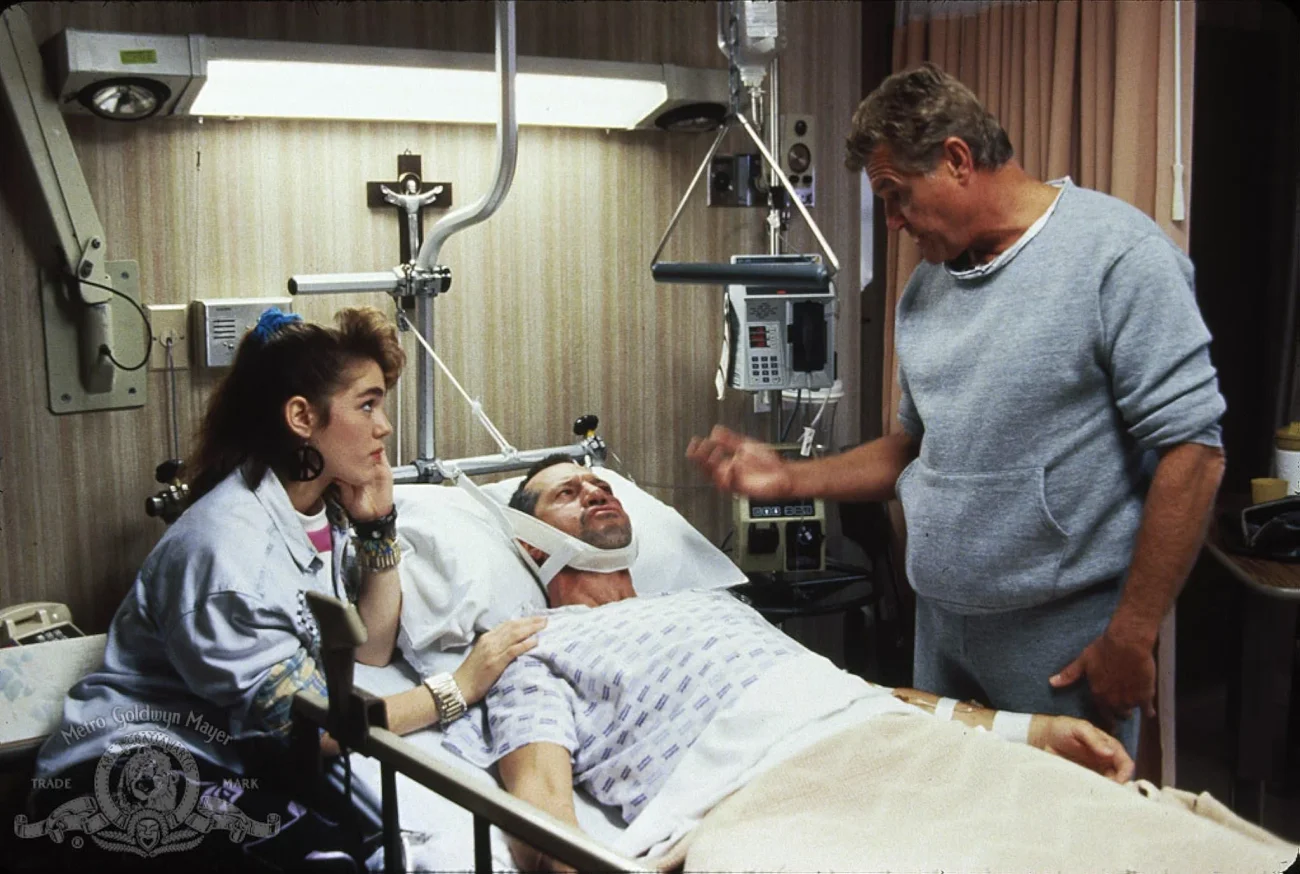
Miami Blues (1990)
 Jay Wilde
The Hook
Junior is freshly out of prison and headed for Miami. Within minutes of stepping off the plane, he's stolen a stranger's luggage and accidentally killed a Hare Krishna. That's not a slow start, that's a mission statement. George Armitage's Miami Blues announces itself as a film where charm and violence live in the same breath, and neither one apologizes for the other.
There's a shot in the trailer of Junior, fresh off the plane, grinning as he hefts a stolen suitcase, his eyes wild and unapologetic. You know immediately this isn't a man who's learned his lesson in prison, he's a man who's been bored, and now he's hungry. That grin stays with you through the whole film, even when the violence starts, because Alec Baldwin makes you want to see what he'll do next, even when you know you shouldn't.
The trailer cuts between Junior's chaotic first hours, Susie's bright smile as she talks about her community college classes, and Moseley's tired face as he stares at a crime scene photo. The music is a mix of brassy jazz and pulsing synth, setting up a Miami that's equal parts sunny paradise and neon-soaked danger. You see Junior impersonating a cop, flashing a stolen badge, you see Susie testing him with that vinegar pie, and you see Moseley putting the pieces together, all while the voiceover promises a crime caper that's not afraid to get its hands dirty. It moves fast, never lingering too long on any one moment, just like Junior himself.
Adapted from Charles Willeford's 1984 novel, the film follows Frederick J. Frenger Jr. (Alec Baldwin), a sociopath who describes himself as a thief who steals from other thieves. He hooks up with Susie Waggoner (Jennifer Jason Leigh), a naive part-time prostitute and community college student, and together they settle into a domestic life she imagines as paradise and he uses as cover. Meanwhile, Sergeant Hoke Moseley (Fred Ward), a grizzled, denture-wearing Miami cop, starts connecting the dots on a Hare Krishna murder that leads straight to Junior's door.
Alec Baldwin was coming off The Hunt for Red October when he auditioned, and his energy was exactly what Armitage wanted, a mix of charm and menace that made you root for a man you know you shouldn't. Jonathan Demme, who produced, brought the same sharp character focus that made Married to the Mob a hit, ensuring every performance felt lived-in, not acted. The film almost didn't happen when Gene Hackman dropped out as Moseley, but Fred Ward stepped in, bringing a weary authenticity that made the grizzled cop feel like a man who'd seen too much Miami to be surprised by anything Junior does. It's a production story that feels as twisted as the film itself, and it shows in every frame.
The Movie
Miami Blues works because it refuses to moralize, a rarity in neo-noir where every crime story feels the need to lecture you on the cost of violence. Armitage lets Junior be as charming as he is dangerous, never once asking the audience to condemn him, which makes the film's darkness land harder because you're complicit in enjoying his chaos. It's a bold choice, one that separates the film from its peers, because most directors would have sanded down Junior's edges to make him a more palatable antihero. Baldwin's performance leans into that edge, never once playing for sympathy, which makes the film's argument clear: some people are just broken, and no amount of domestic bliss with Susie is going to fix Junior. The film understands that charisma can be more dangerous than malice, because we forgive charm what we would never forgive in a villain.
The film's real genius is in its supporting performances, which ground the absurdity without ever feeling like they're fighting against the tone. Ward's Moseley is a masterclass in restrained weariness, a cop who's seen enough Miami to know that Junior isn't the worst thing he's encountered, just the most entertaining. Ward plays him with a lack of heroism that feels radical, there's no grand speech about justice, no moment where he decides to take Junior down for the greater good. He just does his job, dentures in his pocket, mediocre meal cooling on the table, because that's what you do in Miami when the sun's too hot to care. The chemistry between Ward and Baldwin crackles with mutual recognition, two men who operate by their own codes and respect each other despite themselves.
Leigh's Susie is another standout, a character who could have been a cliché, the naive woman who falls for the wrong man, but instead feels like a real person who wants to believe in a version of Junior that doesn't exist. Leigh plays her hope as a choice, not a weakness, which makes her complicity in Junior's crimes feel tragic rather than stupid. The film doesn't mock her for staying with Junior, it just shows you why she does it, and that empathy is rare in crime films where female characters are often just props for the male lead's journey. Her performance adds a layer of melancholy to the film's humor, reminding us that people get hurt in Junior's wake.
Armitage's direction leans into the film's contradictions, never smoothing over the tonal whiplashes that give the film its jagged, unpredictable edge. He lets scenes breathe, even when they don't move the plot forward, because he's more interested in the characters than the crime. The Miami he shoots isn't the postcard version, it's gritty and lived-in, the kind of place where a man can impersonate a cop for weeks without anyone looking too closely at his badge. That sense of place is what makes the film's narrative feel earned, even when it moves quickly, because you've spent enough time in this Miami to know that nothing here lingers longer than it has to.
What separates Miami Blues from the neo-noir pack is its lack of pretension. It doesn't try to be a great American crime drama, it just wants to be a sharp, funny, nasty little film about two men who are more similar than they'd like to admit. Junior steals from thieves, Moseley cuts corners as a cop, and neither one is really a conventional hero of the story. That moral ambiguity is what makes the film stick with you, long after the credits roll, because it doesn't give you an easy answer about who to root for. You end up rooting for both, and neither, and that's a trick few films pull off without feeling muddled. The film's willingness to let its characters be flawed without judging them is what gives it lasting power.
The film also benefits from its source material, Willeford's novel is a lean, mean piece of writing that doesn't waste a word, and Armitage's adaptation keeps that economy. He cuts the subplots that would have slowed the film down, keeps the focus on the three leads, and lets their dynamic carry the runtime. It's a writer's film as much as it is a director's, and that balance is why the dialogue lands so sharply, every line feels like it was written by someone who knows how people actually talk when they're lying to each other. Willeford's dark humor translates perfectly to the screen through Armitage's careful adaptation.
Cinematographer Tak Fujimoto adds another layer, his use of natural light makes every scene feel unpolished, like you're watching a documentary of Miami's underbelly rather than a Hollywood production. There's a roughness to the framing, a willingness to let shots be a little off-kilter, that matches Junior's own unpredictability. You never feel like the camera is showing you something pretty, it's showing you something real, even when the action is absurd. That visual honesty is what makes the film's violence land, it doesn't glamorize it, it just shows it, and lets you react. Fujimoto's background in independent cinema brought an authenticity to the production that big-budget lighting could never achieve. His naturalistic approach grounds the absurdity in a visual reality that makes Junior's violence feel unpleasantly genuine.
Gary Chang's score is another unsung hero, it never tries to tell you how to feel, which is rare for a dark comedy. The music slides between jaunty jazz and tense synth, matching the picture's tonal shifts without ever feeling like it's forcing you to laugh or flinch. It's a subtle score, one that stays in the background until it needs to spike, and that restraint is what makes the bigger moments land harder. Chang's background in both orchestral and electronic composition allows him to shift gears rapidly without jarring the audience.
The narrative moves at a brisk pace, fast enough to keep you engaged yet slow enough to let the characters breathe. Armitage doesn't rush the domestic scenes between Junior and Susie, he lets their relationship develop in small moments, a shared meal, a conversation about community college, a pie that tastes like vinegar. Those moments are what make Miami Blues' later turns hit harder, because you've seen the version of life they were building, even if you knew it was a house of cards. That's the mark of a good film, when the small moments stick with you as much as the big ones.
The People
This is Alec Baldwin's first leading role, and it's still one of his best. He plays Junior with a radioactive charisma that makes you root for him even when he's doing unforgivable things. There's a looseness to his performance, a danger that Baldwin would later sand down into something more polished. Here he's feral, funny, and unpredictable. His impersonation of a cop, using a badge and gun he stole from Moseley, is the film's centerpiece sequence of dark comedy. Junior breaks up crimes only to keep the loot for himself. It's absurd, it's entertaining, and Baldwin makes it feel completely plausible. Baldwin spent weeks riding with Miami police officers to prepare, observing how real detectives carry themselves.
Baldwin was 32 when he auditioned, coming off Beetlejuice and The Hunt for Red October. Armitage said in a 2015 interview: "Alec knocked us out, so I said, 'Fred, what do you think?' He said, 'He's Junior. I'll be Hoke.'" Baldwin's energy was exactly what Armitage wanted, a mix of charm and menace that made you root for a man you know you shouldn't. He and Armitage disagreed on set about how broad to play Junior, with Armitage wanting to rein him in, but Baldwin's energy won out, resulting in a performance that's unforgettable even when it's uncomfortable.
Fred Ward is equally perfect as Moseley. The role could have been a cliché, the weary detective one last case away from retirement. Instead, Ward plays him as genuinely tired, missing his dentures, cooking himself mediocre meals, sharing a dinner with Junior and Susie while knowing full well the man across the table is a killer. Ward had a gift for playing competence without flash, and his Moseley is the anchor the film needs to keep its chaos grounded. Ward was originally set to play Junior, but when Gene Hackman dropped out of the Hoke role, Ward agreed to switch, a decision he later called one of his best career moves. He said in a 1990 interview: "Moseley is a guy who knows the system is broken, he just doesn't care enough to fix it. He's not a hero, he's just a guy with a job." Ward brought his own dentures to set, insisting the prop ones looked too new for a man who had been on the force for decades.
Jennifer Jason Leigh brings something to Susie that the script alone doesn't provide. She's not naive in a dumb way she's naive in a hopeful way, which is worse, because hope makes her complicit. When she tests Junior by ruining a pie with vinegar and he eats it with gusto, you see her heart break in real time. It's a small scene, almost throwaway, and Leigh makes it devastating. Leigh spent weeks in Miami before filming, talking to sex workers to understand Susie's mindset. She said in a 1991 interview: "Susie isn't stupid, she's hopeful. That's a harder thing to play, because hope makes you do things you know you shouldn't." Leigh improvised several of Susie's reactions during the dinner scene, including the moment she realizes Junior has killed again.
The dinner scene where Moseley, Junior, and Susie sit together eating while Moseley is actively investigating Junior for murder is pure cinematic gold. Ward's Moseley never breaks character once he realizes who sits across from him. He just keeps chewing, keeps listening, playing the perfect host while mentally cataloging evidence. Armitage confirmed the scene was shot in a single take, with Ward never breaking character, a choice that made the tension unbearable to watch.
What separates Miami Blues from typical neo-noirs of its era is its complete refusal to moralize or pretend to have something profound to say about American violence. This film just wants to watch two people destroy each other in real time with a gleeful abandon that feels cartoonish without losing its edge.
On-set dynamics were relaxed despite the dark material, thanks to Armitage's low-key direction. Rain delays were frequent, and the cast would play cards in Ward's trailer, with Baldwin entertaining everyone with impressions of the crew. Armitage recalled Baldwin doing a five-minute impression of cinematographer Tak Fujimoto that left everyone in stitches. These moments of levity on set translated to the screen, making the relationship between the three leads feel lived-in rather than acted.
Fred Ward also served as an executive producer, giving him more input into Moseley's characterization. He pushed to make Moseley less of a hero, more of a weary observer, a choice that made the film's narrative feel earned rather than forced. Ward said in a 2020 interview that Moseley was one of his favorite roles, precisely because he got to be the straight man to Baldwin's wild energy.
Jennifer Jason Leigh won the New York Film Critics Circle Award and the Boston Society of Film Critics Award for Best Supporting Actress for her work in Miami Blues and Last Exit to Brooklyn in 1990. She said in a 2019 retrospective that Susie was a turning point for her career, proving she could play complex, unglamorous women without leaning on clichés. That acclaim was well-deserved, as her performance anchors the film's emotional core, making you care about a woman you know is making all the wrong choices.
Alec Baldwin said in a 2015 interview that Junior was the most fun he'd ever had playing a villain, because there was no redemption arc, just pure chaos. He added that he initially pushed to play the role broader, but Armitage's direction kept him grounded enough to make Junior feel dangerous rather than cartoonish. That balance is why the performance has stuck with audiences for decades, even if the film itself remains under the radar.
Armitage later said that Baldwin's performance was so good that he almost didn't want to kill Junior off, but the story demanded it. He added that the tension between Baldwin and Ward was real, as both actors fought for screen time, but that made their scenes together electric, a dynamic that translated perfectly to the final film. This real-life tension is exactly what makes the film's narrative feel cohesive, even when the pace picks up.
The Craft
Cinematographer Tak Fujimoto, a frequent collaborator with Jonathan Demme, shot Miami Blues on 35mm film using ARRI cameras, framing the film in a 1.85:1 aspect ratio that emphasizes the wide, sun-drenched streets of Miami. Principal photography began on September 28, 1988, and lasted nine weeks, with frequent rain delays that forced the cast and crew to wait out storms because the sound of rain on the roof was too loud to record dialogue. Fujimoto's work balances the film's tonal shifts between neon-soaked noir and bright, absurd comedy, using natural Miami light to make the violence feel startlingly grounded. He favored hand-held cameras for action sequences, giving them a documentary-style urgency, and steady cams for domestic scenes, making the quiet moments feel intimate and unpolished, a choice that made the film feel more real than stylized.
Editor Craig McKay, who had previously cut The Silence of the Lambs for Demme, paced the film to lean into its dark comedy. The dinner scene where Moseley shares a meal with Junior and Susie, aware he is sitting across from a murderer, was shot in a single take, and McKay preserved the unbearable tension of Ward's performance without cutting away. The edit avoids over-explaining the film's tonal whiplashes, letting the audience sit with the discomfort of laughing at Junior's crimes one moment and flinching at his violence the next. McKay cut 10 minutes of footage from Armitage's initial edit, removing subplots involving the Hare Krishna community that slowed the film's pace, a decision that sharpened the film's focus and kept the tension consistent.
Composer Gary Chang delivered a score that blends electronic textures with acoustic instruments, matching the film's mix of 1990s slickness and 1980s noir grit. Chang, known for merging computer technology with traditional orchestration, uses synth pads to underline Junior's detached sociopathy and warmer guitar and percussion for the domestic scenes between Junior and Susie, making their relationship feel deceptively sweet before the rug is pulled out. He recorded a 30-piece orchestra for dramatic moments and used distorted synth bass lines for Junior's scenes, creating a sound that was catchy but unsettling, much like the character himself. The score never overpowers the dialogue, leaving space for the cast's sharp performances to land.
Production design leans into the lived-in grit of late 1980s Miami: Junior and Susie's pastel-colored bungalow feels like a real rental, cluttered with thrift store finds, while Moseley's rundown apartment, complete with a denture-soaking cup on the nightstand, grounds Ward's weary performance. The film uses actual Miami locations rather than soundstages, from the airport where Junior steals luggage to the convenience store where he breaks up a robbery, making the city feel like a character as amoral as Junior himself. The police station was a real Miami precinct, which added authenticity to Ward's performance as a cop who knows the system inside out.
Practical effects were prioritized over early CGI, which was still in its infancy in 1988. The scene where Junior has his fingers chopped off was done with prosthetics and practical blood, with the actor playing the bodyguard swinging a real prop axe. The gunshot that ends Junior's story was filmed with a blank, and Baldwin fell backward into a stunt mat, with the take being so good that Armitage used it in the final edit without reshoots. Costume design matched the characters' personalities: Junior wore bright, Miami-style suits to emphasize his charisma, Moseley wore drab, worn clothing to highlight his weariness, and Susie's thrift-store finds reflected her limited budget and naive hopefulness. The props department sourced real stolen merchandise from Miami pawn shops to dress Junior's apartment, adding a layer of authenticity that CGI could never replicate.
The Trivia
-
Gene Hackman was originally cast as Sgt. Hoke Moseley, with Fred Ward set to play Junior. Hackman dropped out of the project, and Alec Baldwin auditioned for Junior, impressing both Armitage and Ward enough that Ward agreed to switch to the role of Hoke.
-
Alec Baldwin's role in Miami Blues was his first leading film role. He entertained the crew on set with spot-on impressions of cinematographer Tak Fujimoto, the electrical department, and director George Armitage, once doing a five-minute impression of Fujimoto that left the cast and crew awestruck.
-
Preview audiences in New Jersey rioted when Junior was killed in the film's ending. Armitage had intended for the audience to feel guilty about enjoying Junior's chaos, but the crowd was so attached to Baldwin's performance that they reacted with outrage to his death.
-
Jennifer Jason Leigh won the New York Film Critics Circle Award and the Boston Society of Film Critics Award for Best Supporting Actress for her work in Miami Blues and Last Exit to Brooklyn in 1990.- The film was delayed by Orion Pictures to capitalize on Baldwin's success in The Hunt for Red October, which was released two months before Miami Blues. The studio's release strategy backfired as the film opened in a crowded marketplace, failing to connect with audiences despite strong reviews for Baldwin's lead performance.
-
The original novel by Charles Willeford includes a plot point where the Hare Krishna Junior kills in the opening sequence is Susie's brother. Armitage cut this thread for economy, noting that explaining the relationship took 10 to 15 pages in the book and felt too serendipitous for the film.
-
Principal photography lasted nine weeks in Miami, starting on September 28, 1988. Rain frequently delayed shooting because the sound of rain on the roof was too loud to record usable dialogue, forcing the crew to wait out storms.
-
Miami Blues was the first producing credit for Gary Goetzman, who later co-founded Playtone with Tom Hanks and produced films like Cast Away and My Big Fat Greek Wedding. Goetzman credited the film with teaching him how to navigate the complexities of independent producing.
-
The haiku Junior recites while breaking into an apartment ("Breaking, entering. The dark and lonely places. Finding a big gun.") was written for the film and does not appear in Willeford's original novel.
-
Fred Ward served as an executive producer on the film, in addition to starring as Sgt. Hoke Moseley. He optioned the novel after reading it, then brought it to Jonathan Demme and George Armitage.
-
The dinner scene where Moseley dines with Junior and Susie, while actively investigating Junior for murder, was shot in a single take. Armitage wanted the scene to feel unbearably tense, with Ward never breaking character as he mentally catalogs evidence against Junior while sharing a meal.
-
The film was shot on 35mm film using ARRI cameras, with a 1.85:1 aspect ratio. It was one of the last films shot in Miami before the city's 1990s boom changed the skyline significantly.
The Verdict
Miami Blues is a nasty, funny, sun-baked piece of neo-noir that deserves far more attention than it gets. Baldwin and Ward are both operating at peak level, the Charles Willeford source material gives the film a literary backbone that most crime comedies lack, and Jonathan Demme's producing touch keeps everything grounded in character even when the plot veers into the absurd. Armitage, who would later direct Grosse Pointe Blank, shows the same ear for dark comedy and the same willingness to let his characters be genuinely dangerous. The film's refusal to moralize sets it apart from its contemporaries, making it feel fresher today than many of its better-known peers.
It's the kind of film that fell through the cracks on release, sandwiched between Baldwin's The Hunt for Red October and the general noise of 1990's crowded film calendar. It slipped through the cracks of 1990's crowded release calendar, which wasn't enough to make anyone at Orion Pictures do a victory lap. But thirty-six years later, it holds up as one of the smartest, dirtiest little crime films of its decade. The film's influence can be seen in later dark comedies that embraced unlikeable protagonists without asking the audience to forgive them.
What makes Miami Blues worth watching is that rare quality where every performance lands perfectly and no scene feels wasted. Baldwin's Junior is exactly the kind of character you'd want to meet at a bar but definitely don't want on your bad side the charisma works because Baldwin never lets him become charming in any traditional sense. Ward's Moseley grounds everything without ever becoming the stoic hero the script doesn't need. Jennifer Jason Leigh's Susie adds an emotional weight that makes the film's resolution land with genuine sadness rather than cheap irony.
The film has quotable lines that stick with you because they capture how these characters see themselves rather than how the world sees them. If Miami Blues had been released five years later, it might have become a cult classic alongside films like Fargo and Pulp Fiction. It remains this slightly forgotten gem that fans of smart crime comedies should seek out.
"Susie's gonna get you, Sarge."