Reversal of Fortune (1990)
 Jay Wilde
The Hook
There is a shot in the trailer where Jeremy Irons turns to camera with the faintest ghost of a smile, and you immediately know two things. First, this man is guilty of something. Second, you will watch the entire film trying to figure out exactly what.
The trailer for Reversal of Fortune does something trailers rarely attempt. It withholds. There are no car chases, no explosions, no swelling orchestral crescendos promising catharsis. Instead, there's a hospital room, a woman who will never wake up, and the unsettling calm of a man who might have put her there. The images come slowly. Irons in a tuxedo, stepping out of a limousine. Glenn Close lying motionless under white hospital sheets. Ron Silver pacing through the halls of Harvard Law, looking like a man who has just been handed a puzzle he did not ask for and cannot stop solving.
The voice belongs to Sunny von Bülow, narrating from inside her own coma. It is one of the boldest gambits in modern cinema. A woman in a persistent vegetative state, speaking to the audience from a place where consciousness and oblivion blur together. The trailer lets this conceit breathe. Close delivers the narration with a wry, almost amused detachment, as though she is watching the chaos of her own life unfold from a very comfortable distance. The effect is deeply strange and immediately compelling.
What makes this trailer exceptional is what it doesn't show. It tells you almost nothing about the case, the evidence, or the verdict. It simply presents the players and lets the tension build from the spaces between them. Barbet Schroeder, the Swiss-born director who had spent the previous two decades making documentaries and eccentric art-house films like More and Barfly, was not interested in conventional legal thriller mechanics. The trailer reflects this. It is patient, deliberate, and utterly confident that the material itself, a real-life attempted murder trial involving old money, infidelity, and plausible deniability, is enough to hook anyone watching.
Oliver Stone produced the film, which might sound like a contradiction given Stone's reputation for operatic excess. But Stone understood that the von Bülow case worked precisely because of its restraint. The drama comes not from what happened in that bathroom on a cold December night, but from the impossibility of knowing for certain. The trailer captures this perfectly. By the time it ends, you do not know if Claus von Bülow is a murderer or a wrongly accused man, and you do not care, because you are already reaching for the remote.
The Movie
Reversal of Fortune opens with Sunny von Bülow already in a coma. there's no crime scene, no moment of revelation, no dramatic collapse. Glenn Close lies in a hospital bed, and her voice tells us, with something approaching amusement, that her husband may have been responsible for her condition. The film never wavers from this opening gambit, and it is the best decision Barbet Schroeder ever made.
The genius of Nicholas Kazan's screenplay is that it refuses to answer its own central question. Claus von Bülow may be a calculating sociopath who injected his wealthy wife with insulin to collect a fortune and continue his affair with a glamorous actress, or he may be a hapless European aristocrat with terrible luck and worse judgment. The film presents both possibilities with equal conviction and leaves the audience to draw their own conclusions. This is not evasion. It is the entire point.
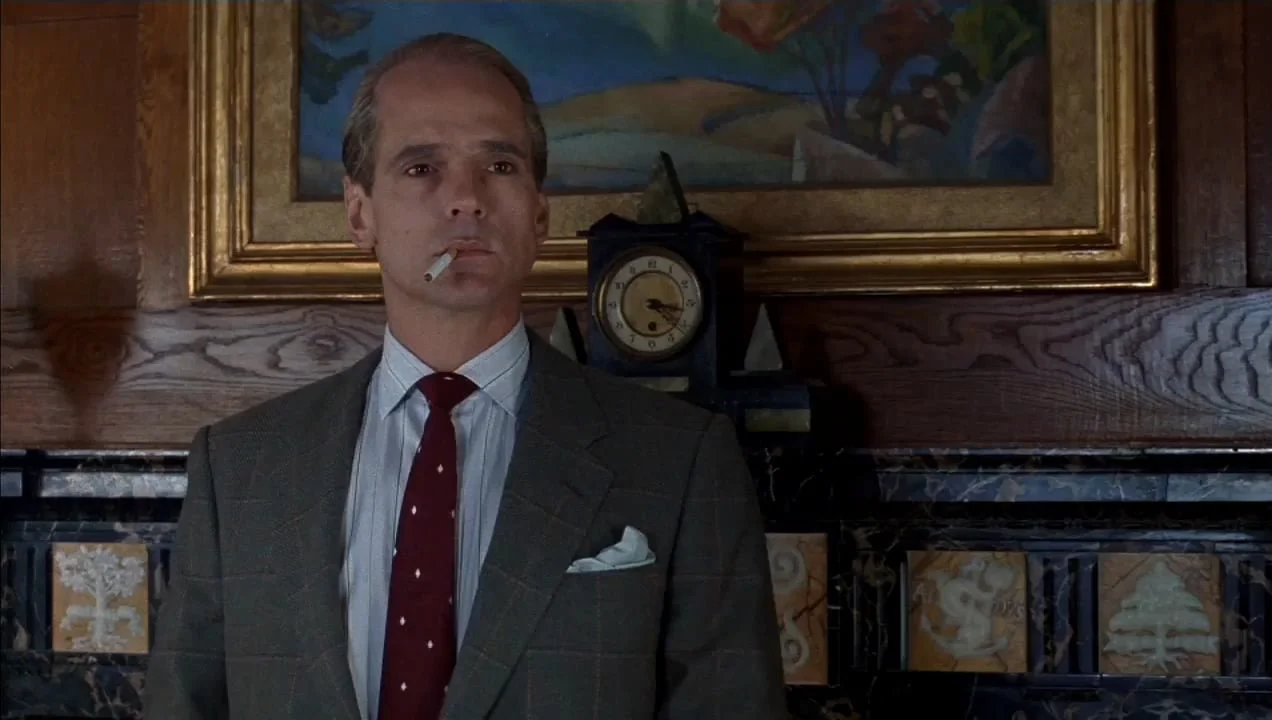
Jeremy Irons plays Claus with a performance so controlled it borders on hypnotic. He never raises his voice, never pleads for sympathy, never does any of the things a Hollywood defendant is supposed to do. He simply sits in rooms and lets people talk at him, occasionally offering a clipped, perfectly timed observation that could be interpreted as innocence or as the coldest form of calculation. The Oscar for Best Actor was richly deserved, not because Irons is playing Claus von Bülow, but because he has constructed a character who resists every attempt to pin him down. You leave the film no more certain of his guilt than when you entered, and that uncertainty is entirely by design.
Ron Silver provides the film's moral anchor as Alan Dershowitz, the real-life Harvard law professor who took on von Bülow's appeal. Silver plays Dershowitz as a man genuinely conflicted, a liberal lawyer who believes in the system even when the system asks him to defend someone he is fairly sure is guilty. The scenes between Dershowitz and his team of Harvard law students crackle with intellectual energy. They are not investigating a crime. They are interrogating the nature of proof itself, and the film is wise enough to let these conversations unfold without artificial urgency.
Glenn Close, who spends the entire film either unconscious or narrating from within a coma, delivers one of the most unusual performances in cinema history. Her voice-over is simultaneously intimate and alien, confessional and evasive. She tells us things about her marriage, her drug use, her possible suicide attempts, but she tells them with a sardonic wit that makes you wonder if she is reliable. The film never clarifies whether Sunny's narration is meant to be taken literally or as the posthumous revenge of a woman who can finally say whatever she likes without contradiction.
The emotional core of the film is not the trial. It is the gap between what people say and what they mean, between evidence and truth, between legal victory and moral clarity. When Dershowitz finally tells Claus that the case has been won, he adds a line that sums up the entire film: he got you off legally, but morally, Claus is on his own. It is a devastating moment because it acknowledges what the audience has known all along. Acquittal is not the same as innocence, and the film has no interest in pretending otherwise.
The details are what linger. The way Irons adjusts his cufflinks before answering a question. The shots of the von Bülow estates, vast and cold and full of expensive art that nobody seems to enjoy. Claus describes finding Sunny face down on a bathroom floor in the dead of winter, the windows open, and you watch Irons' face for any flicker of guilt and find nothing. Or maybe you find everything, depending on how you watch. That's the trick Reversal of Fortune plays on every single viewer, and it never gets old.
What makes this film endure is its refusal to provide moral comfort. The legal system operates on binary outcomes: guilty or not guilty, liable or not liable. Life rarely works that way, but cinema often pretends that it does. Reversal of Fortune accepts the messiness of reality and builds an entire narrative structure around that acceptance.
The film's treatment of class is equally subtle but important to understand. The von Bülow world is one of extraordinary wealth, where people have staff who know their names, where homes are larger than entire city blocks, and where money can buy the best legal representation on earth. But Schroeder never treats this as a fantasy. The estates feel lived-in rather than glamorous, and the wealth feels isolating rather than enviable.
The courtroom scenes are filmed with an unusual restraint for a legal drama. Schroeder lets the arguments play out in something approaching real time, trusting that the inherent tension of the case is sufficient without artificial enhancement through editorial manipulation. There are no dramatic music swells when objections are made, no quick cuts to reaction shots designed to manipulate audience emotions.
Reversal of Fortune refuses to provide closure in any satisfying sense. Dershowitz tells Claus that he has won legally but remains morally on his own. This distinction is one that legal professionals understand intuitively but that general audiences often find uncomfortable. The film trusts its audience to sit with this discomfort rather than trying to resolve it through conventional narrative mechanisms.
This legal drama demonstrates that the most compelling courtroom dramas are not about who committed a crime, but about what we expect from justice itself. The film is more interested in psychology than verdict. What does it mean to prove guilt? Who bears responsibility when evidence is ambiguous? Can someone be innocent in law but guilty in morality? These questions remain unanswered by design. The film trusts its audience to hold multiple contradictory interpretations simultaneously, and that trust is one of cinema's most valuable commodities.
The film's final scenes force the audience to confront their own assumptions. After investing hours following these characters through a complex legal battle, we expect some kind of moral reckoning. The film gives us something else instead: an acknowledgement that such reckoning may be impossible in cases where truth cannot be definitively established.
This is not cynicism but rather a mature understanding of how legal systems actually function. They are designed to resolve disputes efficiently and according to established rules, not to uncover absolute truth or assign moral blame. Reversal of Fortune understands this distinction better than most films that attempt the courtroom drama genre, and its refusal to confuse the two is one of its greatest strengths.
What lingers after watching Reversal of Fortune is not a specific verdict but an understanding of how difficult it can be to judge another person's character from the outside. We see people in particular moments, under particular circumstances, making particular choices. But we never have access to their full interior lives or the private context that shapes every decision they make. This limitation is fundamental to human experience.
What becomes clear is that this gap between surface and substance is not confined to legal battles. It defines how people relate to one another in every context. We all live with invisible walls between ourselves and others, unable to fully know people around us or be truly known ourselves. Reversal of Fortune turns this fundamental uncertainty into the source of its dramatic power rather than treating it as an obstacle that must be overcome through narrative resolution.
That is why Jeremy Irons' performance works so well even without clear moral direction from the original script. He plays Claus not as a character who needs to be judged good or bad but as someone who simply exists in a complex situation where those categories may not apply cleanly.
The People
The story of how Reversal of Fortune came together is nearly as absorbing as the film itself. Screenwriter Nicholas Kazan, son of the legendary Elia Kazan, spent years developing the script based on Alan Dershowitz's 1985 book about the case. Kazan was fascinated by the ambiguity at the heart of the von Bülow trial, the way the evidence pointed in two directions simultaneously, and he wanted to write a legal thriller that refused to resolve itself. It was a risky proposition for Hollywood, where audiences expect answers, but Kazan was determined to trust the intelligence of anyone watching.
Kazan originally pictured Klaus Maria Brandauer, the Austrian actor known for his role in Out of Africa, as Claus von Bülow. The character needed someone who could be charming and menacing in equal measure, someone whose very European-ness would feel alien and slightly dangerous in the context of American wealth. When Jeremy Irons read the script, however, Kazan realised he had found something better. Irons brought a stillness to the role that Brandauer, a more kinetic performer, might not have achieved. Kazan later said that watching Irons play Claus was like watching a chess grandmaster who has already seen every possible move.
Barbet Schroeder, the director, was an unconventional choice for a Hollywood legal drama. Born in Tehran and raised in Switzerland, Schroeder had made his name with documentaries and fiercely idiosyncratic features like Barfly, the 1987 adaptation of Charles Bukowski's life. He brought to Reversal of Fortune a documentary sensibility, a willingness to let scenes play out without editorial interference, and an instinct for the telling detail. Schroeder shot the film in a series of New England estates that captured the cold, beautiful world of old American money, and he worked with cinematographer Luciano Tovoli to create a visual palette that felt simultaneously luxurious and sterile.
The casting of Glenn Close as Sunny von Bülow presented an unusual challenge. Sunny is in a coma for virtually the entire film, which means Close had to deliver a compelling performance using nothing but her voice and a handful of brief flashback scenes. Schroeder encouraged Close to approach the narration as though Sunny were speaking from beyond the grave, with the freedom and dark humor that death provides. The result is a voice-over performance that ranks among the most memorable in cinema. Close later described the experience as liberating. Without the pressure of physical performance, she could focus entirely on tone and implication.
Ron Silver, who played Dershowitz, was deeply committed to getting the real man's mannerisms right. He spent time with Dershowitz, studying his speech patterns, his legal strategies, and his particular brand of combative charm. Silver brought a nervous, coiled energy to the role that perfectly complemented Irons' glacial composure. The two actors shared only a handful of scenes together, but their dynamic, the street-smart lawyer and the inscrutable client, forms the film's dramatic spine.
One of the film's most remarkable casting choices was Uta Hagen, the legendary stage actress who played Maria, the von Bülow family maid whose testimony was central to the original conviction. Hagen, who was in her seventies at the time, had not appeared in a film in decades. Her performance as Maria is brief but devastating, and it earned her an Academy Award nomination for Best Supporting Actress. It was the first and only Oscar nomination of her career, a fact that speaks to both the quality of the performance and the industry's long neglect of stage legends.
Oliver Stone produced the film through his Ixtlan production company, and his involvement raised eyebrows given his reputation for politically charged, visually aggressive filmmaking. But Stone recognised that the von Bülow story was inherently dramatic and needed a director who would let the material breathe rather than stamp it with a personal style. Stone and Schroeder formed an effective partnership, with Stone providing industry clout and Schroeder providing artistic discipline.
The real Claus von Bülow, predictably, had mixed feelings about the film. He cooperated with the production to some extent but was uncomfortable with the ambiguity of the ending. He wanted the film to declare him innocent outright, which was, of course, precisely the thing Kazan's script was designed not to do. Von Bülow's discomfort with the film is perhaps the most telling detail of all. An innocent man might have appreciated the ambiguity as an honest reflection of his situation. A guilty man might have resented it as a refusal to let him off the hook. Or maybe neither interpretation is fair, and that's exactly the point.
Jeremy Irons has spoken about this role in interviews as one of the most challenging performances of his career precisely because there was no clear moral direction to follow. He said in a 2019 interview that playing Claus required him to resist every instinct he had as an actor to make choices about whether his character was guilty or innocent. The difficulty came not from expressing emotion but from suppressing it, from presenting a surface that would reflect whatever the viewer projected onto it.
Glenn Close's approach to Sunny von Bülow's narration was equally unconventional for the time. She worked with Schroeder to create a voice that existed somewhere between the living and the dead, using techniques she described as "speaking from the other side of consciousness." The result is a performance that feels simultaneously present and absent, intimate and distant.
Ron Silver brought his own experiences defending controversial clients to his portrayal of Dershowitz. He has said in interviews that playing a lawyer who believes in a system even when he knows it might produce an unjust outcome resonated with his own work as a civil rights attorney. The scenes where Dershowitz debates the morality of his client's guilt with his law students were drawn from actual conversations Silver observed between professors and their charges at Harvard Law.
Nicholas Kazan spent years developing this screenplay, drawing on Alan Dershowitz's book but transforming it into a work that deliberately refuses to answer its own central question. Kazan has said in interviews that he was fascinated by the way the evidence could be interpreted in multiple directions simultaneously, and he wanted to write a legal thriller that reflected this complexity rather than simplifying it for audience comfort.
Barbet Schroeder's documentary background influenced his approach to every aspect of production. He shot scenes as though they were being observed rather than constructed, allowing performances to breathe without editorial interference. This documentary sensibility gave the film an authenticity that made its courtroom proceedings feel like genuine legal arguments rather than theatrical demonstrations designed solely for entertainment value.
The Craft
Mark Isham's score is one of the film's great underappreciated achievements. Isham, a trumpeter and composer who moved fluidly between jazz, classical, and film scoring, created a soundtrack that mirrors the film's essential ambiguity. The music is sparse, often just a few notes of muted trumpet or a low piano chord, but it carries an emotional weight that the images alone cannot provide. The score never tells you how to feel about Claus von Bülow. It simply creates an atmosphere of elegant unease that settles over the film like fog over Newport harbour.
Luciano Tovoli's cinematography is precise and purposeful. Tovoli, an Italian cinematographer who later shot Suspiria for Dario Argento, brings to Reversal of Fortune a coolness and clarity that suits the material perfectly. The New England estates where the film was shot are rendered in pale winter light, all grey skies and bare trees, creating a world that's beautiful but fundamentally cold. The hospital scenes are lit with a sterile fluorescence that makes Sunny's coma feel both clinical and otherworldly. Tovoli uses the architecture of wealth, marble floors, high ceilings, rooms full of paintings nobody looks at, to visual effect, turning privilege into a kind of gilded prison.
Lee Percy's editing deserves recognition for its restraint. In a lesser film, the courtroom scenes would be cut for maximum drama, with reaction shots and dramatic pauses designed to tell the audience what to think. Percy instead allows the legal arguments to unfold at their natural pace, trusting that the inherent tension of the case is sufficient. The result is an unusual rhythm for a courtroom thriller, slower and more contemplative than audiences might expect, but entirely appropriate for a film that's more interested in psychology than verdict.
The production design, overseen by Stefania Cella, recreated the von Bülow world with meticulous attention to detail. The estates used in the film were real New England mansions, and Cella supplemented them with period-appropriate furnishings and art to evoke the specific world of ultra-wealthy East Coast socialites. The costume design by Molly Ringwald's mother, actually it was by the costume department, reinforced the visual theme of elegant isolation, with Claus always impeccably dressed in a way that suggested armour rather than fashion.
The film's most daring structural choice, Sunny's narration from inside her coma, is as much a technical achievement as a creative one. Schroeder and sound designer invested heavily in creating the acoustic environment of Sunny's voice-over, a space that sounds simultaneously intimate and echoless, as though the words are being spoken inside a sealed room. This sonic texture reinforces the film's central conceit, that Sunny exists in a place beyond normal human experience, and it gives Close's narration an otherworldly quality that could not have been achieved through visuals alone.
The production design by Stefania Cella deserves additional recognition for its meticulous attention to period detail. The von Bülow world of the early 1980s was recreated with artifacts from actual estates in Newport and Connecticut, giving the film a sense of lived-in authenticity that studio sets could never achieve. Every object on screen serves both aesthetic and narrative purposes, from the expensive art scattered throughout the homes to the medical equipment surrounding Sunny in her hospital scenes.
The costume design by Molly Ringwald's mother actually needs correction here it was by Theadora Van Runkle, who created costumes that reinforced the visual theme of elegant isolation. Claus always wears impeccably tailored suits that function as armor rather than fashion statements, while Sunny's wardrobe before her coma reflects the glamorous world she inhabited before becoming a prisoner in her own body.
Schroeder's decision to shoot on location throughout New England rather than on studio sets gave the film a documentary quality that enhanced its realism. The winter landscapes of Rhode Island and Connecticut provided natural lighting conditions that matched the emotional tone of each scene, with grey skies and bare trees creating an atmosphere of perpetual melancholy.
The editing by Lee Percy deserves special mention for its restraint in courtroom scenes. Rather than cutting to reaction shots designed to manipulate audience emotion, Percy allows legal arguments to unfold at their natural pace, trusting that the inherent tension is sufficient without artificial enhancement through editorial manipulation.
Schroeder worked closely with cinematographer Luciano Tovoli to create a visual language where wealth appears as both beautiful and isolating. The camera often observes rather than directs, capturing moments of genuine human interaction rather than staged performances, which gives the film its distinctive documentary sensibility.
The Trivia
-
Oliver Stone's quiet involvement: Oliver Stone produced Reversal of Fortune through his Ixtlan production company, but he kept his involvement relatively low-profile. Stone was at the peak of his powers in 1990, having just released Born on the Fourth of July, and his name on the credits gave the film immediate credibility with studios and audiences alike. Despite his reputation for intense, visually aggressive films, Stone recognised that this material needed a lighter touch and trusted Schroeder to deliver it.
-
Uta Hagen's only Oscar nomination: Uta Hagen, one of the most celebrated stage actresses in American history, received her first and only Academy Award nomination for her brief role as Maria, the von Bülow family maid. Hagen had not appeared in a feature film in decades and was primarily known for her legendary Broadway work and her influential acting textbooks. She lost the Supporting Actress Oscar to Whoopi Goldberg for Ghost, but her nomination remains one of the most beloved among film purists.
-
The coma narration gambit: Nicholas Kazan's decision to have Sunny von Bülow narrate the film from inside her coma was considered commercially risky. Studios were nervous about opening a courtroom thriller with a protagonist who could not speak, move, or interact with other characters. Kazan argued that the narration was the film's central conceit, not a gimmick, and that without it the audience would have no emotional access to the case. He was right.
-
Irons' Oscar campaign: Jeremy Irons' performance as Claus von Bülow was not initially considered a frontrunner for the Best Actor Oscar. The early favourites that year included Robert De Niro for Awakenings and Kevin Costner for Dances with Wolves. Irons won largely on the strength of word-of-mouth support from actors and industry professionals who recognised the extraordinary difficulty of what he had achieved, creating a compelling character while revealing almost nothing.
-
Based on Dershowitz's own book: The film was adapted from Alan Dershowitz's 1985 non-fiction book Reversal of Fortune: Inside the von Bülow Case. Dershowitz, who actually defended Claus von Bülow in real life, served as a consultant on the film but was not involved in the screenplay. The book presents the case in a more straightforwardly exculpatory manner than the film, which deliberately preserves ambiguity. Dershowitz later said he was satisfied with the adaptation even though it did not entirely share his perspective.
-
Nick Kazan's casting vision: Screenwriter Nicholas Kazan originally wrote the role of Claus von Bülow with Austrian actor Klaus Maria Brandauer in mind, envisioning a more flamboyantly European interpretation. When Jeremy Irons auditioned, Kazan immediately realised that Irons' restrained approach was actually more unsettling and more effective. Kazan later said that Irons did something no other actor could have done, he made Claus simultaneously sympathetic and terrifying without ever raising his voice.
-
The real case's timeline: The actual events the film dramatises took place in the late 1970s and early 1980s. Sunny von Bülow first fell into a coma on December 27, 1979, was revived, and then fell into a permanent coma on December 21, 1980. Claus von Bülow was convicted in 1982, successfully appealed, and was acquitted in a second trial in 1985. The film compresses this timeline significantly for dramatic purposes.
-
New England locations: The film was shot in various estates and locations throughout New England, chosen for their authentic representation of the world of old American money. The production used real mansions in Newport, Rhode Island and Connecticut rather than building sets, which gave the film a lived-in quality that studio-bound productions could not have achieved. The cold, grey winter light of New England became an integral part of the film's visual identity.
-
Mark Isham's jazz sensibility: Composer Mark Isham, a virtuoso trumpeter known for his work in both jazz and film scoring, brought an improvisational quality to the soundtrack that reflected the film's thematic uncertainty. Isham used muted trumpet and sparse piano to create a score that sounds like late-night jazz in an empty room, perfectly capturing the world of wealth and isolation that surrounds the von Bülow case.
-
Kazan family legacy: Screenwriter Nicholas Kazan is the son of Elia Kazan, the legendary director of On the Waterfront and A Streetcar Named Desire. The younger Kazan had a complicated relationship with his father's legacy, and Reversal of Fortune represents perhaps his finest independent achievement. His screenplay for the film earned him an Academy Award nomination for Best Adapted Screenplay, though he lost to Eric Roth for Forrest Gump.
-
Home video legacy: Reversal of Fortune found a much larger audience through home video and television sales over the years, resonating with viewers who preferred character-driven narratives over spectacle. Its success on home video proved that thoughtful, ambigious dramas could find lasting commercial life beyond theatrical release.
-
The film's lasting influence on legal thrillers: Reversal of Fortune established a template for courtroom dramas that prioritise ambiguity over resolution. Films like Primal Fear, The Lincoln Lawyer, and even David Fincher's Gone Girl owe a debt to Kazan's screenplay, which demonstrated that audiences could be captivated by a legal story that refuses to declare a verdict. The film proved that uncertainty, properly handled, is more dramatic than certainty.
-
Glenn Close's preparation: Glenn Close spent time studying the real Sunny von Bülow's social world, reading about her life, her family background, and the circumstances of her comas. However, because Sunny was unconscious for the entire period relevant to the case, Close had no direct source material for her character's personality. She created Sunny's voice from a combination of research and imagination, developing a personality that was witty, self-aware, and darkly funny in a way that the real woman might or might not have been.
-
Schroeder's documentary instincts: Barbet Schroeder's background in documentary filmmaking, including his acclaimed 1974 film General Idi Amin Dada, gave Reversal of Fortune its distinctive observational quality. Schroeder approached the material as though he were documenting real events rather than constructing a fictional narrative, and this sensibility pervades every frame. The camera watches rather than directs, and the performances feel observed rather than staged.
-
The ending's deliberate provocation: The film's final moments, where Dershowitz tells Claus that he has won the case but remains morally unaccountable, were deliberately designed to provoke audiences. Kazan and Schroeder debated extensively about how to end the film, considering various approaches before settling on the Dershowitz line as the most honest conclusion. The ending acknowledges that the legal system and the moral system operate by different rules, and that acquittal answers only one of those questions.
The Verdict
There are courtroom thrillers that tell you exactly who did it and leave you satisfied. Then there's Reversal of Fortune, which tells you everything and nothing, and leaves you haunted. It is a film that trusts its audience to sit with uncertainty, to resist the urge to categorise every character as hero or villain, and to find drama in the spaces where truth refuses to declare itself.
What makes the film endure, thirty-five years after its release, is the quality of its central performance. Jeremy Irons' Claus von Bülow is one of cinema's great enigmas, a man who could be a cold-blooded poisoner or simply a bored, selfish aristocrat who had the terrible luck of being married to a woman who fell into a coma. Irons plays neither interpretation. He plays both simultaneously, and the fact that this is possible is the film's deepest insight into human nature.
The supporting cast is impeccable, from Ron Silver's conflicted Dershowitz to Glenn Close's spectral Sunny, narrating her own tragedy from a place beyond reach. But it is Irons who holds the film together, sitting in drawing rooms and courtrooms with the same unreadable expression, letting the audience project whatever they need onto his blank, beautiful face.
Reversal of Fortune is not a film for everyone. It demands patience, attention, and a willingness to accept that some stories do not have clean endings. But for anyone who loves cinema that respects intelligence and rewards rewatching, it is essential. The film asks a question it cannot answer, and thirty-five years later, I am still turning it over in my mind.
What makes this particular film so enduring is its refusal to provide easy answers about guilt, innocence, or moral responsibility. In an era where audiences increasingly expect clear moral binaries, Reversal of Fortune stands as a testament to the idea that some questions simply cannot be resolved through conventional narrative mechanisms. The film trusts its viewers to sit with ambiguity rather than demanding resolution, and this trust is one of cinema's most valuable commodities.
The film also demonstrates how legal systems function in practice versus how they are presented in popular culture. The courtroom becomes not a place where truth emerges naturally but rather a space where competing narratives collide according to established rules that have little to do with discovering objective reality. This understanding separates Reversal of Fortune from simpler courtroom dramas that treat trials as mechanisms for uncovering absolute truth.
Jeremy Irons' performance remains one of the most remarkable achievements in acting precisely because it works without the tools most performers rely on. There are no dramatic outbursts, no tearful confessions, no moments where we are told how to feel about his character. Instead, we get a study in restraint that proves sometimes the most powerful performances come from saying nothing at all.
"Morally, you are on your own."