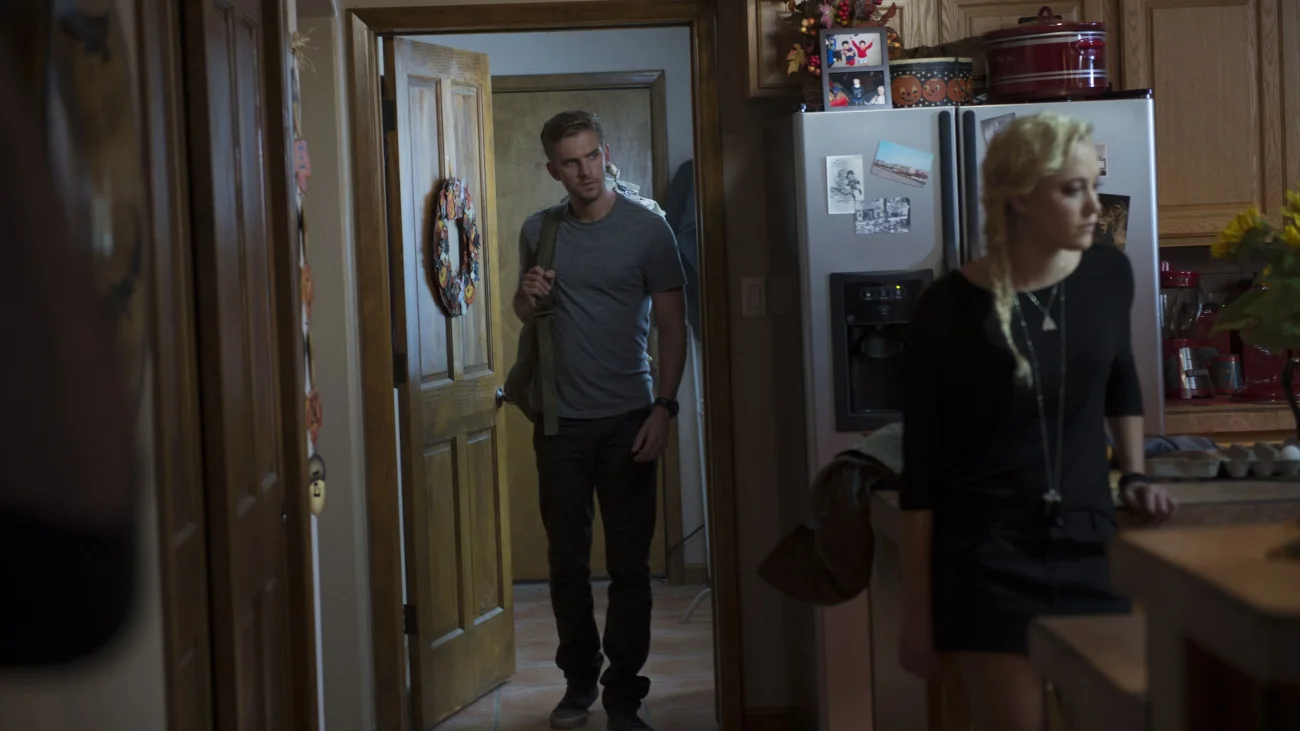
The Guest (2014)
 Jay Wilde
The Hook
There is a moment in the trailer where Dan Stevens looks directly into the camera with those impossibly blue eyes, smiles like a man who has never told a lie in his life, and says he is there to help. You believe him completely. that's the trick of the entire film, distilled into a single frame. The trailer for The Guest sells you a con, and you walk in already conned, already charmed, already doomed.
The images cascade with a confidence that feels almost cocky. A clean-cut man in a pressed shirt arrives at a suburban home. He shakes hands with a grieving mother. He plays with the younger son. He takes the daughter to a party where he is effortlessly cooler than everyone in the room. Then the trailer pivots. Guns appear. Bodies hit the floor. A haunted house flickers with strobe lights and synthwave and blood. The tone shifts from warm domestic thriller to something that feels like John Carpenter directing a James Cameron script after three glasses of whiskey. It is a gorgeous tonal whiplash, and it tells you exactly what kind of ride you are in for without spoiling a single surprise.
What makes the trailer exceptional is how it mirrors the film's own structural gambit. The Guest is, at its core, a wolf-in-sheep's-clothing story, and the marketing plays the same game. It shows you enough charm to get you hooked, then lets the violence creep in around the edges. By the time the trailer ends with Stevens walking through fire in silhouette, you are not entirely sure whether to root for him or run from him. That ambiguity is the whole point.
Simon Barrett wrote the script drawing on his own experience as a private investigator. "It really compartmentalized my life," Barrett has said of that period, "so I've become fascinated by characters that just have a weird interior thing going on." That fascination bleeds through every scene. David Collins is the ultimate compartmentalized man, a walking secret wearing the skin of a perfect houseguest. Barrett conceived the story as a "stranger comes to town" narrative in the tradition of High Plains Drifter, transplanting that Western menace into a contemporary New Mexico suburb. The result feels both classic and startlingly fresh.
Adam Wingard and Barrett had already collaborated on A Horrible Way to Die and the crowd-pleasing home-invasion horror film You're Next. With The Guest, they wanted to push into different territory, blending thriller mechanics with action movie energy and a dash of 1980s synthpop decadence. The film premiered at Sundance in January 2014, where it immediately generated the kind of word-of-mouth buzz that smaller films dream about. By the time it reached theaters that September, it had already earned its reputation as one of the most entertaining genre films of the year.
The Movie
The Guest is a film about a lie that seems better than the truth, and it understands that dynamic with a precision that borders on cruel. David Collins arrives at the Peterson household claiming to have served with their dead son Caleb in Afghanistan. He is polite. He is helpful. He fixes things. He listens to Laura, the mother, talk about her grief with the patience of a saint. He gives Spencer, the father, advice about his stalled career. He bonds with Luke, the teenage son, over bullying and identity. And he charms Anna, the daughter, with a quiet intensity that makes you lean forward in your seat. The Petersons have been drowning in loss, and David is the lifeline they did not know they needed.
What makes David so effective is that every thing he does serves a dual purpose. When he helps Spencer navigate office politics at the factory, he is building loyalty. When he fights the bullies who torment Luke at school, he is earning the boy trust while demonstrating the violence he is capable of. When he sits with Laura in the kitchen and lets her talk about Caleb, he is harvesting emotional intelligence that he will use to keep them compliant. None of this is presented as cynical or calculated. David does these things with a warmth that seems genuine, and that's precisely what makes him terrifying. You cannot tell where the kindness stops and the manipulation begins because there may not be a boundary at all.
The genius of its first half is that it lets you enjoy the con. Wingard shoots David's early scenes with a warmth that feels genuine. The household dinners, the backyard conversations, the awkward attempts to integrate this stranger into their routine, all of it plays like a well-observed domestic drama. You find yourself hoping David is who he says he is. You find yourself wanting the Petersons to have this one good thing. And then the bodies start piling up, and you realize that the warmth was a seduction, and you were just as gullible as the residents.
The pivot, when it comes, is electrifying. Anna makes a phone call to the military base asking about David, and the voice on the line tells her that the man staying in her house died a week ago. From that moment, the film becomes a pressure cooker. Major Carver and his tactical team arrive, and suddenly the Peterson home is a battlefield. Wingard stages the attack on the house with a brutal efficiency that recalls the best sequences from the original Terminator. David dispatches trained soldiers with a calm, mechanical precision that strips away any remaining illusion of his humanity. He is not a charming drifter who happens to be dangerous. He is a weapon that happens to be charming.
Dan Stevens delivers a performance that shouldn't work but absolutely does. Fresh off Downton Abbey, he could have easily played David as a charmless villain or a cartoonish psycho. Instead, he finds the humanity in the monster, making David genuinely likable even as the bodies pile up. His physical presence helps too. At six-foot-three, he looms over the Peterson family, but it's the small choices that unsettle. The way he maintains eye contact a beat too long. The stillness he carries into every room. Stevens makes you understand why the Petersons invite him in, and why you rooted for him too.
What separates The Guest from the long line of stranger-in-the-house thrillers is its refusal to moralize. Wingard doesn't position the Petersons as naive or foolish for trusting David. They are grieving, and David offers exactly what they need in the language they already speak. The film never mocks their vulnerability. It mourns it. There's a gentleness that makes the darker moments hit harder, because Wingard understands that the audience has to fall for David too. We are complicit in the family's trust. We watched him fix the kitchen sink and play catch with Luke and we thought, this is a good man. When David's true nature emerges, it feels personal. It is not happening to the Petersons. It is happening to us.
But The Guest is smarter than a simple monster movie. The real horror is not the violence. It is the way David has insinuated himself into every corner of the household's emotional life. When he stabs Laura, it is not just an act of physical brutality. It is a violation of trust so deep that it makes your stomach turn. When he drives away and attacks Spencer moments later, you feel the full weight of what he has taken from the residents. They invited him in. They fed him. They cried in front of him. And he used all of it.
The confrontation unfolds with remarkable inventive energy. Wingard uses darkness, sound, and movement to create a moment that feels like a nightmare choreographed by a perfectionist. Luke uses the butterfly knife David himself gave him, a payoff so satisfying it almost makes you forgive everything. Almost.
The film leaves us with a lingering unease. David has survived, and he might always be out there. This refusal to provide closure stays with the viewer long after the experience concludes.
The synth-heavy score by Steve Moore deserves special mention. It pulses with an 80s throwback energy that situates The Guest in the lineage of films like Halloween and The Terminator. Moore's compositions signal the film's genre allegiances early and never let you forget them. The music tells you when to relax and when to brace yourself, creating tension independently of the visuals. The soundtrack cycles through different genres, from action to horror to a final stinger of synth ambience, mirroring the film's tonal journey. Wingard never settles into one mode for too long, and that restlessness keeps the audience off balance in the best possible way. You think you are watching a thriller, and then you are watching a slasher, and then you are watching something that feels like a dark fairy tale about a boy who came home from the war and brought the war with him. It is a film that refuses to sit still, and that refusal is what keeps you pinned to your seat from the first frame to the last.
The People
Dan Stevens was not the first choice for David. He was the only choice. Adam Wingard has been characteristically blunt about the casting process. "It was a very expedited schedule in terms of the casting," Wingard said. "It was pretty much only Dan or bust." The British actor, best known at the time for playing Matthew Crawley in Downton Abbey, underwent a physical transformation that startled even his collaborators. He spent hours in the gym building the kind of dense, functional muscle that reads as military rather than cosmetic. When he showed up on set, Wingard and Barrett found exactly what they were looking for. "We knew that Dan would be likable," Barrett said. "He's calm and cool and naturally charming."
The role of David Collins became the bridge between Stevens' career as a prestigious television actor and his later work as a versatile genre performer. He brings a stillness to the character that's genuinely unnerving. David never raises his voice until the moment he no longer needs to. He never rushes. He never looks unsure. Stevens plays him as a man who has been running this particular operation for so long that the performance has become indistinguishable from his real personality. You get the sense that even David doesn't know where the mask ends and the person begins. Stevens has spoken about how he drew on the social dynamics of the Downton Abbey set, where maintaining a composed exterior was part of the professional culture. The difference is that David's composure is not a social grace. It is a tactical advantage. Every smile, every handshake, every patient nod is a weapon in his arsenal, and Stevens makes sure you feel the danger radiating beneath the charm without ever letting it break the surface.
Maika Monroe, who plays Anna, was cast just days after Stevens. She had appeared in a handful of smaller films, but The Guest and the later independent hit It Follows would establish her as one of the defining scream queens of the 2010s. Monroe brings a sharp, watchful intelligence to Anna. She is the first person in the family to sense something is wrong, and Monroe plays her suspicion not as paranoia but as good instincts finally kicking in. Her scenes with Stevens crackle with a tension that has nothing to do with romance and everything to do with a predator and prey animal circling each other in the same living room. Monroe has described the audition process as unusually brief, recalling that Wingard seemed to know with certainty almost immediately that she was right for the part. The chemistry between her and Stevens was apparent from their first read together, and that instant connection translates into a dynamic on screen where Anna's wariness feels earned rather than scripted.
Brendan Meyer, as Luke, delivers one of the most quietly affecting performances in the film. Luke is navigating questions about his identity in a small town that's not kind to him, and Meyer plays those scenes with a vulnerability that gives the film some of its only genuine emotional warmth. The relationship between David and Luke is the most complex dynamic in the story. David genuinely seems to care about the boy, even as he is systematically destroying his family. When Luke finally turns on David in the climax, it is a moment of moral growth that the film earns through Meyer's patient, understated work. Meyer has said in interviews that the role resonated deeply with him on a personal level, and that the scenes where David teaches Luke to stand up for himself were some of the most rewarding work he has done as an actor. The sincerity of that performance is one of the reasons the film lands emotionally in ways that a colder thriller would never manage.
Lance Reddick brings his usual gravitas to the role of Major Carver, the head of the shadowy KPG program that created David. Reddick has only a handful of scenes, but he fills each one with the kind of coiled authority that makes you believe he has been chasing rogue operatives for decades. His arrival at the Peterson house in the film's second act shifts the entire register of the story, and Reddick handles that transition with the ease of a man who understands exactly what kind of film he is in. Wingard has praised Reddick's ability to convey menace through stillness, noting that the actor needed very little direction to find the right tone for Carver. The result is a performance that lingers in the memory long after the credits roll, a reminder that the people who created David are as terrifying as David himself. Reddick reportedly improvised several of Carver's quieter moments, and Wingard kept nearly all of them in the final cut because they added a layer of weary professionalism that made the character feel lived-in rather than expository.
Wingard and Barrett have spoken often about the collaborative nature of their working relationship. Wingard directs, Barrett writes, and the two share an almost telepathic understanding of tone. "One of the things that excites me the most is to have established a pre-existing dynamic like a nuclear family, then introduce an element that's disruptive," Barrett has explained. "I love movies where a stranger comes to town, High Plains Drifter-style." That love is evident in every frame of The Guest. The film trusts its audience to appreciate the craft of the con, even as it recoils from the consequences. Their partnership mirrors the kind of creative shorthand you see in the best director-writer duos, where each person knows instinctively what the other is reaching for before a single word is spoken. Wingard has compared their process to jazz improvisation, where Barrett writes the melody and Wingard riffs on it through the camera. That musicality is not accidental. The Guest feels composed rather than merely directed, every beat landing with the precision of a well-rehearsed performance, and that cohesion comes from two people who trust each other completely.
The Craft
The Guest is a film that understands sound as a storytelling tool. Steve Moore's synthwave score is not just background music. It is the film's heartbeat, its mood ring, its secret weapon. Wingard has said that the score came first, that he was thinking about the music before the cameras started rolling. "For this film I was mostly inspired by electronic and goth bands of the 80s," he explained. The result is a soundtrack that wraps the entire film in a gauzy, neon-lit atmosphere that feels simultaneously retro and modern. Tracks from Clan of Xymox and Survive sit alongside Moore's original compositions, creating a sonic palette that recalls John Carpenter's self-composed scores while carving out its own identity. The music functions as an emotional barometer, shifting from warm and inviting during David's early scenes to pulsing and relentless once the violence begins, guiding the audience's heartbeat without them even realizing it.
The cinematography by Robby Baumgartner deserves far more attention than it typically receives. The film was shot on Super 16mm, and that grainy texture gives the image a warmth and immediacy that digital photography would have stripped away. As the critic Chuck Bowen wrote in Slant magazine, "The intentional grain texture, meant to give The Guest a somewhat timeless look, comes through subtly. The intentional glare of certain lighting is crisp, and the blacks are beautifully inky." The decision to shoot on film was not just aesthetic. It was philosophical. The Guest wants to feel like a memory of a film you might have seen in 1986, and the 16mm grain makes that feeling tangible.
Wingard edits his own films, and his rhythm in The Guest is impeccable. The first two acts move at the pace of a slow-burning thriller, letting scenes breathe, letting conversations develop, letting the audience settle into the Peterson household's rhythms. Then the third act detonates, and the editing accelerates into a breathless sequence of kills, chases, and confrontations that never lets up until the final frame. The haunted house climax is a masterclass in spatial editing. Wingard and his team constructed a genuine Halloween maze as a set piece, and the cutting between David's perspective, Anna's perspective, and Luke's perspective creates a disorientation that mirrors the characters' own terror.
The fight choreography is brutally efficient. David doesn't move like an action hero. He moves like a soldier, every motion economical, every strike designed to end the confrontation as quickly as possible. The beatdown of the bullies in the bar is staged with a cold precision that makes you wince. When David takes on Carver's tactical team, Wingard shoots the violence in wide shots that let you see the full geometry of each kill. there's no shaky-cam here, no rapid cutting to disguise the choreography. The camera watches David work with the same clinical detachment that David applies to his targets.
Production designer Tom Sobeck deserves significant credit for the Peterson home itself, which functions as a character in the film. It is the kind of house that feels genuinely lived in, cluttered with the detritus of a family in mourning. Photographs of Caleb sit on shelves and mantels. The kitchen is too clean, as if Laura has been scrubbing away her grief one counter at a time. The costume choices reinforce the character work too. David arrives in a military jacket that gradually gets discarded as he assimilates into the family, a visual metaphor for the persona shedding its official shell. When violence invades this space, the contrast between the domestic warmth and the physical brutality hits harder because the setting feels so real.
The Trivia
-
Dan Stevens was best known for playing the genteel Matthew Crawley in Downton Abbey when he signed on to The Guest. The casting was deliberately counterintuitive, and Wingard knew that audiences would bring their expectations of Stevens' aristocratic persona into the theater. That dissonance between expectation and reality became the film's secret weapon.
-
The film was shot in just 28 days across various locations in New Mexico, including Moriarty, Edgewood, and Estancia. The tight schedule forced Wingard to rely on his instincts rather than extensive coverage, and the resulting efficiency gives the film its lean, muscular quality. there's not a wasted scene or a superfluous shot in the entire runtime.
-
The film found limited theatrical release, playing in a maximum of 53 theaters in the United States. Like many cult films, its real life began on home video and streaming, where it found the audience it deserved.
-
Simon Barrett based the character of David on his own experiences working as a private investigator. He said the job taught him to compartmentalize different parts of his life, and that fascination with people who maintain hidden interiors became the foundation for David's character.
-
The rough cut of The Guest was approximately 20 minutes longer than the final theatrical version. A test screening revealed that audiences were confused by the sudden arrival of Major Carver and his team, which led to additional scenes being filmed at KPG headquarters to provide context. Other deleted material, including scenes explaining David's backstory and the nature of the KPG program, was cut because both Wingard and Barrett preferred the ambiguity.
-
Wingard and Barrett actively fought against studio pressure to explain who David is and how he became what he is. "We hated explaining David's character and his background," Barrett said. "We wanted to leave it ambiguous." Test audiences agreed, feeling that too much explanation diminished the mystery. The filmmakers were happy to comply.
-
The film's soundtrack was so influential that Lakeshore Records released a sequel album in 2022 titled The Guest 2: Original Soundtrack, featuring contributions from Steve Moore, Ghost Cop, and Wingard himself. The album was conceived as a standalone music project but later inspired Wingard and Barrett to begin developing a potential feature-length sequel.
-
Stevens spent significant time in the gym preparing for the role, transforming his physique from the slender, period-appropriate build of Matthew Crawley to the dense, muscular frame of a combat-trained operative. The physical transformation was so dramatic that it became a talking point when the film premiered at Sundance.
-
The haunted house climax was filmed in a practical set constructed specifically for the production. Wingard used strobe lights, fog machines, and the pulsing synth score to create a disorienting atmosphere that puts the audience inside the characters' terror. The sequence is largely done without CGI, relying instead on practical effects and clever staging.
-
Maika Monroe would go on to star in It Follows later the same year, establishing herself as one of the defining faces of 2010s independent horror. The Guest and It Follows together made Monroe a genre icon, and both films share a similar interest in normal spaces invaded by inexplicable threats.
-
The butterfly knife that David gives to Luke becomes a crucial plot device. It is the weapon Luke uses to stab David in the climax, turning a symbol of David's influence into a tool of resistance. The knife also serves as a visual motif throughout the film, representing the danger and power that David represents.
-
The film was Wingard and Barrett's third collaboration, following A Horrible Way to Die and You're Next. Each film represents a different genre exercise, and The Guest is widely considered the synthesis of what they learned from the previous two. Wingard has said the trio of films was conceived as an informal trilogy exploring how different genres handle the concept of deception.
-
The film's ending, where David escapes disguised as a firefighter, was shot to be deliberately ambiguous about David's survival. The firefighters report only two bodies, and Anna spots a limping firefighter who turns to face her. Wingard has confirmed that David survived, and the ending was designed to leave the door open for a sequel.
-
The color palette of the film leans heavily on saturated reds and deep blacks, a choice inspired by 1980s horror and action films. The Halloween setting provides a natural justification for the visual scheme, but Wingard extended it throughout the film, using colored lighting to underscore shifts in tone and power dynamics.
-
While a feature sequel never materialized, Wingard and Stevens discussed potential ideas for The Guest 2 while working together on Godzilla x Kong: The New Empire in 2024. Wingard has indicated that a sequel could take the form of either a film or a limited series, with Stevens expressing interest in reprising the role.
The Verdict
The Guest is one of those rare genre films that gets everything right and makes it look easy. It is the kind of film you recommend to someone by saying you do not want to tell them anything about it, just watch it. The less you know, the better it works. It is a con artist movie where the con is the filmmaking itself, a film that seduces you with charm and competence and 1980s synthesizers and then pulls the rug out from under you with a violence that feels earned rather than gratuitous.
What makes it endure is Dan Stevens. His performance as David Collins is a magic trick, a man who projects trustworthiness while radiating menace, who makes you want to be in his presence even as every instinct screams to run. It is the kind of role that could have been a one-note villain, but Stevens gives David layers you keep discovering on rewatches. Is he a monster who learned to fake humanity, or a human who was turned into a monster by forces beyond his control? The film doesn't answer that question, and it is smarter for it.
The Guest did not make a splash upon release. It played in tiny theaters for a few weeks and vanished. But it found its people. It found the viewers who stayed up late watching it on streaming and told their friends about it the next morning. It found the critics who recognized that Wingard and Barrett had made something that worked on multiple levels simultaneously, a thriller that was also a satire, a horror film that was also a character study, an action movie that was also a meditation on grief and trust and the strangers we invite into our lives.
Every few years, someone rediscovers The Guest and posts about it online as if they have found buried treasure. that's exactly what it is. A five-million-dollar film made in 28 days in the New Mexico desert, built on a synthwave soundtrack and the most trustworthy smile in cinema, and it walks away from its own crime scene without looking back.
"I'm a soldier."