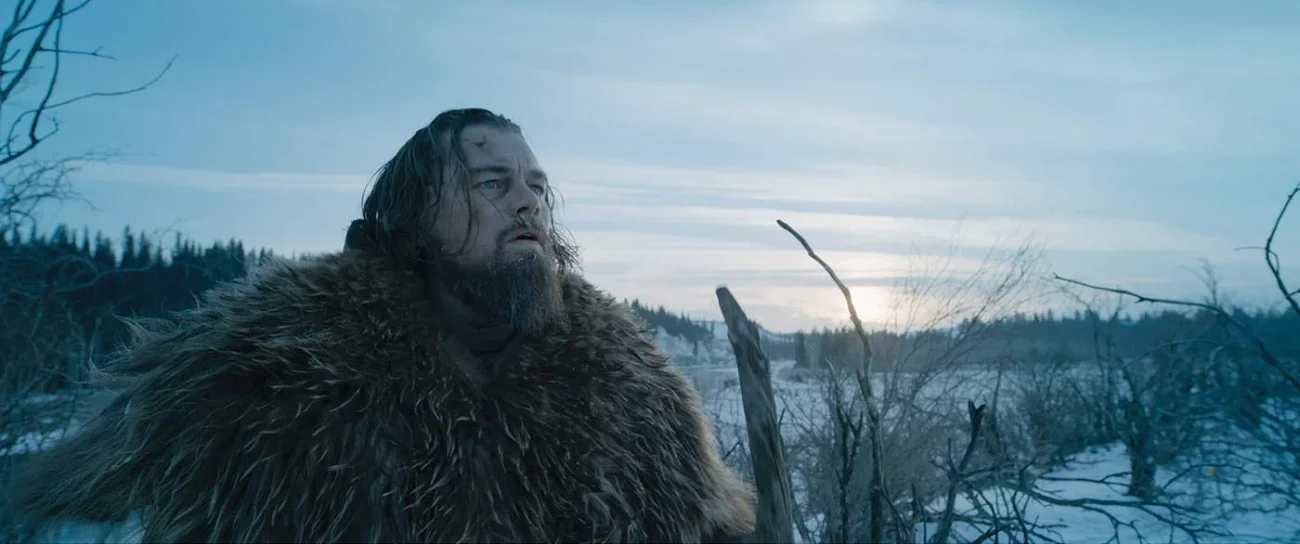
The Revenant (2015)
 Jay Wilde
The Hook
There is a shot in the trailer where the camera pushes through a river of fog and finds Hugh Glass, barely alive, dragging himself across frozen earth with his bare hands. You do not see a movie star. You see a man who has been buried alive, left for dead, and has decided, against every signal his body is sending, to keep going. That single image tells you everything about what The Revenant is going to do to you, and it doesn't lie.
The trailer lays out the bones of the story without giving away the gut punches. You see the fur trappers moving through a wilderness that looks like it was painted by someone who hates human beings. You see the bear attack, or at least enough of it to understand that this film is not going to look away from violence the way most Hollywood films do. You see Tom Hardy's John Fitzgerald, and there's something in his eyes that tells you this man will do the unforgivable and sleep fine afterward. And you see DiCaprio, broken and bleeding and alive, moving through a world that wants him dead, driven by something more elemental than revenge.
What the trailer doesn't prepare you for is how this film was actually made. Alejandro González Iñárritu, fresh off the Oscar sweep of Birdman, decided that The Revenant would be shot entirely in natural light. No artificial lighting rigs. No studio workarounds. If the light was not right, the crew stopped shooting and waited. Sometimes they waited days. Cinematographer Emmanuel Lubezki, already the most daring DP working in Hollywood, built his entire visual approach around the sun's position, the cloud cover, the time of year. The result is a film that looks like nothing else released that decade, a movie that seems to have been carved out of the sky itself. Iñárritu has said in interviews that the approach was about "truth," about making the audience feel the cold and the isolation in every frame. He was not exaggerating.
The production became legendary for all the wrong reasons. Crew members quit. The budget ballooned to 135 million dollars. Filming locations were switched from Argentina to Canada because the snow melted. DiCaprio slept in animal carcasses, waded through frozen rivers, and ate raw bison liver on camera, something he had never done before and reportedly gagged through repeatedly. By the time the film was finished, the cast and crew had been through something that resembled the story they were telling. Iñárritu later admitted that he would not make a film this way again. You believe him.
The Movie
The Revenant is not a comfortable film to watch, and that is precisely the point. It is a story of survival, with revenge acting as a secondary driver rather than the core focus. Hugh Glass, a 1820s frontiersman, is mauled by a grizzly bear, abandoned by his companions, and forced to crawl hundreds of miles across unforgiving wilderness to reach those who left him for dead. Stripped to its bones, the plot is simple. In execution, it is a masterclass in visceral, uncompromising filmmaking that refuses to look away from the harshest edges of human endurance.
The bear attack sequence serves as the film's definitive keystone moment, announcing the unflinching tone immediately. This is not a CGI spectacle in the modern blockbuster sense; the visual effects work is so seamlessly integrated that the violence feels physically tangible, triggering a visceral body reaction before conscious thought catches up. Glass does not fight the bear as action heroes do. He is crushed, pinned, bitten, and the camera lingers without cutting away. The attack stretches for several minutes, devoid of swelling orchestral scores or heroic slow motion, relying instead on raw weight, tearing teeth, and DiCaprio's ragged, laboured breathing as his body is broken. It is a technical achievement that serves the story, not the other way around, and it sets the standard for every frame that follows.
Alejandro González Iñárritu's direction here is intentionally punishing. Fresh from his Birdman Oscar sweep, the director chose to shoot the entire film using only natural light, a decision that shaped every aspect of production. As Iñárritu noted in interviews, the approach was rooted in a pursuit of truth: "We wanted the audience to feel the cold, the isolation, the reality of the environment in every single frame." This meant the crew often waited days for the right light conditions, a logistical nightmare that paid off in a visual language that feels carved from the sky itself. Cinematographer Emmanuel Lubezki, already renowned for his long-take work, built the entire visual approach around solar positioning and seasonal cloud cover, creating a palette of greys, whites, and muted earth tones that makes the wilderness feel like a living, indifferent character rather than a backdrop.
DiCaprio's performance as Glass is remarkable precisely because it rejects traditional movie star heroics. With relatively few lines of dialogue, the role communicates almost entirely through physicality: the shallow, pained breathing, the stiff, damaged gait, the animal desperation in his eyes. His Oscar win, after five previous nominations, sparked debate. Some viewed it as long-overdue recognition; others dismissed it as a "stunt" reward for physical endurance. Both perspectives hold truth. DiCaprio subjected himself to extreme conditions, eating raw bison liver as part of his preparation, sleeping in animal carcasses, and enduring sub-zero temperatures without complaint. The result is a performance that lives in the body rather than the voice, where the actor disappears entirely into the primal survival instinct of the character.
Tom Hardy's John Fitzgerald is the film's stealth anchor. Hardy portrays him as a man shaped by pragmatism and barely contained fury, a survivor who views morality as a luxury he cannot afford. Fitzgerald does not see himself as a villain, but as the only realist among dreamers, and Hardy makes this worldview chillingly persuasive. His thick, deliberately obscured accent adds to the sense of a man who keeps his true thoughts locked behind a wall of deflection. The dynamic between DiCaprio's Glass and Hardy's Fitzgerald drives the narrative: Glass is fueled by grief and a need for closure, Fitzgerald by a ruthless survival instinct. Neither man is entirely sympathetic, and the film refuses to simplify their conflict into hero vs villain tropes.
The film's emotional core is grief, not revenge. Glass is haunted by visions of his late Pawnee wife, her memory a thread connecting him to his humanity amid the brutality. These visions are not explanatory, but atmospheric, adding a layer of interiority to Glass's journey without spelling out backstory. Iñárritu uses the vast wilderness to mirror Glass's internal state: cold, indifferent, vast beyond comprehension. The film's signature long takes, many stretching several minutes without a cut, create a sense of real-time endurance that makes the audience feel every mile of Glass's journey. There are moments where the camera rises above the treeline, revealing Glass as a tiny, fragile figure moving through an ocean of snow, and the scale of his solitude lands with physical weight.
What lingers after the credits roll is the film's refusal to moralize. It does not frame revenge as righteous or survival as noble. The confrontation between Glass and Fitzgerald, when it finally arrives, is messy, unheroic, and deeply human, eschewing the tidy resolution of conventional Hollywood storytelling. The Revenant trusts its audience to sit with discomfort, to understand that survival is often ugly, and that closure is not always neat. It is a film that argues for the raw, unpolished truth of human experience, even when that truth is painful to watch. The natural light cinematography, the uncompromising physical performances, and the director's commitment to realism all serve this singular vision, creating a work that is as much an endurance test for the viewer as it is for the protagonist, and all the more powerful for it.
Lubezki's cinematography deserves specific note here. The use of natural light doesn't just look beautiful; it creates a rhythm to the film tied to the sun's movement, making the passage of time feel tangible. There are no artificial lighting cues to signal mood; the environment itself dictates the emotional tone. This approach, combined with the sparse, atmospheric score by Ryuichi Sakamoto and Alva Noto, which often fades into the background of wind and snow, creates an immersive experience that pulls the viewer into Glass's world completely. Every frame feels earned, every moment of respite hard-won, and the film never feels padded, because every scene serves the central thesis of survival and truth.
The sound design by Martin Hernández is a masterclass in subtlety. The crunch of snow underfoot, the howl of wind through bare trees, the distant snap of twigs, all create an auditory landscape that is as immersive as the visuals. There are long stretches with almost no dialogue, where the sound of the environment carries the narrative, making Glass's isolation feel palpable. This choice reinforces the film's theme of humans as small, insignificant players in a vast, uncaring natural world. The 1820s fur trade era is depicted with gritty realism, avoiding the romanticized version of the American frontier common in older Westerns. Screenwriter Mark L. Smith noted in an interview, "We weren't making a history lesson. We were making a story about what it means to keep going when every part of you wants to stop." This focus on universal themes over strict historical accuracy allows the film to resonate far beyond its specific time period.
The Revenant went on to win three Oscars, including Best Director for Iñárritu, Best Cinematography for Lubezki, and Best Actor for DiCaprio. Its influence can be seen in subsequent survival films, which have adopted its uncompromising, naturalistic approach over more stylized takes. It remains a touchstone for filmmakers looking to blend technical mastery with raw, emotional storytelling, proving that audiences are willing to engage with difficult, challenging material when it is executed with total commitment.
The film's uncompromising approach sparked debates about the line between method acting and self-harm, with arguments that DiCaprio's extreme preparation crossed a line. Others defended it as necessary for the role's authenticity, noting that Glass's journey required a performer willing to endure real discomfort. Iñárritu addressed this in press, stating, "We never put anyone in danger, but we asked everyone to push further than they thought possible. That is the only way to capture truth on screen." This philosophy extends to the film's portrayal of colonialism, with the Arikara attack scenes grounding the story in the historical reality of 1820s frontier violence, avoiding the romanticized "cowboys and Indians" tropes of earlier Westerns.
The makeup department, led by Joel Harlow, created prosthetics for Glass's injuries that were so realistic, crew members often forgot they were fake. DiCaprio wore these appliances for up to 12 hours a day, adding to the physical toll of the role. Harlow noted in an interview, "We wanted the audience to wince when they saw his wounds, to feel the pain as something tangible, not a movie effect." This attention to detail extends to every frame, making the film's violence feel consequential rather than gratuitous.
The film also avoids the lazy tropes that often plague frontier stories, portraying Native American tribes as complex, motivated communities rather than generic antagonists. The Arikara warriors are shown with their own agency, their attack on the trapper camp driven by the kidnapping of a chief's daughter, adding moral weight to their actions. This nuance is a testament to the film's commitment to truth over convenient storytelling, ensuring that even the supporting characters feel like real people with their own stakes.
Iñárritu has said in retrospective interviews that the film's core message is about resilience, not revenge. "Glass's journey is not about getting even," he noted. "It is about what remains when everything is taken from you. That is what makes us human." This perspective transforms a simple revenge narrative into a meditation on the human spirit, elevating the work beyond genre conventions.
The edit rhythm subtly shifts to mirror Glass's deteriorating physical state, with shots becoming shorter and more fragmented as his strength fades. Mirrione used this technique to convey exhaustion without dialogue, letting the visual language do the work. This technique keeps the audience viscerally connected to Glass's journey, feeling his exhaustion as the runtime progresses. This subtle pacing choice is one of the work's quiet masterstrokes, never drawing attention to itself but deepening the viewer's immersion. This attention to detail ensures the pacing never feels stagnant, as each cut serves the character's journey rather than padding the run time.
Viewers encounter the 1820s fur trade era without the romanticized version common in older Westerns. Iñárritu insisted on historical accuracy in every detail, from the primitive trapping tools to the period-accurate clothing that would have been worn by frontiersmen. This attention to detail creates an immersive experience that transports viewers to a specific moment in American history.
The People
Alejandro González Iñárritu approached The Revenant with the same obsessive commitment to authenticity that defined his earlier work, but amplified to a degree that tested every person involved. The director, known for films like Amores Perros, Babel, and Birdman, had a vision for the film that went beyond conventional filmmaking. He wanted to shoot only with natural light, use long unbroken takes, and immerse the audience in a physical reality that most films fake, relying on practical effects for environmental shots rather than CGI. The cost of that vision was enormous, both financially and personally, with nearly 30% of the crew quitting during the grueling shoot due to harsh conditions, including several key department heads.
Iñárritu has spoken in multiple interviews about the toll the production took. "I would not do it again," he told press at the film's premiere. "I think I went too far." The crew worked in conditions many found unbearable, with shooting days extended to chase the perfect light and locations requiring hours of travel through snow and mud. Cinematographer Emmanuel Lubezki, who won his third consecutive Oscar for the film, described the process as "the hardest thing I have ever done as a filmmaker." The two men had developed a boundary-pushing working relationship on Birdman. On The Revenant, they pushed past every limit entirely.
DiCaprio's commitment to the role became the stuff of legend during production and in the years after. The actor, who had been chasing an Oscar for two decades, threw himself into the extreme physical demands with an intensity that occasionally alarmed colleagues. He slept in animal carcasses to understand the cold, waded into freezing rivers, and ate raw bison liver, which he later described as "one of the most revolting things I have ever done." When asked about the experience, DiCaprio told Ellen DeGeneres, "I think the word 'suffering' gets thrown around a lot in Hollywood, but this was actually suffering." He told Rolling Stone in a separate interview, "I wanted to push myself further than I ever had, to understand what Glass went through on a visceral level." DiCaprio even broke a finger during a fight scene but continued filming, which is why the injury is visible in several shots. The actor was not simulating discomfort. He was living it.
Tom Hardy, meanwhile, brought his own brand of intensity to the set. Originally, Michael Fassbender was considered for the role of Fitzgerald before Hardy was cast, originally drawn to the character's deep moral ambiguity. Hardy prepared by studying accounts of 19th century fur trappers and men who had survived extreme frontier conditions, staying in character throughout the shoot and rarely interacting with cast and crew off-camera to maintain Fitzgerald's isolation. He has spoken about the character as someone shaped by trauma long before the film begins, a man who learned to survive by shedding everything soft. Hardy and DiCaprio reportedly had a complicated relationship on set, with creative disagreements that sometimes spilled over into tension. Hardy later told press that the experience was "intense," a word he used like a euphemism. The friction between them, however, translates into something electric on screen. Fitzgerald and Glass circle each other like wounded animals, and the performances have a rawness that feels unscripted. Hardy has since said Fitzgerald remains one of his favorite roles he has played.
Domhnall Gleeson, cast as Captain Andrew Henry, brought a quiet authority to a role that could easily have been thankless. Gleeson has described the shoot as physically grueling but creatively extraordinary, noting that Iñárritu's insistence on natural light meant entire days of preparation could be lost if the weather did not cooperate. "You would arrive at location at four o'clock in the morning and sometimes not shoot a single frame," Gleeson said in an interview. "But when the light was right, the scenes were unlike anything I had experienced on a film set." His performance as Henry carries the weight of command, the burden of a man who must make impossible decisions about who lives and who dies.
Will Poulter, as the young Jim Bridger, delivered what remains one of his finest performances. Poulter was in his early twenties during the shoot and brought an innocence to Bridger that anchors some of the film's most emotionally devastating moments. Bridger is the character who is manipulated into abandoning Glass, and Poulter plays his guilt and confusion with a vulnerability that makes you ache. The role required him to convey moral reckoning through silence, and he does it remarkably well. Poulter later reflected on the shoot as a formative experience, calling it "the hardest and most rewarding thing I have done as an actor."
The production moved between Alberta, Canada and southern Argentina to find consistent winter conditions, as the Canadian Rockies experienced an unseasonably warm winter during the first months of shooting. This added millions to the budget, but ensured the snowy landscapes Iñárritu demanded were authentic. Location scout Mark Bentley spent careful months finding remote areas that had not been touched by modern infrastructure, often hiking for long days to find the perfect spot. The crew's resilience matched that of the characters, with many citing the experience as the toughest but most rewarding of their careers. Many of the locations they found remain untouched by modern development to this day, preserving the pristine wilderness that made the work so visually striking.
The production's challenges extended to every department. Production designer Jack Fisk, a veteran of Terrence Malick films, built sets that felt lived-in and authentic, using only materials available in the 1820s. Sound designer Martin Hernández spent months recording ambient noise in remote wilderness areas to avoid using stock sound effects. The commitment across the board was total, creating a film where every frame feels earned. As Iñárritu noted in a later interview, "We set out to make a film that felt true, and in the process, we all learned what that really cost."
The ensemble cast delivered performances that were universally praised for their raw authenticity. Each actor brought a commitment to their role that matched DiCaprio's intensity, creating a unified vision of survival against impossible odds.
The Craft
The cinematography of The Revenant deserves its own essay, and has received many. Emmanuel Lubezki's work on the film is, by any measure, among the most technically ambitious and visually stunning achievements in modern cinema. The decision to shoot exclusively in natural light was not an aesthetic preference. It was a philosophical commitment that shaped every other aspect of the production. Lubezki and his team calculated the position of the sun months in advance, building shooting schedules around the narrow windows when the light matched Iñárritu's vision. The film was shot using Arri Alexa 65 cameras, the first major production to use this high-resolution system, which allowed Lubezki to capture detailed images even in low natural light conditions. He paired these with vintage lenses to give the image a soft, organic feel that avoided the sterile look of modern digital cinematography. The result is a film that seems to glow from within, where shadows are real shadows and the cold has a visible texture.
The long takes are the most discussed element, and for good reason. The film opens with a single unbroken shot that lasts several minutes, pulling the audience into the chaos of an Arikara attack on a fur trapper camp without the safety net of editing. The camera moves through the violence with a fluidity that feels almost ghostly, and by the time the shot finally cuts, you are breathless. Lubezki achieved this with a combination of Steadicam work, crane shots, and a crew that moved like a single organism through dense forest and knee-deep snow. The bear attack sequence was also filmed in a single take, combining live action with a CGI bear, requiring weeks of rehearsal to coordinate the camera movement, DiCaprio's performance, and the digital elements. The technical coordination required was staggering, and these shots became some of the most studied sequences in film schools within months of release.
The score by Ryuichi Sakamoto and Alva Noto is one of the film's most underrated elements. Sakamoto, the legendary Japanese composer who had battled cancer in the years preceding the film, created a score that's sparse, haunting, and almost subliminal in places. Rather than underscoring every emotion with orchestral swells, the music exists at the edges of the frame, a low drone or a single sustained note that conveys desolation without telling you how to feel. Sakamoto and Noto recorded natural sounds like wind and snow to incorporate into the score, blurring the line between score and sound design. Alva Noto, known for his electronic and minimalist work, contributed textures that blend seamlessly with Sakamoto's compositions, creating a sonic landscape that mirrors the visual one. The music doesn't announce itself. It seeps in, the way cold seeps into bones.
The production design by Jack Fisk deserves recognition for creating a world that feels genuinely inhabited rather than art-directed. The fur trading camps, the fort, the improvised shelters Glass builds from mud and animal hide, all look like they have been used by real people in real conditions. Fisk, who had collaborated with directors like David Lynch and Terrence Malick, understood that the world of the film needed to feel rough and improvised, not cinematic. Costumes were aged and weathered to the point of disintegration, with layers added and removed to reflect the characters' deteriorating condition. Props were functional rather than decorative, from the fur traps to the flintlock rifles. The entire aesthetic serves the film's central commitment to physical truth.
The visual effects work, led by MPC, was intentionally invisible. The bear attack, which won the film its Oscar for Best Visual Effects, was created by animating a digital bear that matched the movement of real grizzlies studied by the effects team. DiCaprio acted against a stand-in bear during filming, with the CGI elements added in post, but the integration was so seamless that many viewers assumed the bear was real. Other VFX work included removing modern infrastructure from remote locations and enhancing the natural landscape to look more hostile, all done without drawing attention to itself.
The editing by Stephen Mirrione is the invisible art that holds the film together. There are stretches where you feel every moment, but that's by design rather than accident. Mirrione's editing doesn't rush. It lets scenes breathe, lets the landscape fill the screen, lets Glass's suffering unfold at its own pace. He worked closely with Iñárritu to ensure the pacing matched the natural light, sometimes cutting scenes shorter if the light changed unexpectedly during filming. There are moments where the cutting rhythm mirrors Glass's breathing, slow and laboured, and other moments where the pace quickens with the violence. The overall effect is of a film that moves like its protagonist, deliberately, painfully, toward its destination.
The Trivia
-
The grizzly bear attack, one of the most viscerally shocking sequences in modern cinema, was created using a combination of motion capture and CGI. The bear itself was performed by an actor in a motion capture suit on set, and the digital team at Industrial Light and Magic built the animal frame by frame. The sequence took several months to animate and went through multiple iterations before Iñárritu was satisfied. The director wanted the bear to feel not like a monster but like a wild animal protecting its cubs, and the result is simultaneously terrifying and naturalistic.
-
DiCaprio's raw bison liver scene was real, though the liver was specially sourced for the shoot. DiCaprio, a committed vegetarian at the time, had to suppress his gag reflex repeatedly during filming. He later described the experience as a moment where "the actor in you dies and something else takes over." The scene was kept in the final cut precisely because the revulsion on DiCaprio's face was genuine.
-
The production originally planned to film in Argentina, where snow and mountains were available in the right season. When the snow melted unexpectedly, the entire production relocated to Canada, shooting in British Columbia and Alberta. The move cost millions and added months to the schedule, but Iñárritu insisted that the landscape had to match the story's Dakota Territory setting.
-
Emmanuel Lubezki won the Academy Award for Best Cinematography for the third consecutive year with The Revenant, following Gravity in 2013 and Birdman in 2014. No cinematographer had ever achieved this streak before. The three films could not be more different visually, which makes the achievement even more remarkable.
-
Iñárritu's insistence on natural light meant that some days produced only minutes of usable footage. The crew would arrive hours before dawn and sometimes shoot for as little as an hour and a half before the light became unusable. Lubezki has described this as "humbling" and "maddening in equal measure."
-
Tom Hardy has acknowledged that he and Iñárritu clashed during the production. The two men had creative disagreements about Fitzgerald's motivation and behavior in several key scenes. Hardy, known for his immersive approach to character, sometimes pushed back against the director's vision. Iñárritu, known for his exacting standards, did not always welcome the pushback. The tension, however, translated into a performance that crackles with barely suppressed aggression.
-
The film defies typical blockbuster expectations with its slow, brutal, and uncompromising pacing, yet resonated with audiences worldwide. Its success proved that viewers were hungry for challenging, uncompromising material that respected their intelligence rather than relying on CGI spectacle.
-
DiCaprio's Oscar win for The Revenant ended one of the most discussed narrative in Academy Award history. The actor had been nominated five times previously without winning, for What's Eating Gilbert Grape, The Aviator, Blood Diamond, The Wolf of Wall Street, and a nomination for Romeo + Juliet that was a Golden Globe nod. The #OscarsForLeo social media campaign had become a cultural phenomenon, and his eventual win was greeted with a standing ovation.
-
The film features dialogue in several Indigenous languages, including Pawnee and Arikara. Iñárritu worked with language consultants and members of the respective communities to ensure the dialogue was accurate. The opening scene, which depicts the destruction of a Native American village, was filmed with input from Indigenous advisors to avoid gratuitous depiction of violence.
-
The title, "The Revenant," refers to a person who has returned from the dead, which perfectly describes both Glass's physical journey and the film's thematic preoccupation with resurrection and vengeance. The word comes from the Old French "revenir," meaning "to come back." Glass was a real historical figure whose survival story, documented in various accounts from the early 19th century, became the basis for Michael Punke's 2002 novel and subsequently the film.
-
Iñárritu won Best Director at the Academy Awards for the second consecutive year with The Revenant, having won the previous year for Birdman. Only three directors in history had achieved back-to-back Best Director wins before Iñárritu, and the feat cemented his reputation as one of the most ambitious filmmakers of his generation.
-
The film's production was so demanding that several crew members quit during filming. Reports emerged of grip and electric crew members leaving the production due to the harsh conditions, the long waits for light, and the general intensity of working with Iñárritu. The director later acknowledged that the conditions were extreme but maintained that the approach was necessary for the film's vision.
-
The scene where Glass is buried alive was filmed in a single take, with DiCaprio actually underground in a shallow grave. The actor has spoken about the claustrophobia of the moment, noting that the dirt was real and the space was genuinely confining. The practical approach, as opposed to using a set piece or green screen, added a physical authenticity that reads on screen.
-
Ryuichi Sakamoto, who composed the score with Alva Noto, was recovering from throat cancer during the production. The score was one of his final major film works before his death in 2023, and it carries an emotional weight that gains poignancy in retrospect. The music's sparseness, its sense of a voice struggling to be heard, mirrors both the film's themes and its composer's personal journey.
The Verdict
The Revenant is not a film you watch casually. It demands your patience, your stomach, and your full attention, and it gives back something that most films never attempt. It is a film about survival that itself feels like a survival experience, a piece of cinema that pushes its makers and its audience to the edge and asks whether you can take one more step. The answer, if you stay with it, is yes, and the reward is one of the most visceral, visually extraordinary films of the century so far.
What makes The Revenant endure is not just its technical achievements, though those are staggering. It is the way the film uses spectacle in service of something human and raw. Hugh Glass's journey is not heroic in the traditional sense. He doesn't triumph over nature or over evil. He simply refuses to die. That refusal, filmed in natural light by a crew that nearly broke themselves to get it right, becomes something that feels earned in a way that most movie heroics do not. You feel Glass's pain because DiCaprio felt it. You feel the cold because Lubezki waited for it. The film earns every frame.
It is a film that rewards rewatching, not because the story changes, but because your relationship to it does. The first time through, the bear attack and the violence dominate. The second time, you notice the quiet moments, the way Lubezki's camera lingers on faces and landscapes with a patience that borders on meditation. The score, barely noticeable on first viewing, becomes a haunting presence. The performances deepen. The film that seemed relentless becomes, paradoxically, one of the most contemplative blockbusters ever made.
If you have not seen it, prepare yourself. It will hurt. It will take your time. It will ask you to sit with images of suffering that most films would cut away from. And when it is over, you will sit in the silence and feel something that's rare in modern cinema: the sense that you have been somewhere real.
"As long as you can still grab a breath, you fight. You keep your heart, and you fight."