They Live (1988)
 Jay Wilde
The Hook
There is a moment in the trailer for They Live where a pair of cheap sunglasses slides onto a man's face and the entire world snaps into black and white. Billboards that once advertised beer and vacation packages now display single words in block capitals: OBEY. CONSUME. CONFORM. STAY ASLEEP. It is one of the most visceral reveals in 1980s cinema, and the trailer plays it like a magician pulling back the curtain. You do not just watch it. You feel it behind your eyes.
The rest of the trailer rattles through the premise with the breathless energy of a guy at a bus stop telling you about the movie he just saw. Roddy Piper, a professional wrestler with no real acting career to speak of, walks into a bank, pulls a shotgun, and starts blasting bug-eyed aliens. There are car chases, gunfights, and a shot of Piper in a trench coat and mirrored shades that became the defining image of the film. The trailer sells a B-movie romp. What it doesn't tell you is that the whole thing is a two-fingered salute to Ronald Reagan's America.
John Carpenter had been chewing on the idea for years before the cameras rolled. He had acquired the rights to Ray Nelson's 1963 short story "Eight O'Clock in the Morning" and a subsequent comic book adaptation called "Nada," but the project kept being deferred as Carpenter moved through other films. By the time he finally sat down to write the screenplay, his frustration with the political landscape had hardened into something sharper. "The picture's premise is that the Reagan Revolution is run by aliens from another galaxy," Carpenter said in an interview around the film's release. "Free enterprisers from outer space have taken over the world and are exploiting Earth as if it is a third world planet. As soon as they exhaust all our resources, they will move on to another world."
Carpenter wrote the screenplay under the pseudonym Frank Armitage, a nod to the H.P. Lovecraft character Henry Armitage from The Dunwich Horror. It was a sly signal about the film's real ambition, which was not about aliens at all but about the hidden architecture of power, the world underneath the surface that Lovecraft wrote about and Carpenter saw every time he turned on a television. Universal, which distributed the film, seemed to miss the irony entirely. When Carpenter explained the premise to an executive, the response was genuine: "Where is the threat in that? We all sell out every day." Carpenter used the line almost verbatim in the film.
The Movie
They Live opens with a shot of downtown Los Angeles that looks like it was filmed through a layer of smog and resignation. The gritty, sun-bleached cinematography immediately establishes a world that feels tired and worn down, the perfect backdrop for a story about invisible exploitation. Nada, played by Roddy Piper, steps off a bus with nothing but a duffel bag and a willingness to work. He finds a construction job, he makes a friend named Frank (Keith David), and he sleeps in a shantytown next to a church where something is clearly happening after dark. The preacher on the street corner rants about aliens and mind control. Nobody listens. That's the first lesson of They Live: the truth is always screaming in public, and we walk past it every single day. It's a lesson that feels more urgent with each passing year, as advertising and media continue to saturate every corner of daily life.
Carpenter uses a striking visual transition to signal Nada's awakening, shifting the world to monochrome to reveal hidden messaging on billboards, currency, and magazines. The effect is stark and deliberate, designed to feel like subliminal advertising made visible, forcing the audience to share Nada's disorientation as his worldview shatters. This sequence is a masterclass in visual storytelling, relying on practical effects and Carpenter's trademark minimalism to land a political point without ever feeling like a lecture. The hidden messages themselves are brilliantly simple: OBEY, CONSUME, CONFORM, printed in block capitals on every surface, a direct visualisation of the film's critique of consumer culture.
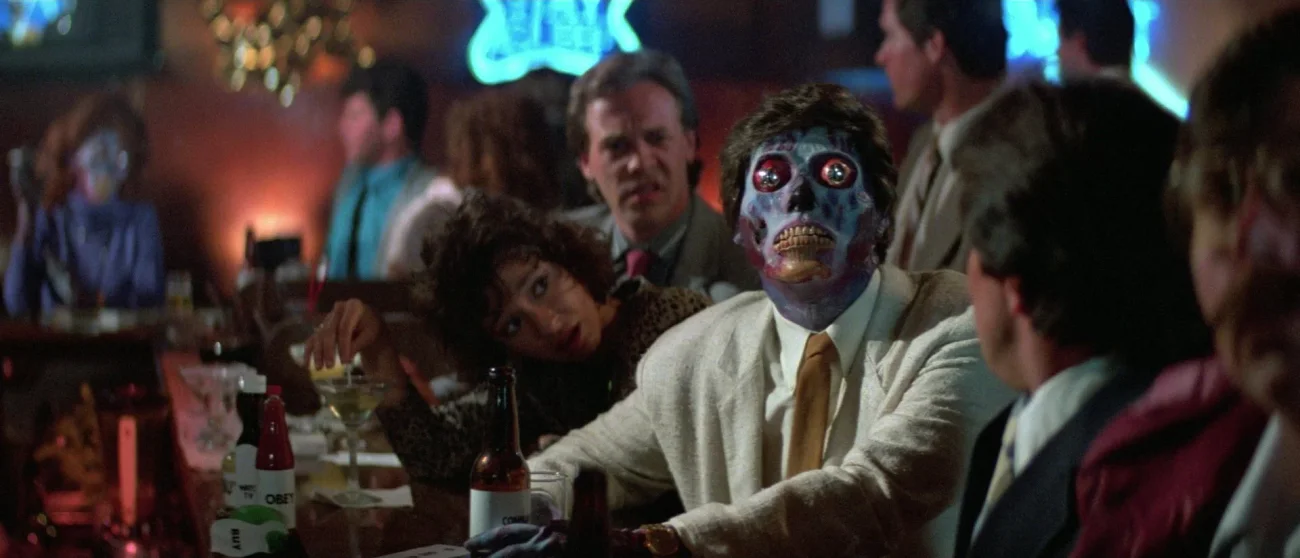
The aliens themselves are a brilliant piece of design that reinforces the film's critique of corporate America. They are not sleek or menacing in the traditional science fiction sense. They look like rotting corpses in suits, ghouls wearing human skin like a bad costume. Carpenter explained that "the creatures are corrupting us, so they themselves are corruptions of human beings." The look is intentionally repulsive but also somehow pathetic. These are not conquerors from the stars in any grand sense. They are middle managers, bureaucrats, landlords, and network executives. Their technology includes wristwatch communicators that let them teleport and surveillance drones that hover like mechanical insects. They have set up their base of operations inside a news network called Cable 54, broadcasting a signal that keeps humanity docile and blind. The metaphor is not subtle, but subtlety was never the point. Carpenter was reacting to the unchecked consumerism and corporate greed of the Reagan era, and the aliens are a literal manifestation of the soulless institutions that prioritised profit over people throughout the 1980s.
What makes They Live more than a simple allegory is Piper's central performance. He was not an actor. He was a wrestler with a gift for improvisation and an unshakeable screen presence that owed more to charisma than technique. His delivery is flat and unpolished in a way that feels completely authentic for the character. When he walks into the bank with a shotgun and announces "I have come here to chew bubblegum and kick ass, and I am all out of bubblegum," it is absurd and perfect in equal measure. The line was improvised. Piper later said he grabbed the sunglasses and prop gun and the words just came out. Carpenter kept the camera rolling and kept the take. It became one of the most quoted lines in 1980s cinema, a piece of accidental poetry that captures the film's tone in a single breath. Piper brings a working-class authenticity to Nada that no trained actor could have replicated. He is not playing a hero. He is playing a guy who is angry, confused, and suddenly burdened with the truth, and he sells every moment with a sincerity that grounds the film's wilder satirical swings.
Carpenter's direction is similarly grounded, eschewing flashy camera work for a clinical, observational style that lets the absurdity of the premise speak for itself. He lets scenes breathe without unnecessary cuts, trusting the audience to absorb the satire without heavy-handed narration. He shot the film on a relatively tight budget, which shows in the best possible way. The practical effects, from the alien prosthetics to the monochrome visualization of the signal's effects, have a tactile quality that CGI could never replicate. Gary B. Kibbe's cinematography leans into muted colours and wide shots that make the alien infiltration feel like it's happening in plain sight, which of course it is. The score, co-composed by Carpenter and Alan Howarth, is a synth-heavy, pulsing backdrop that adds to the film's paranoid atmosphere without ever overpowering the action on screen.
The film's greatest strength is its refusal to offer easy answers or tidy resolutions. It does not pretend that seeing the truth fixes anything. Nada's journey is not a hero's arc. It is a man waking up to a nightmare and choosing to fight anyway, even when the cost is everything he has. The friendship between Nada and Frank, the emotional core of the film, is handled with surprising tenderness beneath the gunfire and satire. Their dynamic illustrates the film's central tension: the choice between comfortable ignorance and painful truth, and the lengths people will go to avoid having their worldview upended. Carpenter does not judge Frank for his reluctance, which makes Nada's persistence all the more compelling.
They Live is a rare film that works as both a B-movie action romp and a sharp piece of political satire. It never talks down to its audience, even as it uses broad strokes to make its points. The sunglasses are a perfect MacGuffin, a simple device that unlocks an entire hidden world without needing lengthy exposition. Every element of the film, from the deliberately cheesy one-liners to the grotesque alien design, serves the central thesis that consumer capitalism is a mask worn by forces that do not have humanity's best interests at heart. Decades later, the film's imagery remains eerily relevant, a testament to Carpenter's ability to tap into the anxieties of his era in a way that outlasts the specific political moment that spawned it.
The People
Roddy Piper was not supposed to be a movie star. He was a professional wrestler, one of the most charismatic performers in the history of the squared circle, but Hollywood had no idea what to do with him. John Carpenter did. The two met at WrestleMania III in 1987, and Carpenter was immediately taken by Piper's raw magnetism. "Unlike most Hollywood actors, Roddy has life written all over him," Carpenter later said. For the role of Nada, Carpenter's first choice had actually been Kurt Russell, his frequent collaborator and friend. But Russell was committed to Tequila Sunrise, a Robert Altman film, and the scheduling did not work. In hindsight, the casting rejection may have been the best thing that could have happened to They Live. Russell would have brought professionalism and range to the role, but Piper brought something else entirely, a rough-edged authenticity that could not be faked by a trained actor. Nada feels real because Piper is real. His reactions are unpolished and immediate, and the film is better for it.
Keith David, who plays Frank, was a different kind of performer entirely. A Juilliard-trained actor with credits that included The Thing, also directed by Carpenter, David brought weight and gravitas to a role that could have been a simple sidekick part. Carpenter wrote Frank specifically for David after being impressed by his work in The Thing, where David played Childs, the only other character besides Kurt Russell's MacReady who survived the ordeal. "I needed someone who would not be a traditional sidekick but could hold his own," Carpenter said. David delivered exactly that. His refusal to put on the glasses is not cowardice. It is the rational response of a man who has been living on the streets and doesn't need another layer of unreality. The fight scene between Piper and David took three weeks to rehearse and is one of the most memorable physical sequences in 1980s film. Carpenter compared it to the legendary brawl between John Wayne and Victor McLaglen in The Quiet Man, and the comparison is apt. Both scenes are too long, too painful, and oddly beautiful.
The iconic alley fight between Nada and Frank was rehearsed for nearly two months in the backyard of Carpenter's production office in Van Nuys. Piper and David did almost all their own stunts, and according to trivia from the set, they were actually hitting each other for real during the scene, only faking blows to the face and groin. Carpenter initially suggested the fight should last only twenty seconds, but the chemistry between the two performers led to it stretching to five and a half minutes, a decision that turned the scene into one of the most memorable brawls in 1980s cinema. Piper even attempted to demonstrate a suplex on Carpenter when the director suggested adding the move to the fight, a moment that sums up the playful but intense energy of the production.
Meg Foster, who plays Holly, brings an icy poise to the role that makes her betrayal land hard. Foster has one of the most distinctive faces in Hollywood, with pale blue eyes that seem almost otherworldly, which made her casting as a possible alien collaborator particularly inspired. She was later cast in other genre roles including Masters of the Universe, where she played Evil-Lyn, further cementing her reputation as a performer who could project intelligence and menace in equal measure. In They Live, Holly is the film's secret. She appears to be an ally, even a love interest, but the final reveal that she has been working with the aliens all along recontextualizes every scene she appeared in. It is a betrayal that the film earns because it has spent its entire runtime arguing that the most dangerous collaborators are the ones who look and sound exactly like us.
Fans with sharp eyes will spot a piece of recycled prop magic in the film: the alien communication device used by the characters is actually the PKE Meter from Ghostbusters, repurposed for They Live on a tight budget. It is a small detail that speaks to the resourcefulness of Carpenter's crew, who made every dollar count. Piper later credited Carpenter and the film with changing his career trajectory, turning him from a wrestler dabbling in acting into a cult film icon. For David, the role cemented his status as a go-to character actor for genre films, a reputation he still holds decades later.
Carpenter himself was going through a difficult professional period during the production of They Live. After the critical and commercial underperformance of Big Trouble in Little China in 1986, he was no longer considered a safe bet by the studios. They Live was made on a shoestring budget by a director who had something to prove and a grievance to air. In American Cinematographer, Carpenter reflected on the film's political edge with characteristic self-awareness: "I have made a lot of money in the film business the way it is run today and I am a complete capitalist. I am just advocating a little humanity in the world. In order to do that you have to go strong in the other direction, be a little outrageous. It is fun to attack the status quo." That tension, between Carpenter's genuine anger at consumer culture and his willingness to play the game, gives They Live its peculiar energy. It is a film that bites the hand that feeds it while acknowledging that the hand is, in fact, feeding it.
The film's low budget also meant long hours and minimal frills on set. Foster later recalled in interviews that the cast and crew operated like a tight-knit family, with Carpenter often working 16-hour days to stay on schedule. There was little studio interference during production, which allowed Carpenter to keep the film's political edge intact, though the marketing team struggled to sell a satirical action film with a wrestler in the lead role. The poster, featuring Piper in sunglasses and trench coat, emphasized the B-movie action elements over the political satire, a choice that may have contributed to the film's modest commercial performance.
George Buck Flower, who plays the drifter in the shantytown, was a regular in Carpenter's films and brought a lived-in quality to the role that grounded the film's more outlandish elements. Peter Jason as Gilbert and Sy Richardson as the Black Revolutionary filled out the resistance with conviction, even though their roles were limited. The ensemble works because Carpenter trusted his actors to inhabit their roles without overexplaining them. The film doesn't deliver its themes through monologues or exposition. It delivers them through faces, through reactions, through the way Piper's eyes narrow when he puts on the glasses and sees the world stripped bare.
The Craft
The score for They Live was composed by Carpenter and Alan Howarth, who had collaborated on several Carpenter projects including Escape from New York and Prince of Darkness. The music is pure Carpenter synth, a pulsing, mechanical soundscape that perfectly matches the film's bleak urban setting. The main theme is built around a repetitive electronic motif that sounds like a factory floor running at night, all grinding gears and steady rhythms. It is not a melody you hum on the way out of the theater. It is a texture that gets under your skin and stays there. Howarth brought technical expertise to the partnership while Carpenter contributed the atmospheric instinct that defined his best film scores. Together they created something that feels less like a soundtrack and more like the sound of the city itself, drained of warmth and operating on autopilot.
Gary B. Kibbe's cinematography is deliberately plain. There are no showy camera movements, no dramatic lighting setups, no visual pyrotechnics. The film looks like a documentary shot in downtown Los Angeles, all concrete and asphalt and flat midday light. This is a conscious choice that serves the film's central conceit perfectly. When Nada puts on the sunglasses and the world turns to black and white, the shift feels natural because the color footage was already muted and gritty. The monochrome world doesn't look like a different place. It looks like the same place with the advertising stripped away, which is exactly the point. The contrast between the two visual modes is subtle enough to feel like revelation rather than trickery.
The production design is minimal by necessity. The three million dollar budget meant that Carpenter and his team had to be resourceful, and they leaned into the real locations of downtown Los Angeles. The shantytown was a real encampment dressed up with a few props. The church was an actual location. The bank, the streets, the alley where the famous fight takes place. These are all real places given just enough production dressing to feel cinematic without losing their documentary texture. The alien headquarters inside Cable 54 is the one exception, a set that looks deliberately corporate and sterile, all clean lines and fluorescent lighting. It could be any newsroom, any boardroom, any room where decisions are made about what the public should see and think.
The special effects in They Live are almost entirely practical. The aliens are achieved through makeup and prosthetics, with actors wearing elaborate headpieces that give them the characteristic bug-eyed ghoulish appearance. The effect is simple but unsettling, especially in the supermarket scene where Nada first encounters the aliens in their true form. The surveillance drones are basic mechanical props, and the teleportation effects are done with simple cuts and lighting changes. None of this should work as well as it does, and the reason it does work is that Carpenter understands that horror is about what you do not see as much as what you do. The alien wristwatch communicators are just watches with blinking lights, but in the context of the film they feel like genuinely alien technology. The sunglasses themselves are the film's most important prop, and their effectiveness comes from how they change the viewer's perception rather than from any technical complexity. When the world goes monochrome and the subliminal messages appear, the effect is achieved through simple in-camera tricks and title cards. It is low-tech filmmaking at its most effective.
The editing by Gib Jaffe and Frank E. Jimenez is tight and unfussy. The film doesn't waste a single minute. The famous alley fight, which runs for five and a half minutes, is edited with minimal cuts to let the physicality play out in something close to real time. It is an unusual choice for an action film of the era, which tended toward rapid cutting, but it gives the scene a weight and presence that faster editing would have undermined. The pacing throughout the film is deliberate, building slowly through the first act before accelerating into the action-heavy second and third acts. The transition from Nada's quiet arrival in the city to the explosive bank shootout is handled with a patience that modern action films rarely allow.
The Trivia
-
The pseudonym "Frank Armitage" is a Lovecraft reference. Carpenter used the name because the screenplay drew from so many sources (Ray Nelson's short story, Bill Wray's comic adaptation, and input from the cast) that he did not feel a single author credit was appropriate. The name itself is a nod to Henry Armitage, a character in H.P. Lovecraft's The Dunwich Horror, reflecting Carpenter's lifelong admiration for Lovecraft's themes of hidden worlds and cosmic indifference. Carpenter has said that "Lovecraft wrote about the hidden world, the world underneath. The world underneath has a great deal to do with They Live."
-
Kurt Russell turned down the lead role. Russell was Carpenter's first choice for Nada and his frequent collaborator on films like Escape from New York and The Thing. However, Russell was committed to Robert Altman's Tequila Sunrise during the same production window and could not take the part. The decision to cast Roddy Piper instead was a gamble that paid off spectacularly, as Piper's untrained screen presence gave the character an authenticity that a more polished actor might not have achieved.
-
The alley fight took three weeks to rehearse. The five and a half minute brawl between Nada and Frank is one of the most famous fight scenes in 1980s cinema. Carpenter staged it in wide shots with minimal editing to let the physicality play out in real time, comparing it to the legendary slugfest between John Wayne and Victor McLaglen in John Ford's The Quiet Man. Both Keith David and Roddy Piper took real hits during filming, and the exhaustion visible in the later stages of the fight is genuine.
-
"I have come here to chew bubblegum and kick ass" was improvised. The most quoted line in the film was not in the script. Piper grabbed the shotgun and sunglasses and the words came out naturally. Carpenter kept the camera rolling and chose that take for the final cut. The line has since entered popular culture to such an extent that it has been referenced in video games, other films, and political commentary. Piper himself was reportedly surprised by its longevity.
-
The sunglasses reveal was achieved through simple in-camera techniques. When Nada first puts on the glasses and the world turns to black and white, the effect was created using color correction and compositing rather than any complex optical process. The subliminal messages were physically printed and placed in the frame, giving them a handmade quality that digital effects could not replicate. The simplicity of the technique is part of what makes the scene so effective. It feels like reality being peeled back rather than a visual effect being applied.
-
The aliens were designed to look like corrupt human beings. Carpenter deliberately avoided the sleek, alien aesthetic common in science fiction of the era. Instead, the creatures look like decaying humans in business suits, ghouls with withered skin and exposed bone. Carpenter explained that "the creatures are corrupting us so they themselves are corruptions of human beings." The makeup was applied by a small team working on a tight budget, and the result is more disturbing than many more expensive creature designs because the aliens look fundamentally wrong rather than obviously foreign.
-
Shepard Fairey's "Obey Giant" street art was directly inspired by They Live. The famous Andre the Giant Has a Posse sticker campaign, which later evolved into the OBEY street art movement, drew its central visual motif from the subliminal messages on the billboards and magazines in the film. Fairey has acknowledged the connection explicitly, noting that the film's commentary on compliance and consumer culture was a primary influence on his work. The OBEY imagery is now one of the most recognizable pieces of street art in the world, and its roots in They Live are a testament to the film's lasting cultural penetration.
-
A Universal executive genuinely did not see the threat. When Carpenter explained the film's premise to a studio executive, the response was "Where is the threat in that?" Carpenter was so struck by the comment that he wrote it directly into the film, where it is spoken by one of the alien collaborators. The moment has become one of the film's most discussed lines, not because it is clever but because it is honest. The executive's reaction revealed exactly the attitude the film was attacking, and the fact that it came from the people financing the movie made it all the more pointed.
-
The film was based on a 1963 short story called "Eight O'Clock in the Morning" by Ray Nelson. Nelson's story appeared in The Magazine of Fantasy and Science Fiction and followed a man named George Nada who discovers that aliens have hypnotized the entire human race. A comic book adaptation called "Nada," illustrated by Bill Wray, appeared in Alien Encounters in 1986 and gave Carpenter the visual foundation for the film. Carpenter acquired the rights to both the story and the comic, using the story's structure as the skeleton for his screenplay while adding the consumer culture critique that became the film's defining feature.
-
Roddy Piper had never carried a film before They Live. Piper was one of the biggest professional wrestlers of the 1980s, famous for his rivalries with Hulk Hogan and his "Rowdy" persona. But acting was uncharted territory. Carpenter saw something in Piper that most directors would have missed, an unscripted quality that made him feel like a real person rather than a performer playing a role. Piper later said that the experience of making They Live was one of the most significant of his career, and he continued to act in smaller roles until his death in 2015.
-
Meg Foster's pale eyes made her a natural for genre roles. Foster's distinctive ice-blue eyes are one of her most recognizable features, and Carpenter cast her partly because she could project an otherworldly quality without any makeup or effects. Her character Holly is the film's secret weapon, appearing to be an ally before being revealed as a collaborator with the aliens. Foster went on to play Evil-Lyn in Masters of the Universe and appeared in numerous genre films and television shows, always bringing the same cool intelligence to her performances.
-
The film was shot in eight weeks during March and April 1988. Principal photography took place entirely on location in downtown Los Angeles, with the shantytown scenes shot in actual areas of urban decay. The tight schedule and small budget forced Carpenter to make quick decisions and trust his instincts, which gave the film a raw energy that more comfortable productions rarely achieve. Many of the locations were real streets and buildings that have since been demolished or gentrified beyond recognition, making the film an inadvertent time capsule of late 1980s Los Angeles.
-
The aliens' use of global warming as a terraforming tool was prescient. In the film, the resistance discovers that the aliens are deliberately altering Earth's atmosphere to make it more suitable for their species while simultaneously depleting its resources. This plot point, written in 1988, anticipated real-world debates about climate change by decades. The film treats it as background information rather than a central plot point, but its inclusion reflects Carpenter's awareness of environmental concerns and his ability to weave contemporary anxieties into genre filmmaking.
-
John Carpenter composed the score himself, continuing his tradition of musical self-sufficiency. Unlike most directors who rely entirely on hired composers, Carpenter wrote or co-wrote the music for most of his films. The They Live score, created with Alan Howarth, uses synthesizers to create a droning, mechanical soundscape that mirrors the film's vision of a world running on autopilot. The main theme is less a melody than a rhythm, a steady pulse that sounds like the machinery of control itself. Carpenter's scores have since become cult favorites in their own right, with the composer touring to perform them live in recent years.
The Verdict
They Live is the most dangerous comedy of the 1980s. It is a film that sneaks inside your head and makes you see the world differently, not through elaborate visual effects or complex plotting but through a simple, devastating conceit: put on the glasses and see the truth. The truth, in Carpenter's vision, is that the systems we live inside are designed to keep us consuming, obeying, and staying asleep. The aliens are not invaders from another planet. They are the system itself, wearing ghoulish faces that are barely different from the ones we see in every boardroom and news anchor chair.
What makes the film endure is its refusal to be clever about its anger. Carpenter was fed up with Reaganomics, with the slick commercialization of every aspect of American life, with the way power operates in plain sight while everyone pretends it doesn't exist. He did not make a subtle film about this. He made a film where a homeless wrestler puts on sunglasses and shoots aliens in a bank, and it works better than a dozen earnest political dramas because it understands that the truth is always absurd. The world really is full of subliminal commands. The billboards really are telling you to consume. The powerful really do look at us the way the aliens in the film look at humanity, as a resource to be exploited.
Roddy Piper never made another film that came close to this one, and he did not need to. His performance as Nada is one of those happy accidents that cinema occasionally produces, a moment where the wrong actor turns out to be exactly the right one. Keith David brings weight and dignity to a role that could have been forgettable, and the fight between them remains one of the most honest depictions of male friendship under pressure that the genre has ever produced. Carpenter, working with his smallest budget in years, made a film that's lean, angry, funny, and strangely beautiful in its vision of a world stripped of color and pretense.
If you have not seen it, watch it tonight. If you have, watch it again. It hits different every time, and the messages on those billboards feel less like satire with every passing year.
"I have come here to chew bubblegum and kick ass, and I am all out of bubblegum."