Thor: Ragnarok (2017)
 Jay Wilde
The Hook
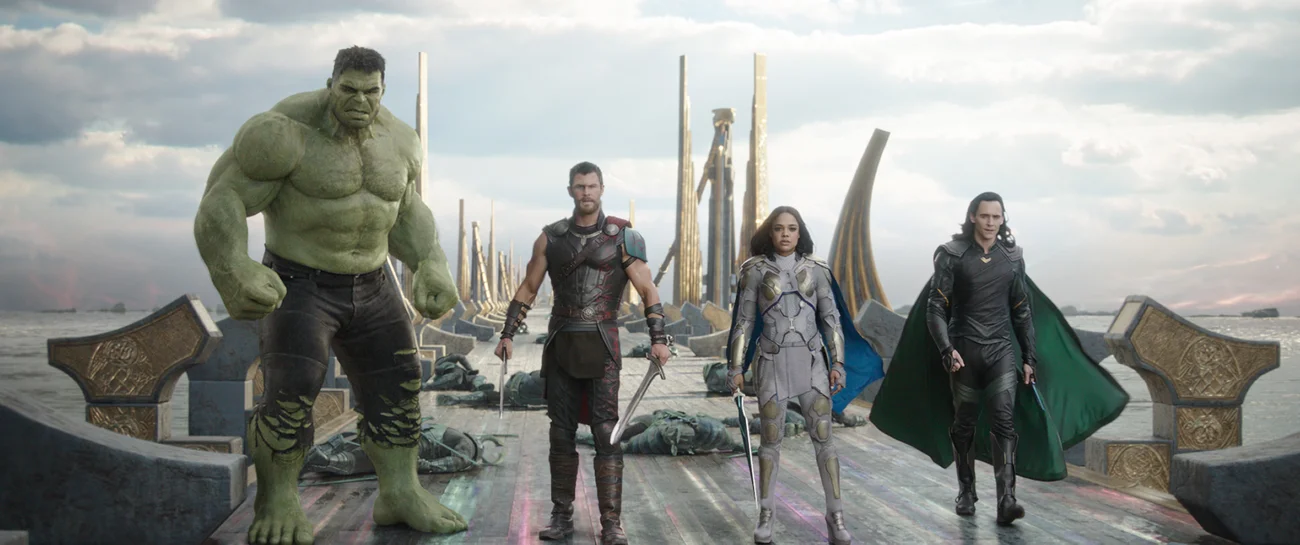
There is a moment, right near the start of the trailer, where Thor is hurled through space and crashes into a vast alien arena. He looks up, bleary and confused, and finds himself face to face with the Hulk. The crowd roars. Electric guitar shrieks. And just like that, everything you thought you knew about Thor gets thrown out of the airlock.
That single shot tells you everything. This is not the Thor of old, the Shakespearean prince standing on a cliff in solemn contemplation. This Thor is getting smashed by the Hulk in a gladiatorial arena while Led Zeppelin's "Immigrant Song" blares, and he is absolutely loving it. The trailer promised a film that looked and felt like nothing the Marvel Cinematic Universe had ever produced before, outrageously colourful, gleefully silly, viscerally exciting. When the film delivered on every one of those promises, the result was something close to miraculous.
What the trailer showed was a kaleidoscope. Neon-lit alien worlds. A massive space dragon. Hela, the Goddess of Murder, casually destroying Thor's hammer with one hand. Jeff Goldblum grinning like a madman on a golden throne. Tessa Thompson soaring through the sky on horseback. Korg, a rock monster made of boulders, delivering deadpan jokes in a gentle New Zealand lilt. It was a kitchen-sink movie, visually inspired by the wild Jack Kirby comic book art of the 1960s and 70s, and it looked absolutely electric. The first trailer debuted at San Diego Comic-Con in July 2017, and the Hall H audience lost their collective minds.
For years, Thor had been the MCU's problem child. Kenneth Branagh's 2011 original was noble but stagey, and Alan Taylor's 2012 sequel, Thor: The Dark World, was widely regarded as one of the franchise's lowest points. Chris Hemsworth was always charismatic, Tom Hiddleston's Loki was a fan favourite, but the films around them felt ponderous and grey. Marvel Studios knew something had to change. Enter Taika Waititi, the New Zealand filmmaker behind the vampire mockumentary What We Do in the Shadows and the coming-of-age comedy Hunt for the Wilderpeople. He was, on paper, the least obvious choice to direct a Marvel blockbuster. That was precisely the point.
Waititi has spoken openly about how he was initially reluctant to take the job. "I had no interest in doing a Marvel movie," he admitted. What changed his mind, he said, was the creative freedom Marvel offered him to reinvent the franchise entirely. He pitched a film that would throw out the old visual language of Thor, the stone castles and stormy skies, and replace it with something wild, something that looked like a prog rock album cover blown up to the IMAX screen. Marvel said yes. The result was a film that earned near-universal acclaim, and is still, years later, the benchmark against which every funny superhero movie is measured.
The Movie
Most superhero franchises hit a wall around their third entry. The novelty has worn off, the beats are getting stale, and the audience can feel the formula creaking. Thor: Ragnarok did not just avoid that wall; it launched over it at warp speed. And the reason it works so brilliantly is that Waititi understood something fundamental about the Thor character that the first two films never quite grasped. Thor is, and always has been, inherently ridiculous. A man with a flying hammer and a magic cape who talks like he just stepped out of a Norse saga and into a modern city. Leaning into that absurdity rather than running from it was the genius move that changed everything.
What the film argues, quietly but consistently, is that identity is not fixed. Thor enters the story still defining himself by the symbols of his power, his hammer Mjolnir, his royal lineage, his place in Asgard. Over the course of the film, those symbols are stripped away one by one, and what remains is something more interesting: a person figuring out who he actually is without the costume. It is a surprisingly resonant thread for a film this comedic, and Waititi trusts the audience to find it without ever belabouring the point. The film never stops to deliver a speech about this. It simply shows us a man losing everything and discovering that the loss is also a kind of freedom.
The other thing that separates Ragnarok from the rest of the MCU is its tone. It is, scene for scene, the funniest superhero film ever made. Not because it undercuts its emotional stakes, like so many Marvel films have been accused of doing, but because it commits so fully to the comedy that the humour becomes its own form of sincerity. The jokes are not deflections. They are the point. When Korg cheerfully describes his failed rebellion, the comedy lands because the characters are genuinely living in this absurd world, not winking at the camera from outside it. Waititi treats the ridiculous with complete seriousness, and that is what makes it hilarious. This commitment to playing it straight within the absurd extends to every performance. Chris Hemsworth, freed from the burden of playing Thor as a noble stoic, discovers a comic timing that was hiding in plain sight across five previous appearances.
What separates this film from its genre peers is its willingness to let the audience be smart. There is no hand-holding, no exposition dumps explaining why things matter. The film drops you into Sakaar and lets you figure out the rules. It introduces Hela and trusts you to understand the threat without a five-minute backstory. The MCU had, by this point, developed a reputation for over-explaining everything, for pausing the action to make sure every viewer understood every detail of the plot. Ragnarok breaks that pattern completely. It is fast, it assumes you can keep up, and it rewards you for paying attention. That confidence, that refusal to over-explain, gives the film a lightness that most blockbusters desperately lack.
The film also has something to say about power and legacy, themes that run beneath the neon surface without ever becoming heavy-handed. Asgard, as presented in the first two films, was all gleaming stone and solemn ceremony. Ragnarok peels back that golden exterior and asks what was being hidden underneath. The answer is uncomfortable: a history of conquest, of imperial violence papered over with mythology. Hela is not just a villain; she is the return of Asgard's repressed past, the bloody truth that Odin built his kingdom on genocide and then spent centuries pretending otherwise. The film does not belabour this point, but it is there in every frame of Hela's scenes, in the murals she tears down, in the way she looks at the golden palace with the contempt of someone who remembers what it was built on.
Then there is the Thor and Loki dynamic, which Waititi handles with remarkable subtlety. After five films together, the brotherly routine could have grown stale. Instead, Waititi uses the movie to quietly shift the terms of their relationship. These two characters who have spent years as adversaries, uneasy allies, and reluctant family, finally reach a point of mutual recognition without either of them ever saying so outright. No big speech, no dramatic declaration. Just two people who have known each other their entire lives, finally understanding where they stand. It is the kind of character work that most superhero films do not have the patience for, and it is one of the reasons Ragnarok endures.
What details most people miss? Watch the way Sakaar is colour-coded. The Grandmaster's palace is all gold and warm tones, suggesting decay masquerading as opulence. The junk planet itself is awash in rust oranges and teals, a world built on the discarded scraps of a thousand civilisations. Every frame feels like a Jack Kirby splash page brought to thrashing, pulsating life. Then notice how Asgard, the "noble" kingdom the first two films treated with such reverence, is recontextualised here. Loki has been impersonating Odin, and his version of Asgard is all theatre and spectacle, a propagandistic golden curtain pulled over something rotten. Ragnarok does not just question Asgard's mythology; it argues that the mythology was always a lie.
Waititi stages action like a comedian, finding the joke in every confrontation. The film understands that humour and tension are not opposites. They amplify each other. A fight scene in Ragnarok can be genuinely thrilling and genuinely funny in the same breath, and that duality is what makes its set pieces superior to the anonymous CGI brawls that plague so many of its peers. The camera work stays loose and handheld where other Marvel films would go for sweeping grandeur, giving everything an energy that feels almost indie.
Underneath all the jokes and the colour and the spectacle, there is a film about letting go. Letting go of who you were told to be. Letting go of the symbols you thought defined you. Letting go of the past so you can build something new. It is a theme that resonates far beyond the MCU, and it is delivered with such lightness, such genuine warmth, that you feel it without ever being told to. That is the magic of Ragnarok. It trusts you to keep up, trusts you to feel things without being manipulated, trusts you to find the meaning underneath the mayhem. And every single time, you do.
Consider what Ragnarok meant in the context of the MCU at large. By its seventeenth entry, the franchise was starting to feel the weight of its own continuity. Every film had to set up the next, every character arc had to dovetail into the overarching saga. Ragnarok gleefully ignores much of that obligation. It references the wider universe when it is funny or useful, and ignores it when it is not. The result is a film that feels liberated from the connective tissue that was beginning to strangulate the franchise. It proved that an MCU film could be genuinely standalone, genuinely surprising, and genuinely fun without betraying the larger project. In doing so, it set the template for what a confident blockbuster could be: not a delivery mechanism for plot points, but an experience unto itself.
There is also something to be said about the film's relationship to its own genre. The superhero movie, by 2017, had become the dominant form of popular entertainment, and yet most entries played it safe. They hit the expected beats, delivered the expected twists, and wrapped up with the expected teaser for the next instalment. Ragnarok plays like a film made by someone who loves the genre enough to take it apart and put it back together in a new shape. It understands what makes these stories work, and it pushes those elements to their most entertaining extreme without ever losing sight of why they matter. That is a difficult balance, and Ragnarok nails it with a lightness of touch that belies how hard it must have been to achieve.
The People
What happened on the set of Thor: Ragnarok is the stuff of Marvel legend. Waititi encouraged his cast to improvise, and by most accounts, roughly 80 percent of the dialogue you hear in the final film was made up on the spot. Chris Hemsworth, who had spent six years playing Thor as a relatively straight-laced hero, was suddenly set free to be funny, goofy, and vulnerable all at once. He has said that working with Waititi brought out sides of the character he did not know were there. "Taika just has this way of making you feel safe enough to try anything," Hemsworth recalled in interviews. "You'd walk onto set with a rough idea of the scene, and then you'd just play." The result is arguably Hemsworth's finest performance in the MCU, a Thor who is simultaneously the most ridiculous and the most likeable version of the character.
Tom Hiddleston, by contrast, was navigating something bittersweet. He has hinted in interviews around the time of Ragnarok's release that he sensed this might be one of his final turns as Loki, and there is a relaxed ease to his performance here, a willingness to let Loki be petty and vain and hilarious without the grim desperation that defined earlier appearances. His improvised moments are among the film's biggest laughs. Hiddleston has spoken about how Waititi's approach gave him permission to stop protecting the character. "With Taika, there was this understanding that Loki didn't have to be taken seriously to be effective," he noted. "The more ridiculous he was, the more dangerous he became, because you never knew what he'd do next." It is a fitting high point for a character who had been the emotional anchor of the Thor series from the very beginning.
Then there is Cate Blanchett as Hela, the Goddess of Murder and Thor's previously unknown elder sister. Blanchett has spoken about how she was drawn to the role because of Waititi's vision. "He pitched her as the villain who has been locked away for thousands of years and comes back to find everything has moved on without her," Blanchett said in a press conference. "She's powerful, yes, but she's also deeply hurt." That duality gives Hela a dimension that most MCU antagonists lack. She is not merely a destroyer; she is a scorned heir returning to claim what she sees as rightfully hers. Blanchett clearly relished the opportunity to let her villain be both terrifying and darkly funny. She has said in interviews that she rarely gets to play characters who are allowed to be physically menacing, and she threw herself into the role with evident glee, bringing a theatrical sensuality to Hela that makes every scene she enters feel charged with danger. That she was willing to take what could have been a one-note villain role and find genuine pathos within it is a testament to her instincts as an actor.
Jeff Goldblum's Grandmaster is a masterclass in casting. Goldblum brings his signature oddball cadence, those halting pauses and sudden emphatic bursts, and applies them to an immortal alien who treats genocide as entertainment. He plays the character as a kind of childish cosmic showman, entirely amoral but so charismatic that you find yourself charmed despite yourself. Goldblum has said the role was a joy to play because Waititi gave him total freedom to embellish. "Taika would just say, 'Do more Goldblum,'" he told interviewers. The result is a performance that feels like it was beamed in from a parallel universe where Goldblum has always been a supervillain. There were reportedly extensive conversations about how to make Grandmaster feel genuinely ancient and alien rather than simply eccentric, and Goldblum worked with the costume and makeup team to develop physical mannerisms that suggested a being who had lived so long that mortality had become an abstract joke. The hand gestures, the way he tilts his head mid-sentence, the sudden bursts of enthusiasm followed by languid indifference, all of it was built collaboratively on set.
Tessa Thompson's Valkyrie is arguably the film's secret weapon. She arrives as a washed-up, booze-soaked former warrior who has spent years running from the trauma of watching her entire sisterhood get slaughtered. Thompson plays her with a weary, sardonic edge that makes every line land. "She's dealing with PTSD, and she self-medicates with alcohol," Thompson told Vanity Fair. "But she's also the most grounded person in the film. Everyone else is larger than life, and she's just trying to get through the day." That groundedness is what makes Valkyrie essential. She is the audience's entry point into this insane world, the person who reacts the way a real person would if they were suddenly swept up in a mythological space opera.
Perhaps the most remarkable thing about the production was Waititi's own performance as Korg, the gentle Kronan rock creature who becomes Thor's unlikely gladiator ally. Waititi performed the role in a motion capture suit, providing both the voice and the physicality. Korg is a triumph of character creation, entirely CGI but rendered with such warmth and specificity that he feels more human than half the live-action cast. His deadpan delivery of lines like "I have seventeen people killed, but I don't count my stepfather" became instant memes, but what makes Korg endure is his innocence. He is not cynical, not bitter despite his imprisonment. He is simply, genuinely kind. In a franchise defined by quips and bravado, a character whose superpower is niceness feels quietly revolutionary. Waititi has said the character came from a desire to include something on screen that was purely gentle, a counterbalance to all the ego and aggression that superhero films typically celebrate.
The on-set dynamics reportedly mirrored the film's tone. Hemsworth and Hiddleston, who had been acting together for years, fell into an easy rhythm that let them riff off each other constantly. Thompson has spoken about how welcoming the environment felt, particularly for newcomers joining an established franchise. Goldblum, known for his generosity as a co-star, apparently spent downtime between takes telling elaborate stories that had the entire crew in stitches. Waititi himself set the tone by being the first to look foolish, whether he was demonstrating a physical gag or delivering a deliberately terrible line as Korg to make Hemsworth break. That spirit of collaborative silliness seeped into every frame of the finished film.
The Craft
The visual language of Thor: Ragnarok is its most radical departure from MCU convention, and production designer Dan Hennah deserves enormous credit for that. Waititi explicitly instructed Hennah to draw from the look of Jack Kirby's original comic book art, the bold geometric shapes, the cosmic scale, the vivid clash of primary colours. The result is a film that looks like no other entry in the franchise. Sakaar is the centrepiece: a junk planet orbiting a cosmic wormhole, governed by a tyrant who styles himself as an artist-king. Every set on Sakaar, from the Grandmaster's gaudy palace to the trash-heap gladiatorial arena, feels simultaneously opulent and rotten. Production designer Shaun Lander has said the team drew from sources as varied as 1970s British glam rock, Soviet brutalist architecture, and Ralph Bakshi's animated films. The fusion shouldn't work, but it does, because it is all held together by that Kirby sensibility, big, loud, unapologetically maximalist.
Cinematographer Justin T. Melck shot the film entirely on Arri Alexa 65 cameras, which gave the images a depth and richness that elevated the already-stunning digital environments. But the real star of the cinematography is the colour palette. Sakaar is bathed in warm ambers, salmons, and teals, an environment alien enough to feel otherworldly but warm enough to feel inviting. Asgard, meanwhile, has been subtly redesigned from its appearance in earlier films; Loki's reign has added garish golds and theatrical reds that suggest a regime more interested in appearances than substance. The contrast is deliberate and sharp. You can read the political subtext through the production design alone.
Stephen Mears' editing keeps the film moving at a breakneck pace without ever feeling rushed. The cross-cutting between Sakaar and Asgard acts as a pressure valve: when one storyline starts to sag, the film pivots to the other, keeping the audience perpetually off-balance. The gladiator fight between Thor and Hulk is a particular editing triumph. The sequence is essentially two people who have known each other for years rediscovering each other through violence, and the cuts mirror that emotional beat. Quick, punchy shots during the brawl give way to wider, slower compositions as the fight turns into something almost playful.
Mark Mothersbaugh's score deserves special mention. Better known as the co-founder of the new wave band Devo, Mothersbaugh was an unconventional choice to score a Marvel film, and his work here is unlike anything else in the MCU. He leans heavily on retro synthesisers, creating a synthwave soundscape that nods to 1970s and 80s sci-fi scores while still feeling fresh. The main theme is heroic and strange in equal measure, brass fanfares colliding with electronic pulses. Mothersbaugh has said the retro-synth approach was Waititi's idea, a way to signal that this was a Thor film from a different era. The soundtrack also features "Immigrant Song" by Led Zeppelin, which appears twice in the film and has become indelibly associated with Ragnarok. The licensing fee was reportedly enormous, but it was worth every penny. There is no better sonic accompaniment to the image of Thor summoning lightning on a rainbow bridge.
The visual effects team faced the enormous challenge of rendering Korg, Hulk, and the vast alien environments of Sakaar largely through CGI. The work holds up remarkably well, particularly Korg, whose performance capture gives him a physical weight and tactile presence that many CGI characters lack. The fire demon Surtur, who sits dormant for most of the film before delivering the final destruction of Asgard, is another standout: a towering elemental figure rendered with impressive detail and scale. Taika VFX supervisors Dan Oliver and Kelly Port have spoken about how the team pushed the digital environments to feel textured and imperfect, avoiding the overly clean look that plagues lesser CGI. Sakaar looks like a place where people actually live, even those people are bug-headed aliens and rock monsters.
The Trivia
-
Director Taika Waititi initially turned down the opportunity to direct Thor: Ragnarok. He has said in multiple interviews that he had no interest in helming a large-scale Marvel film and was persuaded only when Marvel Studios gave him broad creative latitude to reimagine the franchise from scratch. His previous films, What We Do in the Shadows, Boy, and Hunt for the Wilderpeople, were all small-scale independent comedies, making his pitch for a kaleidoscopic, Jack Kirby-inspired superhero adventure one of the most unlikely creative leaps in MCU history.
-
The moment when Thor calls the Hulk "a friend from work" was not in the original script. It was suggested to Chris Hemsworth by a Make-A-Wish child who visited the set during filming. Hemsworth loved the line so much he worked it into the final scene, and it became one of the film's most quoted moments. It is a perfect example of how the production's openness to spontaneity produced some of its best material.
-
Waititi performed the motion capture and voice for the character Korg himself, donning a physical performance capture suit on set opposite Chris Hemsworth. He has said in interviews that he was initially worried the character would feel out of place, but the collaborative improvisation between him and Hemsworth made Korg one of the film's most beloved additions. The result is a character who feels entirely alive despite being made entirely of computer-generated rocks.
-
Approximately 80 percent of the dialogue in Thor: Ragnarok was improvised by the cast. Waititi encouraged a loose, playground-like atmosphere on set, giving actors the freedom to try different approaches to each scene and keeping the takes that felt most spontaneous. Screenwriter Eric Pearson's script provided structure and story beats, but the words themselves came largely from the actors. Chris Hemsworth has said it was the most fun he has ever had making a film.
-
Thor: Ragnarok was the first Marvel Studios film to be shot primarily in the Southern Hemisphere. Most of the production took place at Village Roadshow Studios, with Chris Hemsworth's home country of Australia providing both the filming locations and a significant share of the tax incentives that made the production financially viable. The Australian shoots were supplemented by reshoots filmed later in Atlanta, Georgia.
-
The film's production was significantly affected by the response to its first trailer at San Diego Comic-Con in July 2017. After the overwhelmingly positive reception, Marvel and Waititi made the decision to add approximately 30 minutes of additional footage to the film during reshoots, including expanded subplots for certain characters and additional comedic sequences. The final cut ran 130 minutes, making it one of the shorter MCU films despite its epic scope.
-
Jeff Goldblum's Grandmaster costume took hours to apply each day, involving elaborate prosthetics and a full-body makeup process designed to transform Goldblum into the alien ruler of Sakaar. Goldblum has said the transformation was so complete that he felt like a different person when wearing the costume, which helped him find the character's eccentric vocal patterns and physical mannerisms.
-
Cate Blanchett has spoken about how her role as Hela drew on her experiences playing Galadriel in The Hobbit trilogy, but in reverse. Where Galadriel was all light and ethereal beauty, Hela was darkness and physical menace. Blanchett has said she appreciated that Waititi wrote Hela as genuinely threatening rather than ornamental, a villain who could go toe-to-toe with both Thor and Loki and hold her own.
-
Thor: Ragnarok reversed a long-standing Hollywood assumption: that solo superhero sequels always diminish. After two Thor films that felt increasingly like obligations, Ragnarok proved that a third entry could be the best one yet. Its opening weekend set a new record for the biggest November release at the time, and audiences showed up in droves for a reimagining of a character many had written off. The lesson was not lost on the rest of Hollywood: creative reinvention beats formula every time.
-
"Immigrant Song" by Led Zeppelin features prominently in the film, appearing twice during key action sequences. The band reportedly charged a significant licensing fee for the song's use, but the result was so iconic that "Immigrant Song" experienced a massive spike in streaming numbers following the film's release. Waititi has said in interviews that obtaining the Led Zeppelin track was one of his non-negotiable priorities from the very beginning of production.
-
The film's climactic destruction of Asgard was based directly on the Norse mythological concept of Ragnarok, a series of catastrophic events leading to the death of the gods and the submersion of the world. Waititi and his screenwriters used the myth not just as set dressing but as thematic scaffolding: the idea that destruction can be a form of renewal, that sometimes you have to burn everything down to build something better.
-
Karl Urban, who plays Skurge, the Asgardian warrior who defects to Hela's side before redeeming himself in the film's final act, brought his own comedic sensibility to the role. Urban has said that Waititi specifically asked him to underplay Skurge's cowardice, letting the audience find the humour in the character's escalating panic rather than underlining it with broad mugging. Skurge's final stand at the gates of Asgard, screaming as he fights impossible odds, is one of the film's most unexpectedly moving moments.
-
Waititi directed a short film called Team Thor, released before Ragnarok, which showed Thor living in Australia during the events of Captain America: Civil War in the style of a What We Do in the Shadows mockumentary. The short became a viral hit and helped establish the comedic tone audiences could expect from the feature film. A sequel, Team Thor: Part 2, was later released ahead of Thor: Love and Thunder.
The Verdict
Thor: Ragnarok is the rare blockbuster that manages to be both a reinvention and a love letter. It takes everything that wasn't working about the Thor franchise, the portentous tone, the drab colour scheme, the rigid adherence to Shakespearean gravitas, and replaces it with something joyful, messy, alive, and utterly its own. It is a film that looks at the MCU's stodgiest corner and asks, "What if we just had fun with this?" The answer turned out to be the best thing Marvel had done in years.
What makes it endure is not just the jokes, although there are dozens of moments that still hit just as hard on a fifth viewing as they did on the first. It is the warmth underneath the spectacle. Waititi made a film about found family, about broken people finding each other in the most unlikely of places, about a deposed prince who learns that a home is not a building but the people you would burn the world down for. That emotional honesty, wrapped in neon-coloured madness and killer synth beats, gives Ragnarok a heart that many slicker, more calculated Marvel entries lack.
Every few years, this is the one you come back to. Not because the plot is particularly intricate or the themes are revolutionary, but because it feels like hanging out with mates who also happen to be gods and monsters. It is the MCU at its warmest, its funniest, and its most confident. Asgard may be gone, but the spirit of this film? That is never going anywhere.
"You know, I'm 1,500 years old. I've killed twice as many enemies as that, and every one of them would have rather killed me than not succeeded. I'm only alive because fate wants me alive. Thor, Asgard is not a place. It's a people."