Under the Skin (2013)
 Jay Wilde
The Hook
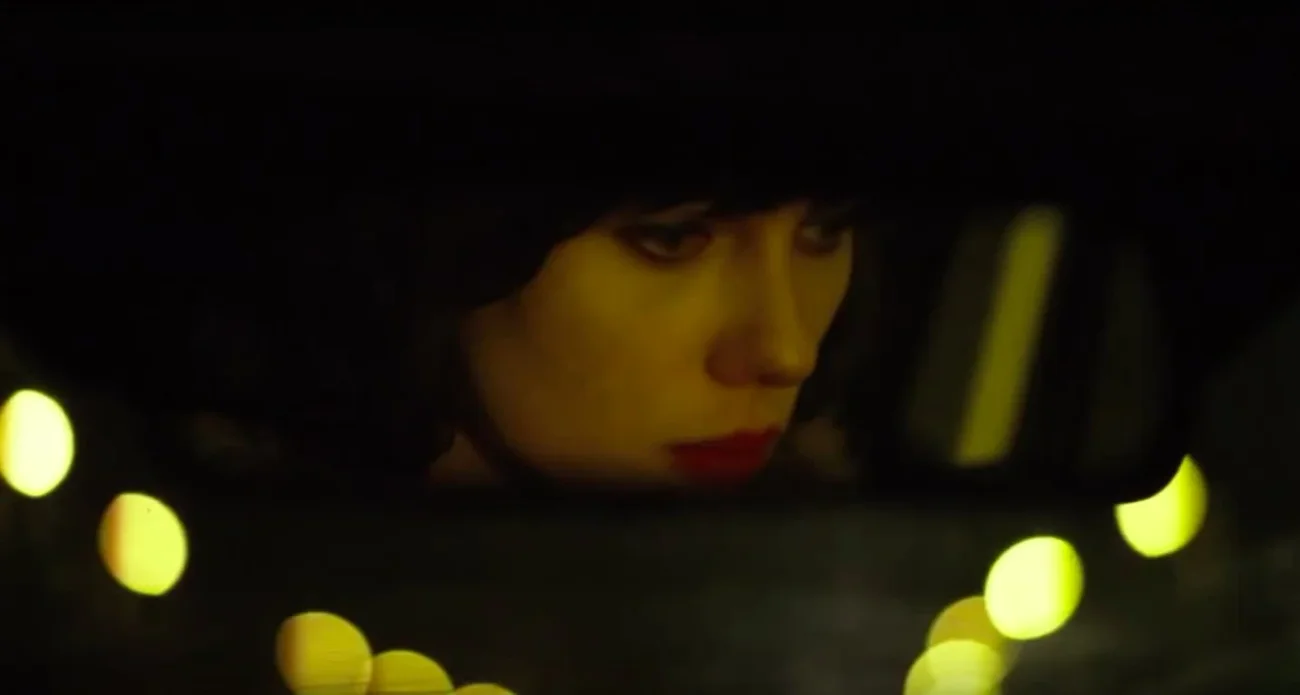
There is a shot in the A24 trailer that haunts me. It is just Scarlett Johansson, sitting behind the wheel of a white Ford Transit van, staring through the windshield at the streets of Glasgow. She is wearing a black fur coat, heavy dark lipstick, a cheap wig. Her face is almost expressionless. She looks like she is studying humans the way a biologist studies bacteria through a microscope. there's no music, just the low hum of Mica Levi's score, all scraping strings and dissonance that sounds less like a film soundtrack and more like the inside of a migraine. The trailer tells you almost nothing about what the film is actually about. It doesn't explain the plot. It doesn't reassure you that everything will be okay. And that's exactly why it works.
What the trailer shows you is a series of fragmentary images. Johansson driving through rain-soaked streets at night. Men approaching the van, leaning in to talk to her through the passenger window. A dark, inky void where bodies float suspended in black liquid like insects trapped in amber. The Scottish Highlands shrouded in fog. It is a trailer that operates on pure atmosphere, pure unease, and it leaves you with the distinct feeling that you have just glimpsed something you were not supposed to see.
The backstory of how this film even got made is almost as strange as the film itself. Jonathan Glazer first decided to adapt Michel Faber's 2000 novel after finishing his debut film Sexy Beast in 2000, but it took over a decade before cameras rolled. Glazer and his co-writer Walter Campbell originally conceived an elaborate, effects-heavy film about two aliens disguised as husband and wife farmers, and Brad Pitt was even cast as the husband. But progress was agonizingly slow, and the script kept getting rewritten. Glazer eventually stripped the story down to its essence, keeping only the female alien character and discarding everything that did not involve her. He described the transformation as "a big, extravagant rock band turning into PJ Harvey."
The result is a film that feels like it was beamed down from another planet, which is, of course, entirely the point. Under the Skin is not really a horror film, though it has moments of genuine horror. It is not really a science fiction film, though its premise is pure sci-fi. It is a film about looking, about the act of observing humanity from the outside, and what happens when that observer starts to feel something she was never designed to feel.
The Movie
The genius of Under the Skin is in what it refuses to show you. In an era of blockbuster alien invasions and CGI spectacle, Glazer made a film about an extraterrestrial that has almost no special effects, no explosions, no grand set pieces. The alien's ship is not a mothership hovering over a city. It is a cramped interior space that looks like a nightmare designed by an architect who has never seen a building. The alien's weapon is not a ray gun. It is her own body, her sexuality deployed as a hunting tool with the cold efficiency of a Venus flytrap. Where most science fiction films explain their aliens through exposition and technobabble, Under the Skin explains nothing. You watch, you feel, and eventually you understand, but only in the way you understand a dream, not a puzzle.
Scarlett Johansson plays the unnamed alien, referred to in the credits only as "the Female." She drives a white Transit van around Glasgow, approaching men on the street, asking them for directions, engaging them in casual conversation. Some of these scenes were filmed with hidden cameras, using real members of the public who had no idea they were talking to one of the most famous actresses in the world. The men are charming, helpful, occasionally flirtatious. They lean into the van window and talk to this woman in the black wig, and you watch them with a sinking feeling because you know where this is heading. The genius of these scenes is in their mundanity. there's nothing overtly threatening about her. She asks about directions, she smiles, she makes small talk. And yet every interaction is charged with menace because we understand the predator-prey dynamic that the men do not.
When she finds a target, she leads them to a nondescript house. They follow her inside, undressing as they go, and step into a void. The void is one of cinema's most extraordinary visual sequences. It is a flat, black, liquid surface that the men walk across as if it were solid ground, following the naked woman deeper and deeper into darkness. The camera stays at surface level, watching them sink gradually, their bodies slowly submerging, their faces registering confusion, then panic, then nothing. It is gorgeous and terrible, and it works entirely through practical effects. What happens beneath that surface is never fully explained. The men float, suspended, their bodies becoming immobile. When the next victim reaches out to touch a previous one, the body collapses, leaving only an empty skin floating in the void as some vital red mass drains away through a trough. It is one of the most disturbing images in modern cinema, and it never shows a drop of blood.
Mica Levi's score is a masterclass in auditory unease. The scraping strings, the dissonant tones, the way the music seems to come from inside the alien's head rather than the environment. It is a score that refuses to comfort the listener, instead amplifying the alien's detachment from the human world. Every note feels designed to make you feel the coldness of her perspective, the way she experiences tenderness as something alien and confusing.
Daniel Landin's cinematography blurs the line between fiction and reality in ways that most films wouldn't dare. The scenes shot with hidden cameras, using real members of the public, have a raw, unpolished energy that no scripted scene could replicate. You can see the genuine reactions of the men leaning into the van, the micro-expressions of confusion or flirtation, and it adds a layer of authenticity that makes the predator-prey dynamic all the more chilling. The Scottish Highlands are captured with a detached, almost clinical eye, emphasizing the alien's isolation in a landscape that feels both familiar and utterly foreign.
The film's real power lies in its later arc, when Johansson's character begins to change. there's a moment when she picks up a man with severe facial disfigurement, played by Adam Pearson, who has neurofibromatosis in real life. She had intended to prey on him like all the others, but something shifts. She looks at him, and then she looks at herself, and she lets him go. It is the turning point of the entire film, and it happens almost without dialogue. Johansson's performance in this scene is remarkable for what it doesn't show. there's no dramatic music cue, no tearful realization. Just a woman looking in a mirror and deciding, for reasons the film never fully explains, to stop being a predator. The film leaves this moment open to interpretation, offering no easy answers about empathy, beauty, or the alien's sudden shift. The film doesn't care which interpretation you choose. It cares that you felt something.
The film offers a sharp subversion of the male gaze that usually defines films starring women like Johansson. Typically, the camera lingers on her beauty, framing her as an object of desire for the male viewer. Here, the gaze is flipped. She is the one watching, the one hunting, using the very societal expectations of female sexuality to lure her prey. It is a clever deconstruction of how women are perceived in media, turning the tables so that the object of desire becomes the predator, and the male subjects become the unwitting victims.
Jonathan Glazer's direction is a masterclass in restraint. After the kinetic energy of Sexy Beast and Birth, he strips away all excess here, leaving only the essential. He trusts the audience to fill in the gaps, to sit with the silence, to find meaning in the alien's blank stares. It is a film that demands patience, but rewards it with a visceral, unforgettable experience that lingers long after the credits roll.
Under the Skin has become a touchstone for independent science fiction, proving that you don't need a blockbuster budget to create something truly alien. It influenced a wave of films that prioritized atmosphere over exposition, mood over plot, leaving a legacy that can be seen in works like Annihilation and The Witch. For a film with almost no dialogue, it speaks volumes about what it means to be human, to feel, to connect.
What follows is a strange, almost unbearably tender shift. The alien wanders the Scottish Highlands, trying to be human. She tries to eat a piece of cake and cannot. She accepts a meal from a gentle man who shows her kindness and tenderness she has never experienced. She examines her own body in a mirror with a mixture of curiosity and horror. She watches television and doesn't understand what she is seeing. These scenes are quiet, patient, and heartbreaking, because they show us what it might feel like to be suddenly aware of your own body, your own mortality, your own capacity for feeling. And in the film's devastating closing moments, she discovers what she really is when another human tears her human skin away, revealing the featureless black form beneath. The logger who attacks her sees only a monster. We see something else entirely.
The film is about empathy, about what it means to suddenly feel something for creatures you were designed to exploit. It asks a question that most alien films never bother with: what if the alien doesn't want to destroy humanity, but instead discovers that she cannot bear to be human? It is a film that trusts its audience to sit with ambiguity, to watch silences, to find meaning in images rather than explanations. It has been read as a meditation on immigration, on gender politics, on the experience of being a woman in a world that views her primarily as an object of desire. All of these readings are valid. None of them is complete. that's what makes the film endure. Jonathan Glazer later noted that the film's ambiguity was intentional, forcing audiences to confront their own biases rather than providing easy answers.
The People
Jonathan Glazer is one of those directors who would rather disappear for a decade than make a film he doesn't believe in. Before Under the Skin, he had made only two features: Sexy Beast in 2000 and Birth in 2004. Both were brilliant. Both were divisive. And then he was gone for nine years, working on Under the Skin in a state of constant revision, unable to find the version of the story that felt right. In an industry that demands annual output and franchise commitment, Glazer chose silence. He made commercials during the long pre-production period, using them as a way to "sketch" ideas and test equipment for the film. Every commercial was a rehearsal for something that might never get made.
Glazer has spoken in interviews about the long gestation period with a kind of weary honesty. "We wrote for three years, each version," he said. "You might write for six months one time and then end up throwing three quarters of it away on a Monday. It was like that." The script went through three different writers before Glazer and Walter Campbell found what they were looking for. The Brad Pitt version was abandoned, the elaborate special effects sequences were stripped out, and the story was reduced to its essential core. Glazer has said that the first writer worked alone and produced a faithful adaptation of Faber's novel, but it was not the film Glazer wanted to make. The second writer collaborated with Glazer for a long period and they made "a lot of great discoveries together," but it still was not quite right. It was only with Campbell that the DNA of the script finally crystallized, and that took another three years.
When asked about the Kubrick comparisons that greeted the film's release, Glazer's discomfort was palpable. "That makes my toes curl up in my shoes," he said. "I think this film, good or bad, should stand on its own or fall on its own. I don't agree with it. I like films that just creep up on you, that you have no introduction to. When you put something in front of that, you are being set up for a fall. It is like a shadow that's not of your own making." This refusal to accept easy labels is part of what makes Glazer's work so distinctive.
Scarlett Johansson was not the first choice. Gemma Arterton was Glazer's original pick, but the film needed a bigger name to secure funding. Eva Green, January Jones, Abbie Cornish, and Olivia Wilde were all considered before Johansson signed on. Arterton later said that she had been Glazer's first choice but "the film needed a bigger star to get funding." Johansson remained committed to the project for four years before it finally went before cameras, and she learned to drive a van and master an English accent for the role.
Glazer has spoken about why casting such a famous actress was important. "It made a great deal of sense to cast somebody very well known out of context," he said. "I remember seeing her walking along the street in a pink jumper on a long lens and she looks like an exotic insect on the wrong continent." And remarkably, Johansson was rarely recognised during the hidden camera shoots. Members of the public did not believe it could really be her driving a Transit van through Glasgow. There were a few times when people recognised her, but Glazer has said it was "surprisingly few. She is not very familiar to people, really, the way she looks. When she is in disguise, driving a Transit van in Glasgow, it doesn't occur to people that she is Scarlett Johansson."
Adam Pearson, who plays the man with facial disfigurement, was not a professional actor. He has neurofibromatosis and had worked in television production. Glazer did not want to use prosthetics for the role and contacted the charity Changing Faces to find the right person. Pearson's own suggestions about how Johansson's character might lure his character were incorporated into the script. He has said in interviews that the experience changed how he thought about vulnerability and connection, and his performance in the scene is one of the most affecting in the film, precisely because it feels unperformable, real in a way that scripted acting rarely achieves.
Jeremy McWilliams, who plays the motorcyclist, was a championship road racer. The film required someone who could ride at high speed through the Scottish Highlands in terrible weather, and McWilliams was able to do things on a motorcycle that a stunt double could not. The logger in the final act was played by the actual owner of a location the production had scouted. Glazer cast him on the spot. In both cases, the casting choice reflects Glazer's broader approach to the film: finding real people and placing them in fictional situations, then capturing what happens.
Johansson has spoken about the experience of filming the nude scenes, which were handled with remarkable restraint given her status as a Hollywood sex symbol. The film's approach to nudity is unlike anything in mainstream cinema. there's no voyeurism, no titillation, no lingering camera. The nudity serves a specific narrative function: the alien has no concept of shame, no understanding of the social rituals surrounding the human body. She removes her clothes because clothes are a human convention, not a necessity. "The way the film frames it, with Johansson having removed almost all of her personality from the character, it doesn't play as even remotely sexual," one critic observed. Johansson herself treated the scenes as a technical challenge rather than a personal revelation, which is exactly the right approach for a film that asks its lead to play something fundamentally inhuman.
The relationship between Glazer and Johansson appears to have been one of deep mutual trust. She waited four years for the film to be made, and in return he gave her a role that required her to strip away everything audiences expected from her. There are no quips, no action sequences, no romantic subplot. Just a face, a body, and a slowly dawning awareness that the world is more complicated than the mission she was sent to complete. It is, in many ways, the performance of her career, and it happened because two people were willing to wait for the right film rather than settle for the easy one.
The Craft
The score by Mica Levi is one of the great film scores of the 21st century, and it sounds like nothing else. Levi, who was only in her mid-twenties when she composed it, created a score built around a viola tuned in an unconventional way, producing sounds that are simultaneously beautiful and deeply unsettling. The main theme is a sliding, dissonant motif that seems to crawl beneath the surface of every scene, creating a constant sense of wrongness, of something alien observing the world through a distorted lens. There are moments where the score sounds almost human, a melody trying to emerge from static, and moments where it retreats into pure noise, as if the alien's inner world is leaking out through the music.
Levi has spoken about approaching the score from the perspective of the alien character. "It's about the space between things," she has said, and the music occupies that space brilliantly. It doesn't tell you how to feel. It creates an atmosphere in which feelings become difficult to identify. The viola slides between notes in ways that classical tuning would never allow, creating microtones that sit in the cracks between the notes you expect. It is the sound of something slightly off, slightly wrong, slightly other. The score received a BAFTA nomination and won the European Film Award for Best Composer, and it launched Levi's career as one of the most sought-after film composers working today, going on to score Pablo Larraín's Jackie and reuniting with Glazer for The Zone of Interest.
Daniel Landin's cinematography is essential to the film's alien quality. The camera moves through Glasgow with the detached curiosity of an anthropologist, capturing the city's brutalist architecture and rain-slicked streets in a way that makes the familiar look strange. there's a technique to the way Landin shoots the van scenes, using long lenses from hidden positions that give the footage a surveillance quality, as if the camera is another alien watching the first alien go about her work. The hidden camera scenes have a different visual texture from the rest of the film, grainier and more immediate, creating a jarring contrast that reinforces the feeling of watching something you should not be seeing.
The void sequences, by contrast, are meticulously composed, the black liquid surface photographed in a way that creates an impossible sense of depth and emptiness. Landin achieved the effect through careful lighting, using reflections and shadows to make a shallow pool look like an infinite abyss. The camera stays at water level, making the men look small and vulnerable as they walk across the surface, their bodies slowly sinking. It is a triumph of practical cinematography, a visual effect created entirely through light and framing rather than digital manipulation.
The production design is deliberately minimal. The van is a work van, not glamorous. The house where the alien lures her victims is a nondescript property that could be anywhere in suburban Scotland. The void interior was a custom-built set, designed to look like a space that doesn't obey the normal rules of physics. Everything is functional, nothing is decorative, which is the perfect design language for a character who doesn't understand human aesthetics. Glazer and his team were not building a world. They were stripping one down to its essentials.
Paul Watts's editing deserves particular praise for its patience. Under the Skin takes its time. There are long stretches with almost no dialogue, scenes that linger on faces or landscapes or the surface of that black liquid void. In lesser hands, this would be self-indulgent. Here, it is hypnotic. The pacing mirrors the alien's experience of the world, slow and methodical and attentive to details that humans would overlook. The editing creates a rhythm that draws you in gradually, so that by the time the film reaches its final act, you are operating on its wavelength, feeling what it feels rather than thinking about what it means. Watts understood something crucial about the film: that the silences are not empty. They are full of something the alien cannot name, and neither can we.
The sound design works hand in hand with Levi's score to create a world that feels acoustically wrong. The void sequences have a muffled, underwater quality, as if sound itself is being swallowed along with the men. The Glasgow street scenes are filled with the ambient noise of a real city, traffic and voices and wind, but filtered through the alien's perspective they sound different, more alien. Glazer has spoken about the importance of sound in the film, even quizzing interviewers about the quality of the sound systems in the cinemas where they watched it. The film was mixed for a specific kind of theatrical experience, one where the bass frequencies vibrate in your chest and the high frequencies make your teeth ache. It is a film that was designed to be felt as much as seen.
The Trivia
-
The film took over a decade to make. Jonathan Glazer first decided to adapt Michel Faber's novel after completing Sexy Beast in 2000, but work did not begin in earnest until after his second film, Birth, was finished in 2004. The script went through three different writers over the intervening years before Glazer and Walter Campbell found the version they wanted to film. Each version took roughly three years of writing and rewriting, with large portions discarded on a regular basis.
-
Brad Pitt was originally cast as the husband in an earlier version of the script that featured two aliens disguised as a farming couple. This version was far more elaborate and effects-heavy, and Glazer eventually abandoned it entirely in favor of the stripped-down single-character story we got. The shift from a Pitt-led blockbuster to a low-budget experimental film represents one of the most radical creative pivots in modern cinema.
-
Glazer described the process of simplifying the script as "a big, extravagant rock band turning into PJ Harvey." He and Campbell deleted every scene that did not involve the female alien character, including all the special effects sequences, which is why the film that resulted has almost no conventional VFX. They also removed all character names, so the credits list roles as "the Female," "the Bad Man," "the Swimmer," and so on, reinforcing the film's sense of alienation.
-
Gemma Arterton was Glazer's first choice for the lead role, but the film needed a bigger name to secure financing. Eva Green, January Jones, Abbie Cornish, and Olivia Wilde were all considered before Scarlett Johansson was cast. In a 2015 interview, Arterton revealed that she had been Glazer's original pick but acknowledged that the production needed someone with greater international recognition to attract investors.
-
Johansson remained committed to the project for four years before it was finally made. During that time, she learned to drive a van and mastered an English accent for the role. The dedication was remarkable given her busy schedule with Marvel films and other major productions, and it speaks to how strongly she believed in Glazer's vision.
-
Most of the cast had no acting experience. The man with facial disfigurement was played by Adam Pearson, who has neurofibromatosis and had worked in television production rather than acting. The logger in the final act was played by the actual owner of a location the crew had scouted. Jeremy McWilliams, the motorcyclist, was a championship road racer cast because the film required someone who could actually handle high-speed riding through the Scottish Highlands in terrible weather.
-
Much of the film was shot with hidden cameras, including the scenes where Johansson's character picks up men in the van, the nightclub scenes, and the shopping centre sequences. Real members of the public were filmed without their knowledge, and the production team had to track them down afterward to get their consent. Glazer has said some people said yes and some said no, so certain scenes were cut because the subjects refused to allow their footage to be used.
-
The crew built their own cameras specifically for the film. Glazer needed cameras small enough to hide in the van's dashboard and in street furniture around Glasgow, but with enough quality for cinema projection and visual effects work. They built ten custom OneCam units, sometimes using two at once and sometimes deploying all ten simultaneously. The technology did not exist off the shelf, so they invented it.
-
Despite being one of the most recognisable actresses in the world, Johansson was rarely spotted during the hidden camera shoots. Glazer has said this was because she was in disguise and out of context. "It doesn't occur to people that she is Scarlett Johansson when she is driving a Transit van in Glasgow," he observed. She wore a black wig, heavy makeup, and a nondescript fur coat, and the combination of the disguise and the unlikely setting made her effectively invisible.
-
Mica Levi composed the score using a viola tuned in an unconventional way, creating sliding, dissonant sounds that became the film's sonic signature. It was Levi's first film score, and it earned her a BAFTA nomination and the European Film Award for Best Composer. The score has since been recognised as one of the most influential film compositions of the 2010s, inspiring a generation of experimental film composers.
-
The film appeared on more than fifty year-end top ten lists in 2013 and 2014. Its lasting artistic legacy has made it a case study in how challenging cinema can endure beyond its initial release, influencing a generation of experimental filmmakers.
-
Under the Skin was ranked 61st on the BBC's 100 Greatest Films of the 21st Century list and appeared on numerous best-of-the-decade lists for the 2010s. Its reputation has only grown since its release, and it is now widely regarded as one of the defining science fiction films of the century. In 2023, it was named the best British film of the 21st century by one major publication.
-
The film is thought to be inspired by the Scottish folklore of the Baobhan sith, female vampire-like creatures who prowl during the night preying on men. Glazer was drawn to the idea of an alien perspective on the human world, but the Scottish setting connects the film to something much older and more primal. The Baobhan sith were said to appear as beautiful women who danced with men in the moonlight, then revealed their true nature and drained their victims of blood.
-
Adam Pearson's own suggestions about how Johansson's character might lure his character were incorporated into the final script. Glazer encouraged Pearson to shape the scene, which gives the encounter an authenticity that a scripted approach could never have achieved. Pearson later said that Glazer's approach made him feel like a collaborator rather than a prop, and his performance reflects that trust.
-
The void sequences, where men walk across a black liquid surface and slowly submerge, were achieved entirely with practical effects. The set was a shallow pool covered with a thin layer of black material, and the submersion effect was created through careful lighting and camera placement rather than CGI. The "men" floating beneath the surface were actually filmed in a separate take and composited in camera using the reflective properties of the liquid, creating the illusion of depth that looks impossible but was entirely real.
-
A24 acquired the US distribution rights and released the film in April 2014. The company was still a young distributor at the time, and Under the Skin became one of the defining films of their early catalog. It helped establish A24's reputation for releasing challenging, artistically ambitious cinema that major studios would not touch. Without Under the Skin, the A24 brand as we know it might look very different today.
The Verdict
Under the Skin is the kind of film that rewires how you see the world for about two hours after you watch it. The streets look different. The people around you look different. You find yourself observing human behaviour with the same alien curiosity that Johansson's character brings to her hunt through Glasgow. It is a film that takes a simple premise, an alien disguised as a woman, and uses it to ask the most fundamental question: what does it feel like to be a body moving through a world of other bodies?
Glazer made a film that refuses to hold your hand. It doesn't explain its mythology. It doesn't resolve its mysteries. It doesn't offer you the comfort of understanding. What it offers instead is something rarer, an experience that lives in your nervous system rather than your memory. The image of bodies floating in that black void, the sound of Levi's score scraping against your eardrums, the look on Johansson's face when she gazes at her own reflection and sees something she doesn't recognise. These things do not go away.
It is also a film that has only grown in stature since its release. Named the best film of 2013 by multiple critics, ranked among the greatest films of the century by the BBC, and now regarded as one of the defining works of the 2010s, Under the Skin proved that you do not need a hundred million dollars or a franchise to make a science fiction film that matters. You need a director willing to spend a decade finding the right story, an actress willing to spend four years waiting for that story to be told, and a composer who can make a viola sound like the sound of alienation itself.
This is not a film for everyone. It is slow. It is strange. It is often uncomfortable. But if you let it get under your skin, it stays there.
"Are you alone?"