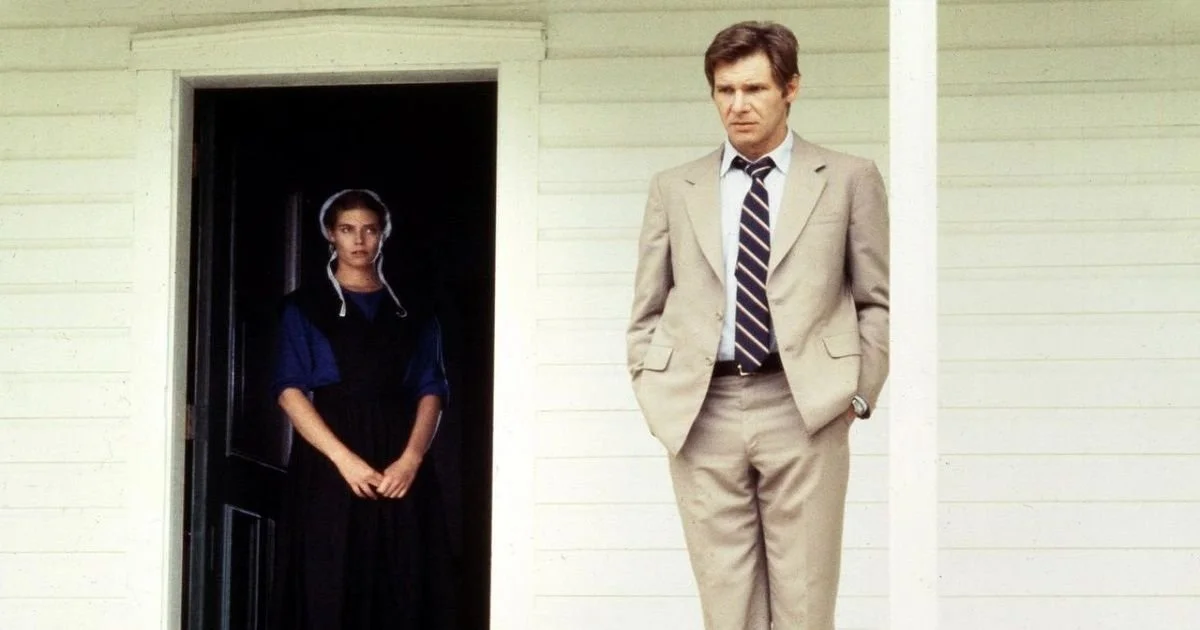
Witness (1985)
 Jay Wilde
The Hook
There is a shot in the trailer for Witness that has nothing to do with murder, corruption, or the plot. It is Harrison Ford standing at a barn raising, sleeves rolled up, hammering nails into a wooden frame alongside a community of Amish men who do not know he is a fugitive. The sun is high. The camera is steady. there's no music. And something about the image, the stillness of it, the way Ford's body language has shifted from coiled detective to something almost peaceful, tells you immediately that this is not going to be the cop movie you expected.
The trailer lays out the bones of the story without spoiling its heart. Eight-year-old Samuel Lapp witnesses a murder in a Philadelphia train station. Detective John Book is assigned to the case. The trail leads inward, back into the police department itself, and suddenly the man meant to protect the boy becomes the boy's only hope of survival. But what the trailer really sells is the contrast: the grey steel of the city against the golden fields of Lancaster County, the noise of a precinct against the silence of a community that has chosen to live without it. You see Ford leaning against a wall in a dark corridor, gun drawn, and then you see him dancing awkwardly at a gathering, and you understand that both scenes carry equal weight in this film.
The production history of Witness is a story about how nearly everything went wrong before almost everything went right. The screenplay, originally titled Called Home (the Amish term for death), had been circulating in Hollywood for years. It was based on an idea by Pamela Wallace, expanded by her husband Earl W. Wallace and fellow television writer William Kelley, whose earliest version traced back to a 1972 Gunsmoke episode. The script ran 182 pages, roughly three hours of screen time. Producer Edward S. Feldman saw the potential but felt the draft spent too much time on Amish traditions and not enough on the thriller mechanics that would get a studio to greenlight it.
Feldman took the script to 20th Century Fox, where it was rejected. Fox did not make "rural movies," the head of production told him. Even after Harrison Ford's agent confirmed his client wanted the lead role, Fox still passed. Every major studio said no. Feldman eventually landed the film at Paramount Pictures, his first choice of director was Peter Weir, an Australian filmmaker who was deep in pre-production on The Mosquito Coast and passed. John Badham dismissed it as "just another cop movie." David Cronenberg was offered the chair and declined, later saying he "could never be a fan of the Amish." When The Mosquito Coast lost its funding, Weir became available, and Witness became his first American film. The urgency was real: a Directors Guild of America strike was looming, and the production had a narrow window to get in front of cameras.
What emerged from that chaos is one of the most quietly radical American thrillers of the 1980s. A film that uses the conventions of a police procedural to smuggle in a meditation on violence, community, and what happens when a man built for conflict is forced to sit still.
The Movie
Witness is less a thriller than a study of two worlds colliding, and what each has to teach the other. Peter Weir, the Australian director who made his name with thoughtful, atmospheric films like Picnic at Hanging Rock and The Year of Living Dangerously, brings a quiet, observant, and distinctive eye to the American neo-noir. He does not rush the story. He does not lean on genre tropes of car chases or shootouts to keep the audience engaged. Instead, he lets tension simmer in the silence between cultures, making the film's 112 minutes feel both sparse, deeply layered, rewarding, and truly memorable. Weir's approach to directing Harrison Ford was unconventional, asking the star to underplay scenes rather than deliver the heroic performances audiences expected from him.
The greatest strength is how it treats the Amish community not as a quaint backdrop for a cop story, but as a living, breathing argument for a different way of living. Weir has said in interviews that he spent months living among Amish communities in Lancaster County before filming, determined to portray their lives with accuracy and respect rather than as a Hollywood stereotype. This care shows in every frame: the way the community moves together during shared labour, the unspoken rules that govern every interaction, the way violence is not just avoided but actively rejected as a core tenet of their faith.
For John Book, a man whose entire career is built on the use of force, this is a revelation. Harrison Ford, best known at the time for his swashbuckling roles as Han Solo and Indiana Jones, delivers a performance of remarkable restraint here. Weir later noted of Ford: "Harrison possesses a rare quality: he can be still. Most actors feel they have to fill the silence. Harrison is comfortable with it." He does not play Book as a tough guy out of water, but as a man who slowly realises that the tools he has spent his life mastering are useless in this place. There is a small moment early in his time on the farm where he reaches for his gun out of habit, then stops, remembering where he is. It sums up the film's central theme: the hardest thing a violent man can learn is how to be still.
The romance between Book and Rachel Lapp is handled with similar restraint, avoiding the overwrought melodrama that often plagues cross-cultural love stories. Kelly McGillis brings a quiet strength to Rachel, a widow torn between duty to her community, love for her son, and growing feelings for a man who represents everything her people reject. The film never rushes their relationship. It builds in small moments: a shared glance across a dinner table, a conversation while working in the fields, the unspoken understanding that their worlds are too different for a happy ending. Ford matches her beat for beat, stripping away the charisma that made him a star to play a man who is uncertain, vulnerable, and trying to be better than his instincts.
The film's visual storytelling reaches its peak without dialogue, relying on community action to convey belonging and acceptance. Weir shoots wide, steady shots that let the rhythm of shared labour speak for itself. Book transitions from observer to participant, hammering nails alongside men who reject violence entirely. Maurice Jarre's score swells gently here, adding warmth without overwhelming the moment. This is community affirming its values while allowing an outsider to join them. It works because it is earned, not forced.
The supporting cast is equally strong. Young Lukas Haas delivers a naturalistic performance as Samuel, never falling into child actor clichés, while Danny Glover shines early in his career as the corrupt McFee, bringing a quiet menace to the role. Alexander Godunov as the earnest suitor Daniel adds gentle tension to the love story, perfectly capturing the conflict between community expectation and personal desire.
Production designer Stan Jolley, who had worked on films like The Sting and The Great Gatsby, brought meticulous attention to detail that made the Amish world feel authentic. He spent months visiting Lancaster County, measuring furniture, studying how light moved through Amish windows, and understanding the geometry of a barn raising. The Amish farm was a real working property, not a soundstage, with Jolley insisting that every prop, from the bonnets to the work boots, be sourced directly from Amish communities. His approach avoided the 'movie farm' aesthetic, ensuring that the Lapp household felt like a place where people actually lived, worked, and prayed together. Jolley's design philosophy was to let the Amish environment speak for itself, using authentic materials and period-accurate construction techniques throughout the production.
What separates Witness from its genre peers is its refusal to frame non-violence as weakness. When the story returns to its thriller roots, the violence is quick, brutal, and deeply uncomfortable, not the stylised action of a standard cop movie. The film's argument is clear: the Amish do not reject violence because they are afraid, but because they have chosen a better way. The resolution relies on the collective presence of a community that refuses to look away. Non-violence, the film suggests, is not a passive absence of action, but an active, strategic choice that violent men cannot comprehend, let alone defeat. Weir has said this was the core message he wanted audiences to take away from the film. The film challenges the audience to consider whether our reliance on force is a strength or a limitation, a question that remains provocative decades later.
Cinematographer John Seale uses natural light for the Amish sequences, giving the countryside a golden, lived-in glow that contrasts sharply with the cold, fluorescent greys of the Philadelphia scenes. The way he frames the Amish community in wide shots emphasizes their collective identity, contrasting with tighter, more isolated frames for Book in Philadelphia. He avoids flashy camera work, relying instead on steady, observant frames that let the performances and the setting breathe. The editing by Thom Noble is equally precise, cutting between the two worlds to highlight their differences without ever feeling choppy. Thom Noble's editing ensures that the transition between the two worlds feels seamless, never jarring the audience but always emphasizing the contrast. Even the smallest details, like the way Amish characters move with a deliberate slowness that clashes with Book's big-city hurry, add to the film's layered storytelling. Maurice Jarre's score is similarly restrained, using simple, folk-inspired melodies that never overpower the action, perfectly matching the Amish community's rejection of excess. The visual argument is clear: light and space reflect moral choices, with the Amish world offering warmth that violence cannot match.
Recognition came at the 58th Academy Awards, where the film earned eight nominations including Best Picture and Best Actor for Ford, winning two for Best Original Screenplay and Best Film Editing. It also won the Writers Guild of America Award for Best Original Screenplay and a BAFTA for Maurice Jarre's score. Decades later, it remains one of the most thoughtful entries in the neo-noir genre, praised for its respectful portrayal of Amish life and its refusal to take the easy route of stylised violence.
The influence extends far beyond its initial release. It proved that a thriller could succeed without relying on non-stop action, paving the way for slower, more character-driven entries in the genre. Its respectful portrayal of Amish life also set a standard for cross-cultural storytelling in Hollywood, showing that marginalised communities could be depicted with depth and dignity rather than as stereotypes. The film challenged Hollywood's assumption that audiences only wanted violence, opening doors for thoughtful films that trusted their intelligence.
The film was a sleeper hit upon release, proving that audiences were hungry for thoughtful, character-driven thrillers that respected their intelligence. It outperformed several big-budget action films released the same year, demonstrating that substance could still draw crowds in the era of blockbusters.
Witness is a film that stays with you not because of what happens, but because of what it makes you think about. It asks whether the way we live is the only way, whether violence is ever truly necessary, and what we lose when we choose force over understanding. For a 1985 thriller, that is a remarkably bold set of questions, and Weir answers them with a quiet confidence that has kept the film relevant for decades.
The People
Harrison Ford was not the first choice for John Book. He was not even the second choice. But he was the actor who understood what the role required, and his commitment to the part transformed what could have been a standard thriller into something genuinely personal.
Ford had just come off Indiana Jones and the Temple of Doom and was looking for something that would let him play a character without a whip or a fedora. When his agent Phil Gersh sent him the Witness screenplay, Ford called producer Edward S. Feldman four days later to say he was in. Before filming began, Ford spent weeks with the homicide division of the Philadelphia Police Department, shadowing detectives, learning their rhythms, studying how they carried themselves in a room. The work shows in every frame. Ford doesn't play John Book as a hero. He plays him as a professional who is very good at a job that requires him to be constantly alert, and who slowly, reluctantly, allows himself to relax. Ford has said he appreciated the chance to play a character whose strength came from restraint rather than action.
Kelly McGillis's casting was almost accidental. Peter Weir was frustrated with the auditions he had seen for Rachel Lapp and instructed his casting director to look in Italy, believing that Italian actresses might bring a more grounded, "womanly" quality to the role. While reviewing Italian audition tapes, McGillis walked in for her own audition in the United States. She put on the Amish bonnet, spoke a few lines, and Weir immediately knew she was Rachel. To prepare, McGillis moved in with an Amish widow and her seven children, learning to milk cows and practicing the Pennsylvania German dialect that Rachel speaks. The authenticity shows in the way she moves through the farmhouse, the way her hands know where everything is.
Lukas Haas was eight years old when he was cast as Samuel, and his performance anchors the entire film. Weir discovered Haas through director Lynne Littman, who had recently worked with the boy on Testament (1983) and recommended him for the part. Haas brings a watchful, serious quality to Samuel that never tips into precociousness. The scenes where he sketches the murder suspect are played with total concentration, and the film trusts him to carry moments of genuine weight without adult actors propping him up.
The supporting cast is stacked with discoveries and unexpected choices. Alexander Godunov, a former ballet dancer who had never acted before, was cast as Daniel Hochleitner, Rachel's Amish suitor, on the recommendation of the casting director, who knew him personally and thought his physicality and quiet intensity were right for the part. Godunov brings a dignity to the role that makes the love triangle feel real. Danny Glover, years before Lethal Weapon made him a star, plays McFee with a chilling calm, a corrupt cop who sees nothing wrong with what he does. And in an early film role, Viggo Mortensen appears briefly as Moses Hochleitner, Daniel's brother. Mortensen later credited his experience on Witness as the catalyst for his film career, saying that the positive experience on set convinced him to pursue acting over other paths. He initially almost turned down the role to perform in Shakespeare in the Park, but his agent convinced him to take the one-day shoot. Weir was so impressed with Mortensen's presence that he expanded the role to last six weeks. As Mortensen recalled: "The part was actually written to be just a day's work... Peter Weir came over to the table where I was sitting with some of the other actors and asked, 'Can I talk to you for a minute?' I felt like maybe I said the thing in German wrong! He said, 'What are you doing the next six weeks?'" That chance encounter launched Mortensen's decades-long film career.
Weir himself was an outsider in Hollywood, and the film benefits from his perspective. An Australian who had built his reputation on films like Picnic at Hanging Rock and Gallipoli, Weir brought a visual sensibility shaped by landscapes, by the way environment shapes behaviour. He drew on 17th-century Dutch Masters, particularly Vermeer, for the lighting and composition of the farmhouse scenes. He and cinematographer John Seale visited an exhibition at the Philadelphia Museum of Art and studied how Vermeer used window light to create depth and intimacy. That influence is visible in every scene where Book recovers in Rachel's house: the soft light, the muted palette, the sense that these interiors are sacred spaces.
Weir's vision for the film was far more nuanced than the original script's writers intended. He joined the project after the screenplay was complete and Harrison Ford was attached, but immediately began making changes. "On Witness, I gave my notes to the writers and it wasn't working the way I've described, so I rewrote it and sent it back to them to put it through their typewriter," Weir recalled. The writers were shocked at his edits: he added more Amish ambience, toned down the overt love story he felt was "rather tacky", and lessened the violence at the end. One writer even asked him, "Don't you want to be walking up the steps at the Dorothy Chandler Pavilion to get your Academy Award?" Weir also imposed a self-imposed Hays Code on the romance, refusing to film explicit scenes and instead focusing on the characters' gazes and unspoken tension. He cut two full pages of dialogue where Ford and McGillis explained their feelings, trusting the audience to understand without being told. "The producer told me that the studio would never accept it because we need to know what they are feeling," Weir said. "I knew that if I had done my job properly, you would know exactly how they were feeling by the time it was all cut together."
Cinematographer John Seale recalled Weir's meticulous approach to even the violent scenes: "Peter walked around the farm looking for a way to kill someone beautifully." This restraint extended to the entire production, proving that a film could be both thrilling and thoughtful.
Ford himself valued the collaboration, later stating: "I supply (Weir) with something, he supplies me with something. We both benefit from the exchange. Peter has a vision and it's not always articulatable... I'm the assistant storyteller."
As Weir has noted about the film's central tension: "The conflict between Amish and non-Amish reflects well on the Amish ways, and it also serves as a redemption story for Captain Book, who regains a new sense of humanity during his displacement in the Amish community." Weir has often said that the film's message is ultimately about the possibility of change, showing that even a man hardened by violence can learn a different way of living when given the space to be still.
The Craft
John Seale's cinematography in Witness deserves its own category of appreciation. Before this film, Seale was known primarily for Australian productions. After Witness, he became one of the most sought-after DPs in Hollywood, eventually winning an Oscar for Glory and shooting Mad Max: Fury Road, The English Patient, and Harry Potter and the Sorcerer's Stone. His work here is a masterclass in using light to tell a story. The Philadelphia scenes are shot in cold blues and greys, fluorescent-lit offices and shadowed parking garages where danger hides in the architecture. The Amish countryside, by contrast, is bathed in amber warmth. The farmhouse interiors use only natural light, window light falling across wooden tables in compositions that echo Vermeer's domestic scenes. Seale insisted on using only practical lighting for the Amish sequences, refusing to bring in artificial film lights that would disrupt the natural, lived-in feel of the locations. The shift in visual temperature between city and country tells you everything about the film's emotional argument before a word of dialogue does.
Maurice Jarre's score is one of the great unsung achievements of 1980s film music. Jarre, who had collaborated with David Lean on Lawrence of Arabia, Doctor Zhivago, and Ryan's Daughter, brought an orchestral warmth to Witness that could easily have felt out of place in a low-budget thriller. But the score is disciplined. Jarre uses a solo oboe to carry the Amish themes, intimate and unadorned, and brings in the full orchestra only when the emotional stakes demand it. The love theme, a gentle melody that first appears during the barn raising, never becomes saccharine. It swells and recedes like breathing, and it does what the best film scores do: it makes you feel something you cannot quite name. Jarre recorded the score with the London Symphony Orchestra, but kept arrangements deliberately sparse, matching the Amish community's rejection of excess. The score won the BAFTA for Best Film Music, and it remains Jarre's last great film work.
Thom Noble's editing is the film's secret weapon. The pacing of Witness is deliberately unhurried in its middle section, but Noble never lets the tension drop entirely. There are subtle cuts throughout the Amish sequences that remind you Book is in hiding. A glance toward a window. A hand reaching for a weapon that's not there. A cut from a peaceful farm exterior to a shadow passing across a doorway. The rhythm of the editing mirrors Book's psychology: he is trying to relax, but his body never fully disengages from threat assessment. Noble used long, unbroken takes for the Amish community scenes to let the actors' natural rhythms shine, reserving faster, sharper cuts for the city sequences to heighten tension. When the final act kicks in, Noble accelerates the cutting rate dramatically, and the contrast makes the violence feel more explosive than it actually is. The film won the Academy Award for Best Film Editing, and it is one of those rare wins where the voters got it exactly right.
The production design, overseen by Stan Jolley, is a study in restraint. The Amish farmhouse feels genuinely lived in, not decorated for camera. The tools on the walls have wear patterns. The furniture is hand-built and functional. There are no decorative flourishes because there would not be any in a real Amish home. Jolley visited multiple Lancaster County Amish farms to study their layout, even noting how curtains were hung and tools were stored, ensuring every detail felt authentic. Against this simplicity, the scenes back in Philadelphia feel almost aggressively modern, all chrome and glass and artificial light. The contrast is not subtle, but it doesn't need to be. The film is arguing that modernity has costs, and it makes that argument through the texture of the sets as clearly as through the dialogue.
The Trivia
-
The screenplay was originally titled Called Home, which is the Amish term for death. The title was changed to Witness because the studio felt the original was too obscure for mainstream audiences. The original title reflects the script's deeper interest in the Amish worldview, where death is not an ending but a transition.
-
Harrison Ford prepared for the role by spending weeks with the Philadelphia Police Department's homicide division. He studied how detectives conducted interrogations, processed crime scenes, and carried themselves in public. The training showed: Ford's John Book moves through the city with a specific, practiced alertness that distinguishes him from every other movie cop of the era.
-
The script was rejected by every major Hollywood studio before Paramount finally picked it up. 20th Century Fox turned it down twice, even after Ford signed on, because they did not make "rural movies." Producer Edward S. Feldman later recalled that Fox's head of production, Joe Wizan, told him that "as much as they liked Ford," they still had no interest.
-
David Cronenberg was offered the chance to direct Witness but declined, saying he "could never be a fan of the Amish." It is a fascinating what-if: the director of Videodrome and The Fly helming a thriller set in a pacifist farming community. Cronenberg's version would have been a very different film.
-
Viggo Mortensen's first film role was in Witness, where he plays Moses Hochleitner, one of the Amish neighbours. He turned down a role as a soldier in Shakespeare in the Park's production of Henry V to take the part. Mortensen later said that the positive experience on set convinced him to commit to a film career.
-
Alexander Godunov, who plays Rachel's suitor Daniel Hochleitner, had never acted before being cast. He was a ballet dancer, a principal with the New York City Ballet, and the casting director thought his physical presence and natural intensity would translate to screen. His performance is remarkably assured for a first-timer, and he brings a quiet dignity to the role that makes the romantic triangle feel credible.
-
Peter Weir and John Seale drew inspiration for the farmhouse scenes from 17th-century Dutch painters, particularly Johannes Vermeer. They visited a Vermeer exhibition at the Philadelphia Museum of Art and used his compositions as blueprints for the window-lit interiors. The influence is unmistakable in the scenes where Book recovers in Rachel's house: soft light, deep shadows, faces turned toward windows.
-
Kelly McGillis moved in with an Amish widow and her seven children before filming began. She learned to milk cows, cook in an Amish kitchen, and speak with a Pennsylvania German accent. The authenticity of her performance comes not just from the dialect coaching but from the physical experience of living within the rhythms of Amish daily life.
-
The barn raising sequence was filmed with a large cast of extras, many of them actual Amish or Mennonite people from the Lancaster County area. The scene was shot over several days, and the communal atmosphere on set reportedly mirrored the communal work it depicted. Ford, a skilled woodworker in real life, performed much of the construction work himself.
-
The film earned eight Academy Award nominations at the 58th ceremony, including Best Picture and Best Actor for Ford. It won two: Best Original Screenplay and Best Film Editing. Ford's Best Actor nomination was the only Oscar nomination of his career, a fact that surprises many people given his status as one of cinema's biggest stars.
-
The corn silo death scene, where Sergeant Ferguson is suffocated under thousands of pounds of grain, was achieved practically using a combination of real corn and breakaway props. The sequence is startlingly physical and remains one of the most unusual death scenes in a mainstream thriller. Grain entrapment is a real danger in farming communities, and the scene has an authenticity that special effects could not have replicated.
-
Witness was Peter Weir's first American film, and he arrived on set with a different sensibility than his Hollywood contemporaries. He was known for letting landscapes and atmosphere carry narrative weight, and the studio reportedly pushed for more conventional thriller pacing. Weir won most of these battles, and the film's reception validated his approach.
-
The film became a sleeper hit, building its audience through word of mouth rather than a massive marketing campaign. Its longevity has proven more valuable than its initial reception.
-
When the corrupt cops arrive at the Lapp farm for the final confrontation, the film's resolution hinges on Samuel ringing the farm bell to summon the community. The image of a hundred Amish neighbours arriving silently, standing witness, is one of the film's most powerful visual arguments. Violence is rendered useless in the face of collective, non-violent presence.
-
The screenplay by William Kelley and Earl W. Wallace won the Writers Guild of America Award for Best Original Screenplay and the Edgar Allan Poe Award for Best Motion Picture Screenplay. The story's origins trace back to a 1972 Gunsmoke episode written by Kelley, which was itself based on an idea he had developed years earlier. The Amish setting was a late addition that transformed a standard procedural into something far more interesting.
-
Witness has been credited with popularising a more sympathetic, nuanced portrayal of the Amish in American popular culture. Before the film, the Amish were largely invisible in mainstream media. After it, they became associated with simplicity, integrity, and moral clarity, qualities the film earned through genuine interest rather than condescension.
The Verdict
There are thrillers that entertain you for two hours, and there are thrillers that rewire something in your understanding of what the genre can do. Witness belongs firmly in the second category. It takes some of the most familiar elements of a cop movie, the murder, the conspiracy, the corrupt department, the witness in danger, and uses them to ask a question that most action films would never bother with: what would happen if a man trained for violence spent extended time among people who have chosen non-violence?
The answer is not a sermon. It is a story, told through light and silence and the way Harrison Ford holds his body differently in the Amish countryside than he does in the precinct. It is a love story told through glances and a single kiss in a field. It is a thriller that trusts stillness as much as it trusts action, that understands the most powerful moments are not about gunfire but about people choosing to stand together.
Peter Weir made one American film and it was this. He could have stayed in Hollywood and built a career of bigger productions. Instead, he returned to Australia and continued making personal films, from The Truman Show to Master and Commander. But Witness remains his most precise achievement, the film where everything he cared about as a filmmaker, landscape, culture, the way people behave under pressure, found its perfect vessel in a Philadelphia detective hiding in plain sight among the Amish.
Every few years, you find it on television, and you watch it again, and it holds up every time. that's the mark of a film that was made with genuine feeling rather than manufactured sentiment. It's one of those rare films that works as a thriller, a love story, and a meditation on culture clash all at once, and it never once feels like it's trying too hard. If you haven't seen it, do yourself a favour. If you have, you already know why it stays with you.
"You be careful out there among them English."