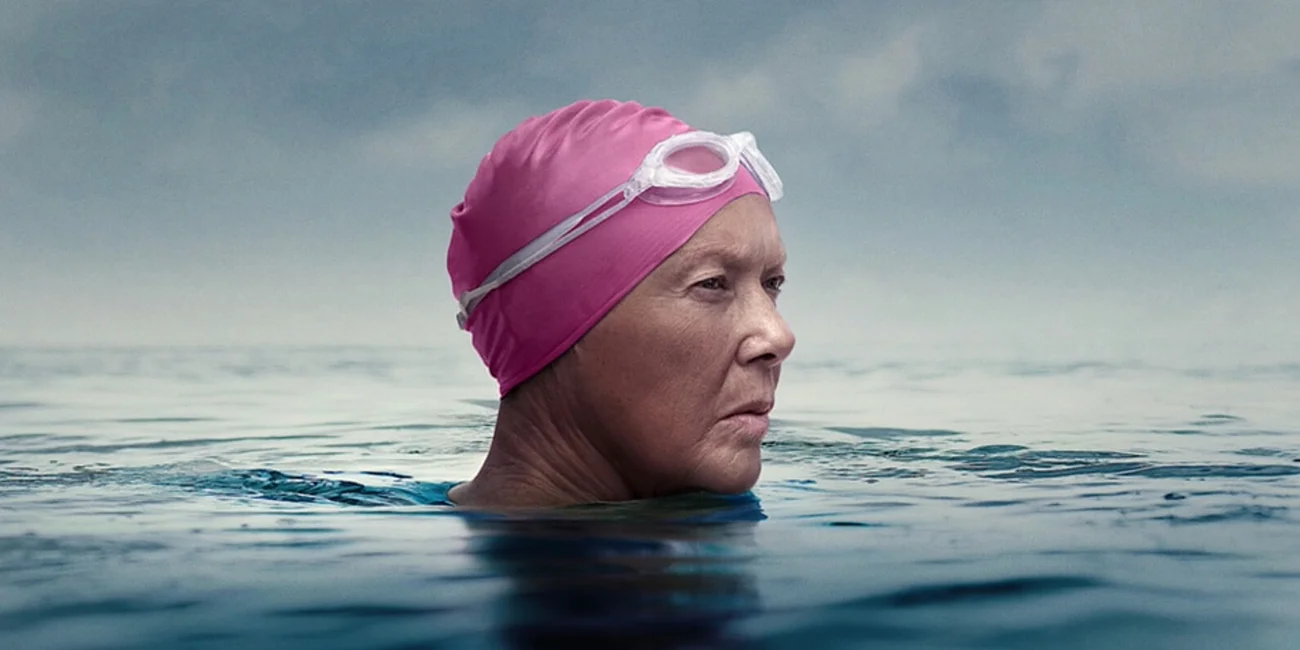
Nyad (2023)
 Jay Wilde
The Hook
There is a moment in the Nyad trailer where Annette Bening breaks the surface of dark water, gasping, her face split by a beam of flashlight cutting through the night. Behind her, the prow of a small boat cuts a white line across black ocean. No music. No title card. Just a woman, sixty years old, somewhere in the middle of 110 miles of nothing between Cuba and Florida, and still swimming. If that image does not stop you mid-scroll, nothing will.
The trailer plays like a dare. It shows us the jellyfish stings that sent Diana Nyad into convulsions, the shark circling below the surface, the moment her body simply gives out and the medic has to haul her onto the deck. It shows us Bening's face doing things that no performance should be able to do, carrying agony and defiance in the same breath. But the real trick of the trailer is what it withholds: it never tells you that this actually happened. It lets the images speak as though this is a thriller, a survival epic, a piece of fiction too extraordinary to believe. And then the title card lands: "Based on a true story."
What makes the trailer land so hard is that directors Elizabeth Chai Vasarhelyi and Jimmy Chin built their careers on documentary filmmaking, winning an Academy Award for Free Solo. They know how to frame real human beings doing impossible things. When they turned their cameras toward fiction for the first time, they brought that documentary instinct with them. The result is a trailer that does not sell you a movie. It sells you a feeling, the feeling that someone, somewhere, did something that should not be physically possible, and two-time Oscar winner Jodie Foster and four-time Oscar nominee Annette Bening are going to show you exactly what it cost.
What most people walking into Nyad do not realize is that the film nearly did not get made. For years, studios passed on the project because they considered it "a movie about an old woman swimming," as Vasarhelyi has described the resistance. It took the combined passion of Bening, who pursued the project personally and refused to let it die in development, and Netflix, which picked it up as a streaming original, to finally bring the story to screen. In a strange way, Bening's fight to get this film made mirrors Diana's own refusal to accept that her dream was impossible. The trailer you watched was the product of years of persistence mirroring the very thing it depicts.
The Movie
Nyad is, on paper, a sports biopic about an older woman doing something physically extraordinary. That description makes it sound like a niche film for a specific audience. What Vasarhelyi and Chin deliver instead is one of the most viscerally tense and emotionally devastating films of 2023, one that works whether or not you have any interest in open-water swimming.
The film's structure is deceptively simple. Diana Nyad attempts the Cuba-to-Florida swim four times over four years. Each attempt follows a similar arc of hope, crisis, and failure. What keeps the film from becoming repetitive is the way it uses each attempt to peel back another layer of who Diana is and why she cannot stop. The first attempt is about ego and ambition. The second is about denial and physical limits. The third is about the damage she has inflicted on the people she loves. The fourth, and final, attempt is about surrender, about letting go of the need to conquer the ocean and simply becoming one with it.
Bening's performance is the engine that drives the entire picture. She did not simply age herself with prosthetics and makeup. She rebuilt her entire physicality, studying Diana Nyad's swimming stroke, her posture on the boat, the way she breathed when exhausted. The result is a performance that feels observed rather than performed. When Diana's body begins to fail during her attempts, Bening does not act the exhaustion. She inhabits it. You feel your own muscles tighten watching her swim. During the jellyfish scenes, her physical contortions are so specific, so uncomfortably real, that it becomes difficult to watch. That is the mark of a committed performance, one that prioritizes truth over spectacle.
Jodie Foster, meanwhile, delivers what may be the most enjoyable work of her late career as Bonnie Stoll, Diana's best friend, former romantic partner, and coach. Foster plays Bonnie with a sharp, dry humor that provides much of the film's warmth. She is the only person in Diana's life who will tell her the truth, and Foster plays that dynamic with a kind of exasperated love that anyone who has ever had a complicated friendship will recognize immediately. The relationship between Bonnie and Diana is the spine of the film, and Foster and Bening generate genuine chemistry that makes their arguments land like punches and their reconciliations feel earned.
Rhys Ifans deserves special mention as John Bartlett, the navigator tasked with guiding Diana across the straits. Ifans brings a working-class groundedness to the role that prevents the film from drifting into inspirational movie territory. His John is not a cheerleader. He is a practical man with bills and a family, doing a dangerous job because someone has to. When he eventually returns for Diana's final attempt, it is not out of heroism. It is out of loyalty, and Ifans plays that distinction perfectly.
What separates Nyad from lesser sports biopics is its refusal to simplify its protagonist. Diana is not likable in any conventional sense. She is selfish, obsessive, and frequently blind to the toll her obsession takes on the people around her. The film does not ask you to admire her. It asks you to understand her. There is a flashback structure, interspersed throughout the attempts, that reveals Diana's childhood abuse at the hands of her swimming coach. These scenes are handled with restraint, never exploitative, always contextual. They do not explain Diana so much as they deepen the question of what drives a person to put their body through such punishment. The film wisely never draws a clean line between trauma and triumph. It simply lets both exist side by side and trusts the audience to sit with the discomfort.
The film's flashback structure, which weaves Diana's childhood abuse at the hands of her swimming coach into the present-day attempts, is handled with a restraint that elevates the entire picture. These are not melodramatic reveals. They surface quietly, in fragments, as Diana pushes herself beyond what seems humanly possible. The connection between past trauma and present endurance is never spelled out, and that ambiguity is the film's greatest strength. We are left to decide for ourselves whether Diana's obsession is a form of healing or a form of self-destruction, and the film refuses to resolve that tension even in its triumphant final moments. It is a rare biopic that trusts its audience to hold two contradictory truths at once, and Nyad does so without flinching.
This complexity extends to the film's treatment of age itself. Hollywood has a well-documented habit of celebrating perseverance only when it looks photogenic, only when the athlete looks noble and determined in slow motion. Nyad resists this at every turn. Bening plays Diana as frequently unglamorous, mouth open in ragged breathing, shoulders hunched, her body audibly protesting every stroke. The camera does not flinch from the physical deterioration across four attempts. Diana ages visibly between each try, not through makeup but through the weight of accumulated failure. It is a film about aging that refuses to sentimentalize aging, and that honesty is what gives the triumphant final swim its overwhelming force. We have watched this woman suffer for ninety minutes, so when she finally reaches the shore, the catharsis is not manufactured. It has been earned in every frame that came before.
The supporting performances add crucial dimensions that a lesser film would have omitted. The medics and boat crew members, while given less screen time, are portrayed as working professionals with their own limits, not as anonymous extras cheering from the sidelines. This gives the attempts a genuine sense of communal risk that most sports films gloss over. And the film's treatment of Diana's public persona, including media appearances and self-promotional tendencies, adds a layer of self-awareness that prevents the narrative from collapsing into hagiography. Diana Nyad was a celebrity before the swim, and the film acknowledges this without reducing her to it.
The swimming sequences themselves are among the most physically immersive in recent cinema. Cinematographer Claudio Miranda, who previously shot Life of Pi, films the ocean sequences with a combination of practical cameras and body-mounted rigs that put you directly in the water with Diana. There are no sweeping drone shots to aestheticize the swim. Instead, the camera stays close, bobbing with the waves, capturing the repetitive churn of Diana's stroke, the way her shoulders begin to collapse, the salt crusting on her face. It is the opposite of glamorous, and that is exactly what makes it powerful. During the third attempt, when the storm hits, Miranda shifts to tighter handheld framing that makes the audience feel the boat's instability. The ocean is no longer a backdrop; it becomes a character in its own right, and Miranda shoots it with the same indifferent beauty that the real Diana Nyad must have seen from the water.
Composer Alexandre Desplat, one of the most prolific working film composers, scores the film with restraint. Rather than pushing the audience toward emotion, his score recedes during the most intense swimming sequences, letting the sound of water, breathing, and radio chatter do the work. When the music does swell, during Diana's hallucination of the Yellow Brick Road from The Wizard of Oz during her successful swim, it lands with genuine emotional force precisely because the film has earned it through silence. Desplat has spoken in interviews about the challenge of scoring a film where the most dramatic moments involve a woman swimming alone in open water. His solution was to treat the score as an extension of Diana's internal world, music that exists only when she needs it to, fading back into the ocean when she draws strength from somewhere deeper than emotion. Its closing moments, held in an unbroken take that refuses to cut away from Bening's face, are among the most powerful in recent cinema, transforming what could have been a triumphant montage into something far more intimate and earned. It is a film that understands endurance not as a single heroic moment but as the accumulation of countless ordinary decisions to keep going, and it earns every ounce of its emotional payoff.
The People
Every great sports film is really a film about the people around the athlete, and Nyad understands this instinctively. The directors, Elizabeth Chai Vasarhelyi and Jimmy Chin, built their careers on documentary filmmaking, winning the Academy Award for Best Documentary Feature for Free Solo, their 2018 portrait of Alex Honnold's rope-free climb of El Capitan. That documentary background shapes everything about how they constructed Nyad. They are not interested in manufactured drama or tidy emotional arcs. They are interested in the texture of real human relationships under extreme pressure, and that sensibility is what makes the film feel so lived-in rather than constructed.
For Vasarhelyi and Chin, the transition from documentary to narrative filmmaking was not as dramatic as it might seem. They approached the project as though they were making a documentary with a scripted framework, shooting many of the swimming sequences with multiple cameras and allowing Bening and Foster to work through scenes with minimal interruption. The directors have spoken about how this methodology created a sense of spontaneity that a more traditional, coverage-heavy approach would have killed. It also meant that the two leads, both accustomed to precise blocking and rehearsed line readings in their other work, had to adapt to something closer to a documentary rhythm, responding to real conditions in the water rather than hitting predetermined marks.
Jodie Foster has spoken openly about what drew her to the project, calling Bonnie Stoll "one of the most extraordinary women I have ever encountered." The fascination is not surprising. Stoll is a force of nature: a former professional racquetball player who competed on the national circuit through the 1980s before channeling that competitive intensity into outdoor athletics. She met Diana Nyad in the late 1990s when Diana approached her for fitness coaching, and their friendship developed through a shared language of physical discipline that predated any involvement in marathon swimming. Foster spent extensive time with the real Stoll, studying not just her mannerisms but the specific cadence of their friendship, the shorthand communication that comes from decades of intimacy. After seeing the finished film, the real Bonnie Stoll told reporters, "The first time I watched it I honestly thought I was watching myself. Jodie is just so down to earth, and just a really cool lady. And that's great." That endorsement matters, because Stoll is not the kind of person who offers praise lightly. "We spent a lot of time together," Stoll later added. "I didn't have to tell her one thing. I learned things that I do from seeing her on screen. She is just a very observant person." Foster's Bonnie is not a supporting character in the traditional sense. She is the emotional anchor of the entire picture, the one person willing to tell Diana the truth even when the truth is that she might die trying.
For Annette Bening, the physical transformation was the most demanding of her career. She trained in open water for months before filming began, learning to swim the way Diana swims, with that distinctive long, rhythmic stroke designed for endurance rather than speed. She has described the experience of filming the ocean sequences as "the hardest physical work I have ever done," noting that even with safety divers and controlled conditions, the ocean does not care that you are acting. The jellyfish scenes, in particular, required Bening to contort her face and body in ways designed by the stunt team to simulate the neurotoxic effects of box jellyfish venom. Multiple takes left her genuinely bruised. Beyond the ocean work, Bening committed to a full physical regimen that included long-distance swimming, strength training, and studying hours of Diana Nyad's actual race footage. The result is not a performance of imitation but one of deep internalization. Bening does not play Diana Nyad so much as she channels the specific quality of stubbornness and vulnerability that defines her.
One of the most fascinating casting stories is that of Rhys Ifans. The role of John Bartlett was originally discussed with older, more established character actors, but Vasarhelyi and Chin wanted someone who could convey the lived-in exhaustion of a working navigator. Ifans, already known for transformative physical performances in films like Notting Hill and Mr. Nice, threw himself into the research, spending time with actual Florida straits navigators to capture the specific way they communicate, issuing terse, practical instructions over radio while the ocean tries to kill the person they are guiding. The directors have noted that Ifans was the only actor who auditioned who seemed genuinely uncomfortable in the water, and that discomfort translated into an authenticity that a more polished swimmer might not have been able to achieve. John Bartlett is not a hero in this story. He is a working professional doing a dangerous job, and Ifans never lets you forget that.
On the set, the dynamic between Bening and Foster became the talk of the production. Despite both being Academy Award winners with decades of experience, neither dominated the set. Vasarhelyi has spoken about how the two would spend hours between takes discussing the scenes, sometimes disagreeing about how a moment should play, and that energy fed into the authenticity of their on-screen relationship. The arguments between Diana and Bonnie in the film have a rawness that suggests genuine creative tension rather than choreography. Bening and Foster would often run scenes well beyond what the script required, exploring different emotional registers, and the directors encouraged this improvisational approach within the broader scripted framework. The result is a friendship on screen that feels forged in real time, with all the friction and affection that implies.
Diana Nyad herself was a constant presence during filming, though she reportedly gave Bening and Foster space to make the roles their own. Nyad has said in interviews that watching Bening swim was both thrilling and strange, because the mannerisms were so accurate that it felt like watching herself from the outside. Her famous post-swim speech, delivered to reporters on Key West beach in 2013, is reproduced almost verbatim in the film's climax: "Never ever give up. You're never too old to chase your dreams. It may look like a solitary sport, but it takes a team." Hearing Bening deliver those words in the film's final moments, with the real Key West coastline visible behind her, is a genuinely moving experience.
The Craft
Nyad is a film that succeeds as much through its technical craft as through its performances. Every major department contributed to a picture that feels simultaneously raw and meticulously composed.
Alexandre Desplat's score deserves particular praise for its discipline. Desplat, who has scored over 100 films including The Shape of Water and The Grand Budapest Hotel, is known for his lush orchestral writing. For Nyad, he deliberately pulled back, using sparse piano motifs and ambient textures rather than sweeping themes. The reasoning is practical: the ocean itself provides the score during the swimming sequences. All you hear is Diana's breathing, the slap of water against skin, the crackle of radio communication. Desplat's music enters only during the emotional peaks, and because the film has conditioned you to listen to the water, the sudden presence of a melody hits harder than any full orchestral arrangement could.
Cinematographer Claudio Miranda made the bold choice to avoid the traditional beauty shots of ocean cinematography. There are no golden-hour establishing shots, no majestic wide angles showing Diana as a speck against the vast sea. Instead, Miranda keeps the camera tight, often at water level, so that the ocean fills the frame from edge to edge. The effect is claustrophobic and immersive. When Diana is stung by jellyfish, the camera does not cut away to a reaction shot on the boat. It stays in the water with her, and you feel the panic. During the storm sequence of her third attempt, the handheld camera work becomes genuinely disorienting, rocking with the waves, making you feel the boat's distress as if you were standing on its deck.
Production designer Todd Fjelsted built practical sets that blended seamlessly with location shooting. While the film was shot primarily in the Dominican Republic, using the water tank facilities at Pinewood Studios Dominican Republic, the goal was to make every scene feel like it could have been filmed on location in the Florida Straits. The boat used in production was a working vessel adapted for camera rigs, and the crew shot during actual ocean conditions whenever possible, rather than relying entirely on controlled tank work. The result is a tactile quality that distinguishes this film from more polished biopics.
Editor Christopher Tellefsen faced the enormous challenge of making four separate swim attempts feel distinct rather than repetitive. His solution was to vary the pacing and rhythm of each attempt. The first attempt is edited briskly, emphasizing Diana's confidence and the speed of the failure. The second, jellyfish attempt is drawn out, lingering on Diana's face as the venom takes effect. The third attempt, during a thunderstorm, is cut with urgency, quick cuts between Diana in the water and the flooding boat. The final, successful attempt is given the most breathing room, with long, unbroken takes that allow Bening's performance to exist in extended moments of near-silence. It is masterful work that turns what could have been a formulaic structure into a genuinely escalating narrative. Each failed attempt also features a distinct sound palette: the first is dominated by the rhythmic slap of calm water and steady breathing; the second introduces the sharp crackle of radio distress calls and the unsettling silence that follows when Diana goes under; the third layers wind, rain, and the groaning of a flooded hull beneath the chaos of the waves; and the fourth strips almost everything away until there is only Diana's breath and the vast, indifferent hum of the ocean.
The sound design work deserves special recognition for how it captures the alien acoustics of open-water swimming. Most audiences have never heard what it sounds like to be in the ocean at night with nothing but a thin wetsuit between your skin and the deep, and the film's sound team recreates this with startling fidelity. Underwater sequences carry a muffled, pressurized quality that communicates the disorientation of salt water in your sinuses and ears. Above water, the sound alternates between eerie calm and sudden violence, mirroring Diana's psychological state as effectively as any score could.
Production designer Todd Fjelsted's contributions also warrant closer examination. The boat sequences feel authentic because the boat was real. The production team acquired a working catamaran and modified it with hidden camera mounts and reinforced safety rails, creating a set that could operate in open water while accommodating a film crew. The medical equipment shown throughout the attempts was sourced from actual marathon swimming support teams, giving the on-deck scenes a documentary quality that studio recreations could never have achieved. Even the jellyfish prosthetics used in the sting scenes were developed in consultation with marine biologists to ensure that the visual effects matched the real physical manifestations of box jellyfish envenomation, with the translucent tentacles and raised welts rendered in painstaking detail.
The Trivia
-
Beneath the surface of this remarkable film lies a treasure trove of fascinating production details and real-life oddities. Let us dive deep into the details that make Nyad a film worthy of discussion long after the credits roll.
-
The jellyfish scene, widely regarded as the most harrowing sequence in the film, was partially inspired by a real incident that nearly killed not just Diana but her lead medic. During Nyad's second attempt in 2011, she was stung by box jellyfish, and the medic who jumped in to help her was also stung and had to be rescued from the water. The film recreates this with terrifying accuracy, and Annette Bening worked with a movement coach to replicate the specific muscle contractions caused by box jellyfish venom, including the way the pain radiates outward from the sting site.
-
Bonnie Stoll, the real-life inspiration for Jodie Foster's character, was a professional racquetball player before she ever became a swimming coach. Stoll competed on the Professional Racquetball Tour throughout the 1980s and was ranked among the top players in the country. She and Diana met when Diana asked her for fitness coaching, and their friendship developed through shared athletic discipline long before swimming entered the picture. Their transition from fitness partners to swimming partners took over a decade.
-
The scene in which Bonnie jumps into the water to encourage Diana near the end of the swim never actually happened. The filmmakers have acknowledged this is the film's most significant departure from reality. Bonnie Stoll has confirmed she never entered the water during any of Diana's attempts, though she has said she wishes she had. The moment was conceived by Jodie Foster during rehearsals as a way to externalize Bonnie's emotional investment, and Vasarhelyi and Chin agreed it was too powerful to cut.
-
Diana Nyad's celebrated 1975 swim around Manhattan, frequently cited in her biography, has been disputed. According to a detailed investigation by the Los Angeles Times, Nyad was actually the seventh person to complete the circumnavigation, not the first, as she stated in her memoir "Find a Way." Additionally, she claimed to have placed sixth at the 1968 Olympic trials in Mexico City, a claim that has been debunked. Nyad never actually attended those trials. The controversy adds a layer of complexity to the film's celebration of its protagonist.
-
The Guinness Book of World Records formally revoked Diana Nyad's record for the Cuba-to-Florida swim. The revocation stemmed from the lack of independent observers and incomplete documentation during the 2013 crossing. Nyad has acknowledged the controversy with characteristic stubbornness, telling reporters, "Maybe I had too much hubris, like, 'I don't need to prove this to anybody.' That's my bad."
-
The film was shot primarily in the Dominican Republic, not in Florida or Cuba. The production utilized the water tank facilities at Pinewood Studios Dominican Republic, a relatively new studio complex that opened in 2018. The Dominican Republic's Caribbean coastline also doubled for Key West in several exterior scenes. The decision to film there was driven by both practical considerations, including favorable tax incentives, and the availability of controlled ocean conditions that would have been impossible to guarantee in the Florida Straits during a multi-week shoot.
-
During the real 2013 swim, Diana Nyad experienced vivid hallucinations as her body began to shut down. She later described seeing the Yellow Brick Road from The Wizard of Oz and the Taj Mahal floating in the water around her. The film recreates these hallucinations in the fourth attempt sequence, and they function as some of the most surreal and emotionally resonant moments in an otherwise grounded picture. The Yellow Brick Road scene in particular suggests Diana's lifelong desire to simply get "home," a metaphor the film never over-explains.
-
The production required Bening to train in open water swimming for over six months before principal photography began. Her preparation included daily ocean swims of several miles, coached by professional marathon swimmers who could replicate Diana's specific stroke mechanics and breathing patterns. Bening has described the training as the most physically demanding preparation of her career, exceeding even her work on American Beauty, which required months of boxing training.
-
After the real swim was completed on September 2, 2013, Diana Nyad could not eat solid food for three weeks. The salt water had so severely damaged the inside of her mouth that she could barely speak, let alone consume food. Bonnie Stoll has described this period with characteristic dark humor: "She couldn't eat anything for three weeks, her mouth was so cut up from all the salt. She didn't speak well, which was a drag, because the only thing she cares about other than swimming is talking."
-
During the period between failed attempts, Diana and Bonnie had a serious falling out. After Diana's third failed attempt, Bonnie confronted her about the risks she was taking, not just to herself but to the boat crew. The argument escalated to the point where Bonnie quit as Diana's trainer and the two stopped speaking about the swim entirely. They eventually reunited with the help of a professional mediator, an intervention that is depicted in the film. As Stoll described it: "We finally went to a mediator, and the mediator is supposed to bring the best and worst of each position."
-
The real-life Diana Nyad, Bonnie Stoll, and John Bartlett all visited the set during filming. Nyad reportedly watched Bening film the swimming sequences from the deck of the production boat, and Stoll spent several days on set observing Foster's preparation. However, the real people were careful not to impose their own interpretations on the actors, instead allowing Bening and Foster to develop their own versions of the characters.
-
Following her historic swim, Diana Nyad and Bonnie Stoll co-founded EverWalk in 2016, a national initiative designed to encourage Americans to walk more and sit less. The program includes walking challenges, community events, and partnerships with healthcare organizations. It represents a more grounded continuation of the physical discipline that defined both women's partnership, and the film acknowledges this legacy in its epilogue text.
-
The film features no post-credits scene or sequel tease, a deliberate choice by directors who wanted the story to conclude on Diana's triumphant arrival on the Key West shore. However, the ongoing controversy surrounding the verification of Nyad's swim has generated as much public discussion in the years since the film's release as the swim itself, ensuring that the conversation around the film extends well beyond its runtime.
The Verdict
Nyad is not a film about swimming. It is a film about what it costs to refuse to stop, and whether that refusal is heroism or pathology, or perhaps both at once. Bening and Foster elevate the material beyond the biopic formula, finding the bruised, complicated humanity in two women who gave each other the best and worst years of their lives in service of a single impossible goal. The ocean sequences are punishing in their realism, and the quieter scenes between Diana and Bonnie carry the kind of accumulated emotional weight that only comes from performances this committed.
What makes the film endure in memory is not the spectacle of the swim but the cost of it. Every mile Diana covers is paid for in jellyfish welts, hallucinations, broken relationships, and a body that should have quit long before it did. The film respects that cost without romanticizing it, and it trusts its audience enough to let the ambiguity remain. Diana Nyad's story is not a clean parable about the power of perseverance. It is messier and more interesting than that, about a woman who may have been brilliant and delusional in equal measure, and about a friendship that survived both. It is also, in its quietest moments, a film about the particular loneliness of pursuing a dream that no one else can fully understand, and the grace of finding one person who stays beside you anyway.
If you have ever had someone in your life who believed in you more stubbornly than you believed in yourself, this film will hit you in a place you did not know was unprotected. And if you have ever chased a dream that everyone around you thought was insane, Diana's fifth attempt, her final push toward the Key West shoreline, will feel less like watching a sporting achievement and more like witnessing someone argue with the ocean itself and win.
"Never ever give up."