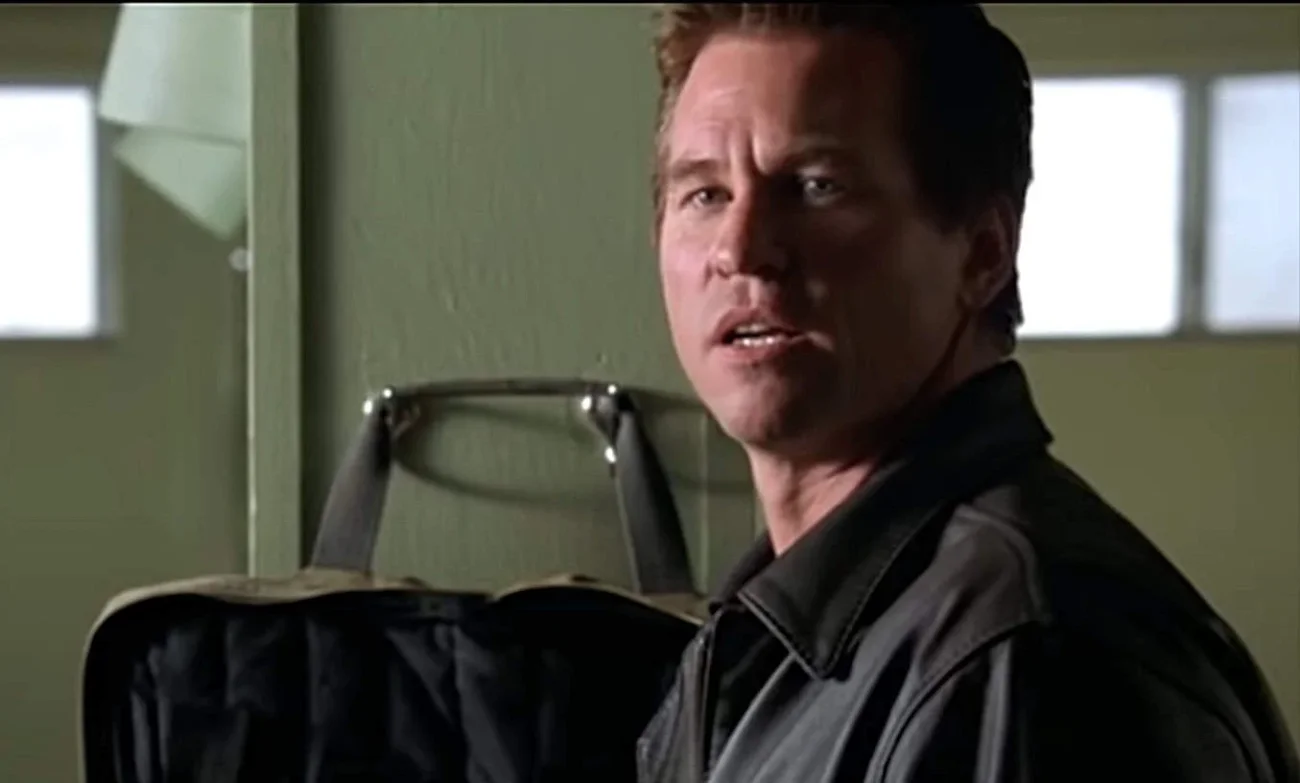
Spartan (2004)
 Jay Wilde
The Hook
There is a moment in the trailer for Spartan where Val Kilmer, playing a Delta Force handler named Bobby Scott, leans into a young sergeant on a training range and says, in that flat, clipped Mamet cadence, "Don't teach them knife fighting. Teach them to kill." It is such a clean, brutal line that it bypasses your critical faculties entirely. You do not think about whether the film will be good. You think only about watching more of this man, in this world, speaking this way.
The trailer lays out the bones quickly. A president's daughter vanishes. Scott is pulled into a clandestine operation to find her. The trail leads through a Washington brothel to a federal prison to the deserts of Dubai. There are guns, there are shadows, there are people who know more than they are saying. The music is sparse. The cuts are quick. The whole thing feels like a clenched fist. It doesn't promise you a good time. It promises you a specific time, and that specificity is what makes you press play.
What the trailer cannot prepare you for is how strange the film actually is. Spartan arrived in March 2004, at a moment when the country was deep into the Iraq War and questions about who was really pulling the strings in Washington carried a particular charge. Mamet, always a contrarian, always a provocateur, wrote a thriller that functions simultaneously as a procedural about sex trafficking and as a parable about presidential power, the expendability of the young, and the quiet, anonymous violence that keeps empires running. It is not subtle about its politics. It is also not interested in your approval.
The production had the kind of chaotic energy that seems to follow Mamet wherever he goes. Franchise Pictures, the production company behind the film, was run by Elie Samaha and produced a string of mid-budget thrillers in the early 2000s, many of them forgettable. But Mamet was given a tight budget, reportedly around 12 million dollars, and a relatively free hand. He cast Val Kilmer at a point when Kilmer's reputation for being difficult on set had already calculated into industry legend. He hired Derek Luke, then best known for his breakout in Antwone Fisher, to play Scott's young protégé. He brought in William H. Macy, his old collaborator, for a small but crucial role as a grizzled intelligence veteran. And he cast Kristen Bell, then a relative unknown who was about to become famous for the television series Veronica Mars, as the missing first daughter.
Mamet has said in interviews that the film's structure was inspired by the hard-boiled fiction he grew up reading, the kind of story where the plot unfolds through accumulation rather than revelation. "You don't explain the world," Mamet once noted about his approach to writing. "You present it." Spartan takes that principle to an almost extreme degree. Characters speak in shorthand. Exposition is delivered in fragments, half-heard over car radios or glimpsed on television screens. The audience is expected to keep up or get left behind. It is a film that respects your intelligence and doesn't care if you find that respectful or rude.
The Movie
Spartan is not a film that reveals itself on first viewing. It is a film that rewards patience and rewatches, that accumulates power the more you think about it afterward. The plot, on paper, sounds like a dozen other political thrillers: a covert operative races against the clock to rescue a kidnapped first daughter from an international sex trafficking ring while navigating conspiracy at the highest levels of government. But Mamet is not interested in the mechanics of the rescue. He is interested in the machinery around it, the systems of power that make a young woman disappear and then make her rescue politically inconvenient.
Mamet’s signature rhythmic dialogue is present here, but stripped of the showy bravado of his earlier work like Glengarry Glen Ross. Here, the lines are clipped, functional, almost military in their economy. There are no monologues, no grand speeches. Even the villains speak in short, transactional bursts. It creates a world where no one says more than they need to, and every word carries weight because of it. This is a thriller where the tension comes not from what is said, but what is left unsaid, the gaps between the lines where the real power dynamics play out. This stripped-back style forces the audience to lean in, parsing every pause and half-statement for meaning, making even the most mundane exchange feel loaded with unspoken threat.
The scene that defines the film, for me, comes about a third of the way through. Scott and his handpicked partner Curtis, played by Derek Luke in a performance of remarkable quiet intensity, have traced the kidnapping to a brothel that funnels young women into a trafficking pipeline. There's no big raid, no dramatic shootout. Scott moves through the space with the efficiency of a man who has done this before, who knows exactly how these operations work because he has been inside similar ones. The tension comes not from the violence but from the procedural precision, the way Kilmer delivers the performance as a man doing a job he finds morally repugnant but professionally routine. You can see it in his eyes. He is not disgusted. He is beyond disgust. That's worse.
Cinematographer Juan Ruiz Anchía shoots the film with a cold, desaturated palette that matches Scott’s emotional register. There are no warm tones, no comforting lighting. Even the scenes set in the Middle East (filmed in Morocco) have a washed-out, documentary-like quality that makes the violence feel unpleasantly real. The camera rarely lingers on action; it observes from a distance, as if even the filmmaker is unwilling to get too close to the brutality on display, using long lenses to maintain that emotional distance.
The sound design mirrors the visual approach: sparse, diegetic, and unobtrusive. Mark Isham’s score is minimal, often little more than a low hum or a single sustained note, leaving the natural sounds of the environment to carry the tension. You hear the scrape of boots on gravel, the click of a pistol slide, the distant hum of an air conditioner in a safe house. These mundane sounds become more frightening than any orchestral sting because they feel real, like something you might hear in your own life. This grounded approach to audio reinforces the film’s thesis that covert work is not glamorous or heroic, but a series of small, quiet, often unpleasant tasks carried out in the shadows.
Mamet subverts the classic thriller hero archetype completely here. Scott is not a charming rogue, not a brilliant detective, not a man driven by personal trauma. He is a tool, a professional who does what he is told, and Kilmer plays him with a complete lack of ego that is rare in leading men. There is no moment where Scott gives a rousing speech, no moment where he breaks the rules for love or justice. He follows orders, he gets the job done, and then he fades back into the shadows. It is a radical way to structure a film around a protagonist, and it works because Kilmer never asks the audience to like Scott, only to understand him.
Kilmer's performance in Spartan is a masterclass in withholding. Bobby Scott is a man who communicates primarily through silence and economy of movement. He doesn't brood or emote. He processes. When he speaks, it is in the clipped, rhythmic sentences that are pure Mamet, but Kilmer delivers them with a flatness that makes them feel less like dialogue and more like field reports. he interrogates a prison informant, played by Saïd Taghmaoui, and the whole exchange plays out in a low register, two professionals negotiating the price of information. There are no raised voices, no threats. Just the quiet understanding that one of them is going to get what they want and the other might not survive the transaction. It is thrilling in the most literal sense of the word.
William H. Macy appears in a brief but memorable role as a bureaucrat who treats the kidnapping as a PR problem to be managed rather than a human tragedy to be solved. It’s a performance that sums up the film’s central argument: in this world, people are interchangeable, problems are logistical, and morality is a luxury no one can afford. Ed O’Neill, playing a fellow operative, brings a weary gravity to the role, a man who has been in the game too long to believe in happy endings.
The film's emotional core is not Scott's determination to save Laura Newton, though that drives the plot. It is the relationship between Scott and Curtis, a mentorship that never has time to fully blossom before it is brutally severed. Derek Luke brings a vulnerability to Curtis that makes his eventual fate genuinely devastating. He is the human heart of the film, the one character who still believes in the mission, who still thinks that doing the right thing matters. When that belief is taken from him, the film becomes a colder, lonelier place. It is a structural choice of real sophistication, the kind of thing Mamet pulls off with what looks like effortless simplicity but must have required careful calibration.
Spartan is notable for how it handles the women in its story, particularly the missing first daughter Laura Newton. Unlike most thrillers, which treat kidnapped women as passive objects to be recovered, Spartan hints at Laura’s agency even when she is off-screen. The film suggests she may have orchestrated her own disappearance, a twist that reframes the entire mission and adds a layer of moral ambiguity to Scott’s work. It is a bold choice that elevates the film above its genre peers.
Released in 2004, at the height of the Iraq War and the global war on terror, Spartan feels uncomfortably of its moment. The themes of government mendacity, the exploitation of young women, the use of prostitution as a tool of war, all resonated differently in a post-9/11 world. Mamet does not lecture the audience, but the film’s casual acceptance of these horrors as business as usual feels like a quiet critique of the era’s political climate.
What makes Spartan stick with you is its refusal to comfort. Most thrillers, even dark ones, eventually reassure you that the system works, that good people win, that justice prevails. Spartan offers no such comfort. It leaves you with questions instead of answers, with a lingering sense of unease rather than the warm glow of resolution. Mamet refuses to tie the story up in a neat bow, instead leaving the audience to sit with the moral ambiguity of Scott’s actions and the systems he serves. The film’s power comes from this unwillingness to sugarcoat the reality of covert work, where right and wrong are rarely clear-cut, and every outcome forces the audience to grapple with the cost of the mission.
The People
Val Kilmer's casting in Spartan came at a curious inflection point in his career. By 2004, he had already delivered the performances that would define his legacy: the cocky pilot in Top Gun, the doomed gunslinger Doc Holliday in Tombstone, the tortured Jim Morrison in The Doors, the brooding Batman. But he had also developed a reputation for being extraordinarily difficult to work with, a reputation that had cost him roles and opportunities. David Mamet, who has never been intimidated by strong personalities, cast him anyway. The result is arguably the most disciplined performance of Kilmer's career, a role that required him to suppress every instinct he had as an actor and deliver something stripped, minimal, and lethal.
Kilmer prepared for the role by spending time with active Delta Force operators, learning their movement patterns, their speech rhythms, their emotional flatness. In interviews, he has said that Mamet demanded a complete abandonment of traditional acting technique, telling him, "Don't act. Just do the job." It is a directive that shows in every frame of the film, where Kilmer never seems to be performing, only existing.
There were rumors at the time that Mamet initially considered a more traditionally charismatic lead for the role of Scott, someone who could bring instant movie-star appeal to the project. Kilmer's reputation for difficulty nearly cost him the part, but Mamet held firm, arguing that the role required an actor capable of disappearing into the character rather than imposing his own personality on it. It was a prescient choice, as Kilmer's lack of ego is exactly what makes the performance work.
Kilmer's famous DVD commentary track for Spartan has become almost as legendary as the film itself. In it, he oscillates between genuine insight about the craft and a kind of performative antagonism toward Mamet, referring to the director as "Daveed Mamé" and offering bemused observations about the production. The critic for MUBI described the commentary as transforming "an ordinary film of the early century into a true masterpiece," arguing that Kilmer's simultaneous roast and tribute revealed depths in the film that were not visible on the surface. Whether Kilmer intended this as art or merely as catharsis is unclear, which is perhaps the point.
Derek Luke was a relatively unknown actor when Mamet cast him as Curtis. His previous major role had been the title character in Antwone Fisher, directed by Denzel Washington, a performance of such open-hearted sincerity that it seemed like an odd fit for the Mamet universe. But that sincerity is exactly what makes Curtis work. He is the audience's surrogate in a film full of opaque professionals. When he insists that Laura Newton is still alive, presenting an earring he found at the beach house as evidence, he is operating on instinct and faith, the two qualities that every other character in the film has learned to suppress. Luke plays these scenes with a conviction that makes you believe him even when the evidence is thin.
William H. Macy's role as Stoddard is small but essential. He appears in only a handful of scenes as a veteran intelligence operative who provides Scott with critical information and context. Macy, who co-wrote the Mamet-penned Glengarry Glen Ross and has appeared in multiple Mamet projects, understands the rhythms of the dialogue instinctively. His scenes with Kilmer have the quality of two jazz musicians improvising around a shared theme, each one knowing when to play and when to listen.
Mamet is famous for his "never say hello" rule on set, forbidding actors from engaging in casual conversation between takes to maintain the tension and focus of the scene. Derek Luke has recounted that this approach initially felt cold, but ultimately helped him access the single-minded focus of his character. Mamet also encouraged improvisation within the rhythm of his dialogue, allowing actors to find their own way through the lines as long as they maintained the cadence.
Kristen Bell has only a few scenes in Spartan, but they are among the film's most memorable. Her Laura Newton is not a passive victim. She is frightened and resourceful, and in the crucial scenes where Scott tries to convince her to trust him, Bell plays the calculation behind Laura's eyes. She knows she has no choice but to go with this stranger, but she is assessing him, testing him, deciding whether he is what he claims to be. It is a performance that suggests the career Bell would go on to build, one built on intelligence and a refusal to be underestimated.
Bell was only 23 when Spartan was released, and the role was her first major film appearance after a handful of television guest spots, before landing the lead in the cult series Veronica Mars the following year. She has joked in later interviews that she was so intimidated by Mamet and Kilmer that she rarely spoke on set unless the script required it, a naturalism that translated perfectly to her character's wary silence.
The supporting cast is a murderer's row of character actors doing excellent work with limited screen time. Ed O'Neill, best known at the time for the sitcom Married with Children, plays Robert Burch, a senior intelligence official, with the cold pragmatism of a man who has been making life-and-death decisions for so long that they no longer register as such. Clark Gregg, years before his Coulson fame, appears as Agent Miller. Johnny Messner, Saïd Taghmaoui, Lionel Mark Smith, and Kick Gurry all contribute memorable turns in roles that could easily have been thankless in lesser hands.
Eric L. Haney, a retired Command Sergeant Major who served in Delta Force, served as the film's technical advisor and even makes a brief cameo appearance. His involvement lends the film a procedural authenticity that goes beyond the usual Hollywood military window dressing. After Spartan, Haney and Mamet collaborated on The Unit, the CBS television series that took similar material and stretched it across multiple seasons, with mixed results. Haney later wrote the bestselling book Inside Delta Force, which became required reading for military enthusiasts.
The Craft
Juan Ruiz Anchía's cinematography is one of the film's quiet triumphs. Anchía, who had previously shot Mamet's The Spanish Prisoner and The Winslow Boy, understands exactly how much visual information Mamet wants to give the audience and, more importantly, how much to withhold. The film's palette is muted and institutional, all cold blues and grays, the colors of government buildings and military facilities. The Dubai sequences, despite being filmed in Los Angeles, achieve a convincing sense of geographic displacement through lighting alone. Anchía shoots many scenes in tight close-ups, faces filling the frame, which creates a claustrophobic intensity that matches the dialogue's compressed energy.
Mark Isham's score is a study in restraint. Isham, a trumpeter and electronic musician who had scored Mamet's earlier films, provides a soundtrack that hovers at the edge of perception, all low drones and subtle electronic textures. There are no big musical cues, no swelling orchestral moments. The score functions more like ambient sound, creating a sense of unease that permeates the film without ever announcing itself. When music does become more prominent, it is usually during transitions, between locations or time periods, providing a momentary breath before the tension ratchets down again.
Mamet's direction is deliberately anti-flash. He shoots the action sequences with the same measured calm he brings to the dialogue scenes. There are no rapid-fire montages, no shaky camera work, no slow-motion shots of bullets hitting their targets. When violence occurs in Spartan, it is sudden, ugly, and over quickly, which makes it feel more real and more disturbing than the stylized mayhem of most contemporary thrillers. The rescue sequence in Dubai is a perfect example. It should be a triumphant set piece. Instead, it plays out as a series of chaotic, confused decisions, operations going wrong, people dying before they can explain themselves. It feels less like a Hollywood climax and more like a news report.
Barbara Tulliver's editing deserves particular praise. The film runs just 107 minutes, and every scene feels precisely trimmed to its essential elements. Mamet's dialogue scenes, in particular, benefit from an editing rhythm that knows when to cut away from a face, when to hold on a reaction shot, when to let a silence breathe. The film moves at a pace that feels both urgent and unhurried, which is a difficult balance to achieve and which speaks to the skill of the editorial hand guiding the material.
The production design, overseen by David Wasco, creates a world of institutional blandness that serves the story perfectly. The military facilities look like military facilities. The Washington offices look like Washington offices. The brothel looks like a place where terrible things happen behind a facade of normalcy. There are no visual flourishes, no attempts to make the world of the film look more interesting or glamorous than it is. This is a world of concrete and fluorescent lighting and functional furniture, and the absence of visual comfort is itself a kind of storytelling.
The custom knife used in the film, called "The Spartan," was designed specifically for the production by Severtech Knives. It is an automatic switchblade that becomes a small but memorable part of the film's visual identity, appearing in several key scenes and functioning as a symbol of the kind of professional, purpose-built violence that defines Scott's world. The fact that Mamet commissioned a custom weapon for a film with a 12 million dollar budget tells you something about where his priorities lay. It is a detail that reinforces the film's commitment to procedural authenticity, where even the tools of the trade are given careful consideration.
The Trivia
-
The Dubai sequences in the film were actually shot in Los Angeles, standing in for the Middle Eastern emirate through careful set dressing and lighting. This was a budget decision, as filming in the actual Dubai would have been prohibitively expensive for a 12 million dollar production, but Anchía's cinematography is convincing enough that most viewers never question the geography.
-
Val Kilmer's legendary DVD commentary track for Spartan became almost as famous as the film itself. In it, he alternates between genuine insight about the filmmaking process and a kind of performative antagonism toward Mamet, whom he refers to as "Daveed Mamé." The commentary has been described by critics as simultaneously a roast, a tribute, and an act of avant-garde performance art.
-
Eric L. Haney, who served as the film's military technical advisor, was a real retired Command Sergeant Major who operated in Delta Force. His involvement lent the film procedural authenticity, and Mamet was so impressed by their collaboration that they later co-created The Unit, the CBS television series about a secret military operations team.
-
Kristen Bell was largely unknown when cast as Laura Newton. She was about to begin filming Veronica Mars, which would make her a star. Her role in Spartan is small, just a handful of scenes, but it marked one of her earliest significant film appearances.
-
Alexandra Kerry, the daughter of then-Senator John Kerry, who would go on to become the Democratic presidential nominee in 2004 and later Secretary of State, has a small role as a bartender in the film. Her casting was noted at the time as a curious intersection of Hollywood and Washington.
-
Mamet's rabbi, Mordechai Finley, appears in the film as one of the training cadre during the Delta Force selection exercise. This kind of personal casting, pulling people from his real life into his fictional worlds, is a characteristic Mamet habit.
-
The line "One riot, one Ranger" spoken by Scott in the film is a piece of Texas Rangers lore that Mamet had previously used in House of Games, his 1987 thriller. He would later use it again in The Unit, making it one of the few lines of dialogue that spans three different Mamet projects.
-
The automatic knife used in the film, called "The Spartan," was designed specifically for the production by Severtech Knives. It is a custom switchblade that appears in several key scenes and became a small but notable piece of the film's visual identity.
-
Spartan has gained a dedicated cult following in the years since its release, particularly among fans of David Mamet's sharp, dialogue-driven approach to thriller material. Its uncompromising pace and layered procedural detail have made it a frequent reference point in discussions of early 2000s neo-noir cinema.
-
The film's political subtext, which strongly implies that the President of the United States is using national security crises to cover extramarital affairs, was considered controversial at the time of release. Conservative critic Ross Douthat wrote that "David thinks Jenna and Barbara should be keeping a weather eye on their Dad," referencing President Bush's twin daughters.
-
Mamet later adapted the material and themes of Spartan into The Unit, the CBS television series that ran for four seasons from 2006 to 2009. The series expanded on the film's themes of secret military operations and procedural authenticity, drawing directly from the same research that informed Spartan.
-
Political operative Ed Skyler, who served as communications director for New York City Mayor Michael Bloomberg, has publicly praised Spartan for its realistic depiction of the inner workings of the Washington political establishment, calling it one of the most accurate portrayals of how power actually operates. Skyler noted in a 2005 interview that the film's portrayal of bureaucratic inertia and political maneuvering closely mirrored his own experiences in city government.
-
The film was released at the Bangkok International Film Festival on January 31, 2004, more than a month before its US theatrical release on March 12, 2004. The early festival premiere did little to generate buzz, and the film opened without significant marketing support from Warner Bros.
-
Tia Texada, who plays Sergeant Jacqueline Black, a knife-fighting instructor who becomes an unlikely ally, trained extensively in martial arts preparation for the role. Her character was expanded from a minor part in the original script to a significant supporting role because of the physical commitment Texada brought to the part.
-
David Mamet has spoken about how the hard-boiled detective fiction of writers like Dashiell Hammett and Raymond Chandler influenced Spartan's narrative structure. The film unfolds through accumulation of detail rather than conventional exposition, mirroring the way those novelists built their plots through layered revelation.
The Verdict
There is a particular kind of thriller that doesn't get made anymore, the kind that trusts its audience to pay attention, that refuses to explain what it already knows you can figure out, that treats silence as a legitimate form of communication. Spartan is that kind of film. It is a movie made by adults for adults, a film that respects your intelligence even as it withholds the comfort you might want.
The film's greatest achievement is Val Kilmer's performance. At a career crossroads, playing a character who could easily have been a generic action hero, he found something precise and haunting. Bobby Scott is a man who has been hollowed out by the work he does, who operates with a competence that's both admirable and deeply sad. Kilmer plays him as a man who has stopped feeling, not because he never could, but because feeling became an impediment to doing what needed to be done. It is one of the great performances of the 2000s, and it has been criminally underappreciated.
Spartan doesn't end with triumph. It ends with a man watching a television screen in a London shop window, hearing the government spin the story of what happened into something politically useful, and walking away. It is an ending that offers no catharsis, no reassurance, no promise that the system will do better next time. It is also the only honest resolution a film like this could have. Mamet knew that the real world doesn't offer clean resolutions, and he refused to offer one in his film.
The movie underperformed upon release, was divisive among critics, and faded from public memory with a speed that suggests it was always destined to become a cult object rather than a mainstream hit. But cult objects have a longer shelf life than hits. Twenty years later, Spartan plays better than it did in 2004, its political anxieties more resonant, its refusal to comfort more necessary. If you missed it the first time, you owe it to yourself to find it now.
"One riot, one Ranger."