The Holdovers (2023)
 Jay Wilde
The Hook
There is a moment in the trailer where Paul Giamatti's Paul Hunham stands in a snow-dusted courtyard, surrounded by the stone grandeur of a New England boarding school, and delivers a line about the students stuck there over Christmas with all the warmth of a man ordering them to dig latrines. You see it and you think, I know this man. Every school had one. The teacher who seemed to exist solely to make your life harder, who quoted Marcus Aurelius at you while giving you a detention for breathing wrong. And then the trailer shifts, just slightly, and you catch something softer underneath the bluster. Not sentimentality. Something earned.
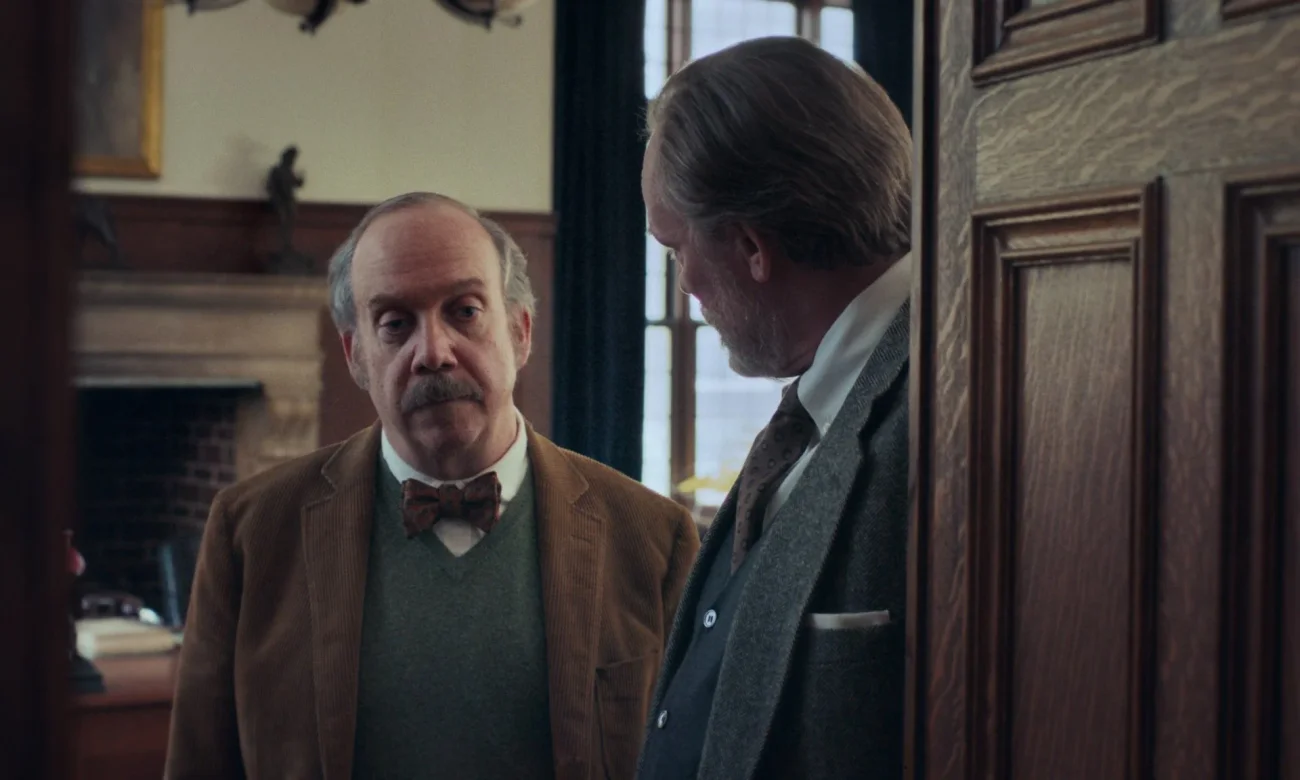
The Holdovers is set in December 1970 at Barton Academy, a fictional New England prep school that looks and feels like every stone-walled institution you have ever seen in a film or walked past in New England. Hunham, a classics teacher with a reputation for impossible standards and an even worse personality, is assigned to supervise the students who cannot go home for Christmas. there's Angus Tully, a bright but troubled teenager whose mother has just remarried and left him behind. there's Mary Lamb, the school cafeteria manager, whose son recently died in Vietnam. These three are stuck together, and the trailer makes it clear that none of them wants to be.
What the trailer does beautifully is promise you a film about people who are forced into proximity and slowly, reluctantly, become important to each other. It doesn't oversell the comedy or the tears. It lets the performances do the talking. Giamatti's face does half the work. That slightly crossed eye, that permanent expression of intellectual disappointment, the way he holds his jaw like he is biting back something he will never say out loud. You see Dominic Sessa, making his film debut here, and there's something in his defiance that feels untrained in the best possible way. And Da'Vine Joy Randolph, whose face in the trailer carries more grief than most entire films manage. there's a shot of her sitting alone at a table, and it stops the trailer cold.
The backstory here is worth knowing. Alexander Payne conceived the film after watching Marcel Pagnol's 1935 French film Merlusse, a Christmas story about a strict teacher stuck supervising students over the holidays. Payne had been sitting on the idea for years, waiting for the right screenwriter. He found David Hemingson, whose boarding school television pilot had caught Payne's attention. Hemingson was running his ABC show Whiskey Cavalier in 2018 when Payne called. The original pilot was set in the present day, but Payne pushed for a period setting. They settled on 1970, partly because it had more cultural resonance than an even earlier decade, and partly because 1958 would have felt too close to Dead Poets Society. Hemingson later revealed that the film is semi-autobiographical. Several scenes, including a confrontation with a sex worker and the cherries jubilee moment, were taken directly from his childhood. He has called the script "a love letter to my mom and my uncle and my dad."
The trailer promises a film about three lonely people at Christmas. It delivers something closer to a small miracle.
The Movie
The Holdovers works because it refuses to be the film you expect it to be. The setup screams Oscar bait. Grumpy old teacher softens through the love of a troubled kid. We have seen this movie a hundred times, and it usually involves a montage of them learning to laugh, a monologue about seizing the day, and a hug at the airport. Payne and Hemingson are smarter than that. The Holdovers earns every single emotional beat by refusing to shortcut the process. These three people do not like each other. They do not warm to each other through shared montages. They grind against each other, they say the wrong thing, they retreat into their respective loneliness, and the connections form in the margins.
The Christmas Eve party defines the film for me. It starts as a social experiment, Hunham awkwardly flirting with the headmaster's assistant while Angus tries to act older than he is. Mary drinks too much and falls apart in front of everyone. It is humiliating, painful, and completely real. The film doesn't cut away from her grief. It doesn't offer a kind stranger with a tissue. It leaves the grief there, ugly and honest, and you feel the room go silent. This is Da'Vine Joy Randolph's Oscar-winning performance distilled to its essence. She doesn't ask for sympathy. She simply exists in her grief, and the film respects her enough to let her.
Giamatti is extraordinary here, and it is worth saying that this is a performance that could not have existed without the twenty years of work that came before it. His Hunham is not a lovable grump. He is genuinely difficult. He is petty, he holds grudges, he grades students on a curve designed to humiliate them. He claims to have trimethylaminuria, a condition that makes him smell bad, and you are never quite sure if this is real or a defense mechanism he has built around himself. When he tells Angus about his expulsion from Harvard, it is not a redemption speech. It is a confession from a man who has never quite forgiven himself or the world. Giamatti plays it with this wonderful quality of a man who has decided that being right matters more than being liked, and who is slowly discovering that this calculus has cost him everything.
Payne's direction here is a masterclass in restraint. He has built a career out of dissecting flawed, unlikable men, but Hunham is his most nuanced creation yet. There is no attempt to soften the edges, no last-minute redemption arc that feels unearned. Even the small moments of connection between the three leads are messy, interrupted by bad timing or sharp words, which makes the rare moments of genuine kindness land harder. You never feel like the film is manipulating you into caring about these people. It just lets them exist, flaws and all, and trusts that you will find the humanity in them anyway.
The 1970 setting is not just a costume choice. It is integral to the film's argument. This is a year when the Vietnam War was raging, when the draft was tearing families apart, when the gap between the wealthy elite at schools like Barton and the working class was at its most visible. Mary's grief over Curtis, who was drafted because he couldn't afford college, lands differently in 1970 than it would in any other era. The film doesn't hit you over the head with the historical context, but it seeps into every frame: the grain of the film stock, the vintage cars, the lack of cell phones that forces the characters to sit in their discomfort without distraction. It is a period piece that never feels like a costume drama, because the emotions it depicts are timeless.
Dominic Sessa, in his debut, holds his own against two powerhouse performances, which is no small feat. Angus is not a typical troubled teen. He is smart, articulate, and angry in the specific way that kids from wealthy families are angry when they realize their money has not protected them from being abandoned. His visit to his institutionalized father is devastating not because of what happens, but because of what Sessa does with his face in the moments after. there's a fear there that's bone deep, the terror of becoming the man behind that door.
Sessa's Angus is a revelation precisely because he avoids the typical "troubled teen" tropes. He isn't rebellious for the sake of it, isn't given a redemption arc that involves learning a life lesson from a wise teacher. That is a wound that doesn't heal in 90 minutes, and the film doesn't pretend it does. The dynamic between him and Hunham is particularly sharp, because neither character is interested in being a mentor or a prodigy. They are two people who have been forced together, and the friction between them generates more heat than any crafted "bonding" scene ever could.
The emotional core of the film is about what happens when people who have been discarded by the people who should love them find themselves stuck together. Mary has lost her son to a war that privileged boys like Angus escape through college deferments. Hunham was expelled from Harvard because a legacy donor's son decided his career mattered less. Angus has been left behind by a mother who chose a new husband over her own child. The film knows that class is the invisible architecture of American life, and it builds its entire structure around the ways that money and status determine who gets to grieve in private and who gets forced to grieve in a school cafeteria.
This focus on class is what separates The Holdovers from every other "strangers stuck together over a holiday" film. It isn't a feel-good story about found family. It is a story about how the systems we live in fail us, and how the only solace we find is in other people who have been failed the same way. Hunham is a failure by the school's standards: a teacher who never married, never climbed the ranks, never became the alumni donor the school wants him to be. Mary is a failure of the system that sent her son to war and gave her a job in the cafeteria as consolation. Angus is a failure of his parents, who see him as an inconvenience to their new lives. The film doesn't try to fix these failures. It just sits with them, and in doing so, makes you care about the people left behind.
What Payne does that most directors would not is let the comedy emerge from the misery without ever undermining it. there's a running bit about Hunham's various medical conditions that gets funnier every time it surfaces. The scenes where he tortures the students with Latin quizzes and forced calisthenics are genuinely hilarious because Giamatti plays them with such deadpan commitment. The film trusts that you can laugh at a man being awful and still care about him.
The humor in The Holdovers is never mean-spirited, even when Hunham is at his most unpleasant. Payne has a gift for finding the absurdity in human misery, and here it works perfectly. The running gag about Hunham's medical conditions (the trimethylaminuria, the bad knee, the sinus issues) never feels like a cheap laugh, because it is rooted in the character's deep insecurity. He uses these ailments as armor, a way to keep people at a distance, and Giamatti plays every wince and grimace with such commitment that you laugh even as you feel sorry for him. It is a delicate balance, and the film never tips too far into comedy or drama. It just exists in the messy middle, where most real life happens.
The details matter in this film. When Hunham takes Angus to the Museum of Fine Arts in Boston, they stand in front of a painting and neither of them speaks for a long time. Most films would have the characters say something profound about art, about beauty, about life. Payne lets them just look. This quiet moment stands out because it shows two people who struggle to connect finding common ground in shared appreciation of art, without needing to say a word.
The Boston field trip marks the most dramatic tonal shift in the entire narrative. After an hour of confinement at Barton Academy, the shift to the city brings a visual and emotional energy that carries the rest of the story. Hunham and Angus ice skating on the Boston Common, visiting the Orpheum Theatre to see Little Big Man, walking through streets that are clearly cold and real and not a studio backlot. The choice to show them at the movies watching a Dustin Hoffman western is a lovely meta touch. They are watching a film about a man who outlives everyone around him, which resonates differently for a teenager afraid of becoming his institutionalized father and an aging teacher who has outlasted every relationship he ever had.
There is a moment at the Christmas Eve party where Mary has too much to drink and the grief she has been carrying since her son Curtis died in Vietnam just breaks out of her. It could easily tip into melodrama, but Randolph plays it with such specific precision that it never does. She doesn't cry prettily. She falls apart the way real people fall apart, messily and loudly and at the worst possible time. The other characters do not know what to do with her grief, and the narrative refuses to resolve that discomfort for the audience. It sits with it. Hunham insisting they leave the party is not a rescue. It is a man who doesn't know how to help someone and is doing the only thing he can think of, which is removing the audience.
Payne has always been interested in the way that institutions shape people, and here the institution is literally the architecture. Barton Academy acts as a silent, imposing character in its own right. Its stone walls and dark hallways and echoing chapels are not just setting, they are the physical manifestation of everything that's expected of these boys and this teacher. When Angus runs through the halls and throws himself into a pile of gym equipment, it is not just a tantrum. It is a kid trying to break out of a building that has been designed, brick by brick, to contain him. The fact that the school looks like a fortress is not an accident. Payne understood that the visual language of prep schools is a language of control, and he uses it throughout the work to highlight the characters' core struggle.
The People
Alexander Payne has spent his career making films about difficult people learning, reluctantly, to be less difficult. From Election to Sideways to The Descendants, his protagonists are stubborn, self-righteous, and usually their own worst enemies. Hunham fits perfectly into this lineage, but Payne has said in interviews that this film came from a different place. "I wanted to make a film about people who are stuck," he told Variety. "Not just physically stuck in a school over Christmas, but stuck in their lives, stuck in their grief, stuck in the versions of themselves they cannot escape."
The collaboration with Paul Giamatti is their second, after Sideways in 2004, and Payne has talked about how the nineteen years between films changed their dynamic. "Paul was already a brilliant actor then, but he has this quality now of total command," Payne said. "He doesn't need to prove anything. He can just be." Giamatti, for his part, has spoken about how Hunham connected to his own prep school experience at Choate Rosemary Hall in the 1980s. "I knew a teacher like Hunham," Giamatti said. "He was not a happy man. But there was something in him that was deeply committed to what he was doing, even though it made him miserable. I always remembered that."
The casting of Dominic Sessa is one of those happy accidents that changes a film. Payne wanted to cast an actual prep school student, and his team scouted at Deerfield Academy in Massachusetts, where Sessa was enrolled. It was his first audition ever. Payne has said that what drew him to Sessa was "this quality of intelligence mixed with defiance. He doesn't look like a movie teenager. He looks like an actual kid who has read too many books and is angry about it." Sessa has talked about the experience with the wide-eyed honesty of someone who had no idea what he was getting into. "I showed up on set and Paul Giamatti was there, and I thought, I am going to be terrible," he told The Hollywood Reporter. "But he was so generous. He would do takes where he would just react to me, and it made everything easier."
Da'Vine Joy Randolph won the Academy Award for Best Supporting Actress for her performance as Mary Lamb, and the win was one of those rare cases where every single person in the room agreed it was deserved. Randolph has spoken about how she prepared for the role by spending time with real cafeteria workers and military mothers. "I wanted to understand the weight of that kind of service," she said in her Vanity Fair cover interview. "Mary feeds these boys every day. She knows their names, their allergies, which ones are homesick. And then the world takes her son and leaves her to keep feeding other people's children." Her acceptance speech at the Oscars, where she thanked "the Marys of the world," was the emotional centerpiece of the ceremony.
The behind-the-scenes details reveal how meticulously the film was constructed. To create Hunham's amblyopia, or lazy eye, makeup artist Cristina Patterson designed custom hand-painted soft contact lenses for Giamatti. Each lens required multiple attempts to get the color right. Originally, Giamatti was supposed to wear one only in his left eye, but Payne decided during filming that he wanted the flexibility to use either eye, so the audience would never be sure which one was the "wrong" one, mirroring Angus's own uncertainty. "Adjusting to the ways the lens limited me physically gave me a lot to work with imaginatively," Giamatti told Vanity Fair. "And I suppose the eye is one factor among several that makes Paul Hunham feel like he is kind of an outsider."
The casting of the supporting roles shows how invested Payne was in authenticity. Carrie Preston, who plays the headmaster's assistant Lydia Crane, brings a specific kind of warmth to her scenes that makes Hunham's attraction to her feel earned rather than contrived. Andrew Garman, as the headmaster Dr. Woodrup, plays Hunham's former student with the right mix of institutional authority and personal discomfort. He is a man who owes his career to the teacher he is now in a position to fire, and that tension is visible in every scene they share. Naheem Garcia, as the janitor Danny, has minimal dialogue but contributes enormously to the film's sense of community. He is the person who actually keeps the school running while the administrators posture and the teachers lecture, and the film knows this.
Payne assembled a crew of collaborators he trusted implicitly. Cinematographer Eigil Bryld, who shot the film on an Arri Alexa with vintage Panavision H series lenses, has described the visual approach as capturing the feeling of 1970s cinema without literally recreating it. "There is a spirit of the seventies movies, breaking away from studios," Bryld said. "The DPs of that period would push the film stock, do handheld, take risks. that's what I wanted to go for." The framing arc of the film mirrors its emotional one. At the beginning, Hunham, Angus, and Mary are separated in the frame. By the end, they share it.
Kevin Tent, who has edited every Payne film since Election, brings a steadiness to the rhythm that's easy to underestimate. Tent has talked about how the editing process on The Holdovers was about restraint. "Alex doesn't like cuts that draw attention to themselves," Tent said in an interview with IndieWire. "He wants you to forget you are watching a film. So the editing has to be invisible. You hold a shot a little longer, you let the actors breathe, and the audience leans in." This philosophy is evident throughout. The most emotionally devastating moments in the film are also the most patient in their editing, and that's not a coincidence.
The relationship between Payne and Giamatti has the quality of a long friendship that deepens over time. When they made Sideways, Giamatti was primarily known as a character actor. In the nineteen years between films, he won an Emmy for John Adams, became one of the most respected actors of his generation, and developed a partnership with Payne that allows for a kind of shorthand. "We do not have to explain things to each other," Payne has said. "Paul understands what I want before I say it, and I trust him to find things I did not know were there." Giamatti has reciprocated that admiration, calling Payne "the only director I would wait nineteen years to work with again."
The Craft
The Holdovers is a film that looks like it was made fifty years ago, and this is entirely by design. Alexander Payne has always been a director who cares about texture, about the physical reality of his films, and here he commits fully to the 1970s aesthetic without ever letting it become a gimmick.
Eigil Bryld's cinematography is the foundation. The decision to shoot digitally on an Arri Alexa but process the footage to mimic the grain and color of 1970s film stock gives the movie a warmth that feels organic rather than retro. The Panavision H series lenses, particularly the 55mm lens that Bryld favored, create what he called a "vintage portrait look," soft around the edges, focused on faces. The color palette is muted and natural. Greens and browns dominate the school interiors. The snow outside the windows looks like actual New England snow, not Hollywood snow. there's a quality to the light in this film that makes everything feel slightly remembered, like you are watching a photograph from someone's family album.
Mark Orton's score is restrained and effective, working in concert with a period-perfect soundtrack that includes The Allman Brothers Band, Badfinger, Labi Siffre, and Cat Stevens. The music choices are never heavy-handed. When a 1970s song plays, it feels like something that might actually be playing on the radio in 1970, not like a needle drop designed to signal nostalgia. The choral arrangement of "O Little Town of Bethlehem" that opens the film sets the tone immediately. It is beautiful and slightly mournful, the way church music sounds when you are alone.
The production design team, led by Ryan Heffernan, recreated the fictional Barton Academy from five real Massachusetts prep schools. The chapel came from Groton School, the dining hall from St. Mark's School, the study hall from Fairhaven High School. This patchwork approach gives the campus a feeling of authenticity that a single location could not achieve. Every room looks like it has been used for decades. The headmaster's office has the right amount of wood polish and quiet authority. The cafeteria has the institutional weariness of a place where thousands of meals have been served.
Kevin Tent's editing is a masterclass in pacing. The film never feels slow. Tent understands that in a film about three people trapped together, rhythm is everything. The transitions between scenes often linger for a beat longer than you expect, letting a moment breathe before moving on. The Christmas Eve party sequence is cut like a slow-motion disaster, each small humiliation building on the last until the whole thing collapses. Tent has said that the key to editing The Holdovers was resisting the urge to fix performances. "When an actor is doing something real, you do not cut around it. You stay on their face and let the audience do the work."
One of the most impressive craft details is the work done on the studio logos. Graphic designer Nate Carlson created retro versions of the Focus Features and Miramax logos, complete with film emulation, to make them look like they belonged in a 1970s film. Since neither studio existed in that era, Carlson had to invent them from scratch, designing a lowercase "ff" logo for Focus and a looped zoom animation for Miramax. Miramax was so pleased with the result that they adopted Carlson's design as their permanent new logo. The film even opens with a 1963 Universal Pictures logo, the kind of detail that ninety percent of the audience will never notice but that completes the illusion.
The sound design deserves mention. Supervising sound editor and re-recording mixer Ren Klyce, who has collaborated with David Fincher on most of his films, brings a subtle but crucial layer to the experience. The creak of old wooden floors, the distant echo of a chapel bell, the specific quality of silence in a large stone building on a snowy day. These are not the kind of details you consciously register, but they make the world of Barton Academy feel lived in and real. The sound of the dining hall, the scrape of chairs on stone, the clatter of trays, all contribute to the film's sense of institutional life.
Production designer Ryan Heffernan and costume designer Wenlan (Wenlan) created a 1970s New England that feels earned rather than decorated. Hunham's tweed jackets and bow ties are not costume. They are armor. Mary's practical uniforms and sensible shoes tell you everything about her relationship to the school before a word of dialogue. The boys' blazers and ties, slightly too big, slightly too formal, capture the specific awkwardness of teenagers being dressed like their fathers. Every costume choice serves the story without ever calling attention to itself. The production design is similarly restrained. The study hall looks like a study hall. The headmaster's office looks like every headmaster's office. The genius is in the restraint.
The Trivia
-
The film is Alexander Payne and Paul Giamatti's second collaboration, after Sideways in 2004. Nineteen years separated the two films, and Payne has said that the gap made the reunion better because both men had changed as artists and as people. "We were different people when we made Sideways," Payne told IndieWire. "Paul had become this towering actor, and I had become someone who understood better how to give an actor space. The second time around was easier and deeper."
-
Screenwriter David Hemingson has revealed that the film is semi-autobiographical. The scene where Hunham encounters a sex worker was based on an incident Hemingson experienced as a seven-year-old on First Avenue and 30th Street in New York, and the cherries jubilee scene was taken directly from his childhood with his mother. "So many of the things in the movie are just a love letter to my mom and my uncle and my dad," Hemingson told The Hollywood Reporter.
-
Dominic Sessa was cast from Deerfield Academy, one of the real prep schools used as a filming location. The Holdovers was his first film role, and he was still a student when production began in January 2022. Payne's team had been scouting at Deerfield when they noticed Sessa in a school play. He was brought in for an audition, and Payne immediately knew he had found his Angus.
-
To create Hunham's lazy eye, makeup artist Cristina Patterson designed custom hand-painted contact lenses for Giamatti. Each lens required multiple attempts to match the correct color, and Giamatti could not see out of the eye wearing the lens. The effect was so convincing that several critics mentioned Hunham's eye condition as one of the character's most distinctive physical traits, not realizing it was created entirely through prosthetics.
-
The fictional Barton Academy was assembled from five different Massachusetts schools, including Groton School for the chapel and river scenes, Northfield Mount Hermon for the chapel and building exteriors, Deerfield Academy for the front lawn, St. Mark's School for the dining hall and gymnasium, and Fairhaven High School for the study hall and auditorium. Location manager Kai Quinlan chose each school for specific visual qualities that, when edited together, created the illusion of a single campus.
-
The film was shot digitally on an Arri Alexa with vintage Panavision H series lenses, but the footage was processed with film emulation and color grading to make it look like it was shot on 1970s film stock. Cinematographer Eigil Bryld tested both digital and film formats before settling on digital with heavy post-production processing, deciding that the flexibility of digital was more important for a film that required precise control over the vintage look.
-
Payne originally considered setting the story in 1958, but chose 1970 because the earlier date would have felt too close to Dead Poets Society, which is set in a 1959 prep school. The year 1970 also allowed the film to explore the cultural tensions of the Vietnam War era, which becomes important in Mary's subplot about her son Curtis dying in the conflict.
-
Focus Features acquired distribution rights for the film for $30 million after a special screening for buyers in September 2022. The acquisition happened unusually early, before filming had even wrapped, which spoke to the confidence the industry had in the project.
-
The film resonated strongly with audiences during a crowded awards season, outperforming several of Payne's previous films including Nebraska and Downsizing for a quiet character drama without franchise elements. Its themes of grief, institutional indifference, and class inequality connected deeply with post-pandemic audiences, who saw reflections of their own experiences in the characters' struggles. The film's intimate, dialogue-driven approach stood out in a season dominated by franchise blockbusters, proving there was still a robust audience for personal, character-focused storytelling.
-
Graphic designer Nate Carlson created retro versions of the Focus Features and Miramax logos for the film, since neither studio existed in the 1970s. He designed a lowercase "ff" logo for Focus with animated text moving into place on a red background, and a looped zoom-in animation for Miramax. Miramax was so impressed that they adopted Carlson's design as their new permanent logo, debuting it with Operation Fortune: Ruse de Guerre in 2023.
-
Da'Vine Joy Randolph won the Academy Award for Best Supporting Actress, the Golden Globe for Best Supporting Actress, and the BAFTA for Best Supporting Actress for her role as Mary Lamb. She swept every major award in the category. Her Oscar acceptance speech, in which she thanked "the Marys of the world, the women who show up every day and take care of other people's children while grieving their own," was widely cited as the emotional highlight of the ceremony.
-
The film premiered at the 50th Telluride Film Festival on August 31, 2023, where it generated immediate awards buzz. It was then released in theaters on October 27, 2023. The Telluride premiere was attended by Giamatti, Randolph, Sessa, and Payne, and the reception was rapturous enough that Focus Features moved up its release strategy to capitalize on the critical enthusiasm.
-
Giamatti drew on his own experience attending Choate Rosemary Hall in the 1980s to inform his performance. He has described a teacher from his school who inspired the character of Hunham as "not a happy man." The specific details of Hunham's teaching style, including the Latin quizzes and forced exercise, were drawn from Giamatti's prep school memories.
-
The soundtrack features classic songs from the 1970s era, including tracks by The Allman Brothers Band, Badfinger, Labi Siffre, Cat Stevens, and Shocking Blue, as well as a piece by the contemporary band Khruangbin. The inclusion of Khruangbin, a modern band, in the score is one of the film's subtle anachronisms, a choice that adds texture without disrupting the period feel. The soundtrack was released digitally by Back Lot Music on November 10, 2023, and on vinyl on November 17.
-
The film was named one of the top ten films of 2023 by both the National Board of Review and the American Film Institute, and received five Academy Award nominations including Best Picture, Best Actor for Giamatti, Best Supporting Actress for Randolph, Best Original Screenplay, and Best Film Editing. Randolph won the Oscar, making her the first person to win Best Supporting Actress for a performance in a film that also received a Best Picture nomination since 2017.
-
Payne's first choice for the period setting was actually 1958, but screenwriter Hemingson pushed for 1970, arguing that the cultural landscape of that year had more parallels with the present and would resonate more with modern audiences. The choice proved prescient, as the film's themes of grief, institutional indifference, and class inequality connected strongly with post-pandemic audiences.
-
Location manager Kai Quinlan, who had previously worked on Spotlight and Black Mass, drew on her Massachusetts upbringing to find authentic New England locations. She has said that the challenge was finding schools that looked period-appropriate without requiring extensive modifications. The five schools used in the production each had architectural details that naturally evoked the early twentieth century, requiring minimal set dressing to pass as 1970.
-
The film's title refers to students who are "held over" at school during holiday breaks because they cannot go home. This practice was common at boarding schools and is the source of the film's central dramatic situation. The term has a secondary meaning that becomes clear as the film progresses. Every character is held over in some sense, stuck in their grief, their institutions, their routines, their versions of themselves.
-
Payne shot several scenes at the historic Somerville Theatre and Orpheum Theatre in Boston, as well as on the Boston Common. The scene where Hunham and Angus see Little Big Man was shot at the Orpheum, which has been operating since 1912 and still retains its original architectural details. The theatre's vintage interior reinforced the film's period authenticity.
-
There was a plagiarism accusation surrounding the screenplay, with some noting similarities between Hemingson's script and an earlier unpublished work. The issue was resolved before the film's release, with Hemingson maintaining that the script was entirely original and drew primarily from his personal experiences.
The Verdict
The Holdovers is that rare film that trusts its audience enough to be quiet when it matters most. It doesn't explain its emotions. It doesn't underline its themes with swelling music and meaningful glances. It simply puts three people in a room and lets the chemistry do the work. Alexander Payne has made a career out of films about difficult people, but this one feels different. It is gentler, more patient, more willing to let silence carry weight. The performances are uniformly exceptional, anchored by Giamatti in career-best form and elevated by a newcomer and a supporting actress who both delivered the kind of work that rewires your expectations of what those roles can do.
What stays with me is not any single scene but the cumulative feeling of having spent time with people who needed each other before they were willing to admit it. The film understands that the most important relationships in our lives are often the ones we did not choose, the ones that form through circumstance and stubbornness and the slow erosion of our defenses. It is a Christmas film that never mentions the meaning of Christmas but somehow captures its essence better than almost any film that does. There is a small, private rebellion near the close, the kind that matters because it is the first one that feels like it might actually change something, and it lands with a lightness that only comes from two hours of careful character work.
I keep thinking about the shot where Hunham and Angus share a frame for the first time as something approaching equals. It happens quietly, without fanfare, and you realize that the entire film has been building toward this visual and emotional moment. These two people who started in separate corners of the frame have found their way to the same place. It is not sentimental. It is earned, moment by moment, by a director and cast who understood that the best stories about human connection are the ones that never announce themselves. The Holdovers doesn't ask you to love it. It asks you to sit with it, and by the time the credits roll, you realize you already do.
"I have an eye condition that affects my appearance."