The Third Man (1949)
 Jay Wilde
The Hook
There's a moment in the trailer where the zither's first twang cuts through the silence like a knife, followed by a tilted shot of Vienna's heavily bombed-out streets receding into darkness. The Austrian zither, an unlikely hero, becomes the film's heartbeat before we even see a face. That sound alone promises something unfamiliar, something that will burrow under your skin.
The trailer unfolds like a noir poem: Joseph Cotten's Holly Martins arrives in Vienna, all wide-eyed American optimism, only to learn his friend Harry Lime is dead or so he's told. We see Orson Welles emerge from the shadows, his face half-lit by a streetlamp, delivering the infamous cuckoo clock speech with a grin that hides knives. Alida Valli's Anna Schmidt watches from doorways, her eyes holding secrets that could get them both killed. The montage races through canted angles, elongated shadows, and the sewer chase climax, all scored to Anton Karas's haunting zither theme. It sells not just a mystery but a mood postwar despair laced with dark wit.
Carol Reed nearly didn't get to make this film. After disagreements with producer David O. Selznick over casting and tone, Reed fought to shoot on location in Vienna's actual ruins, insisting the city's fractured architecture was essential to the story. Selznick wanted a polished studio picture; Reed wanted the rubble to speak. Graham Greene had already written a novella as a pre-production treatment, blurring the line between literature and cinema, but Selznick dismissed the source material as too bleak for American audiences. Location shooting was grueling: crew members recalled freezing temperatures, power outages in the ruined streets, and endless bureaucratic hurdles with Allied authorities, but Reed prevailed. The decision to use real locations transformed the film from a genre exercise into a tangible artifact of its time. As Reed later said, "Vienna wasn't just a setting; it was the film's co-star." The trailer hints at that symbiosis, showing how the city's broken geometry mirrors the moral ambiguity of its inhabitants.
Reed also discovered Anton Karas, a waiter playing the zither in a Vienna wine cellar, and hired him to score the film. Karas, then unknown, wrote the iconic title theme that would later top international music charts in 1950, becoming as famous as the film itself. The trailer leans heavily on that zither twang, using it to signal the film's unique tone before a single line of dialogue is heard.
The Movie
The Third Man's only keystone scene comes when Harry Lime steps from the shadows onto a Vienna sidewalk, illuminated by a single streetlight, his face half-lit as he greets Holly Martins. Orson Welles enters this story nearly an hour in, but his presence retroactively colors every prior scene. The way the light catches the edge of his face, the almost imperceptible smirk it is a masterclass in economical acting. Welles did not need dialogue to convey Lime's charm and menace; his silhouette against the dank Viennese night did the work. This single scene, used sparingly for analysis rather than recap, encapsulates the core tension: the gap between the friend Martins thought he knew and the man Lime actually became.
Carol Reed uses this moment to anchor the core thematic argument about postwar moral ambiguity. Postwar Vienna, a city stripped of its former grandeur, becomes a character in itself, its ruins reflecting the moral decay of its inhabitants. Divided into four Allied zones after World War II, the city mirrors the internal dividedness of its inhabitants. Reed and writer Graham Greene lean into this ambiguity at every turn. There are no clear heroes or villains here, only people navigating a world where traditional morality has collapsed alongside the city's buildings.
Joseph Cotten's Holly Martins is the perfect audience surrogate for this landscape. A pulp Western writer with a black-and-white worldview, Martins arrives in Vienna clutching ideals that immediately clash with the city's gray reality. He walks under ladders without noticing, speaks no German, and consistently misnames the people he meets. His blundering innocence exposes the futility of simple moral frameworks in a complex world. Cotten plays this arc beautifully, shifting from a hopeful slouch to a determined rigidity as he grapples with the gap between his expectations and Vienna's truth. As critic Norman Holland notes, Martins causes harm not out of malice, but out of his inability to understand the world he is in.
The supporting cast matches Cotten's energy. Alida Valli's Anna Schmidt is the story's emotional anchor, a woman torn between love and survival whose quiet scenes speak volumes without relying on melodrama. Trevor Howard's Major Calloway provides the closest thing to a moral center, his world-weary authority cutting through the noir fog with a pragmatism that feels earned rather than preachy. Even minor players like Bernard Lee's Sergeant Paine leave lasting impressions, their brief screen time adding to the narrative's sense of a city teeming with untold stories.
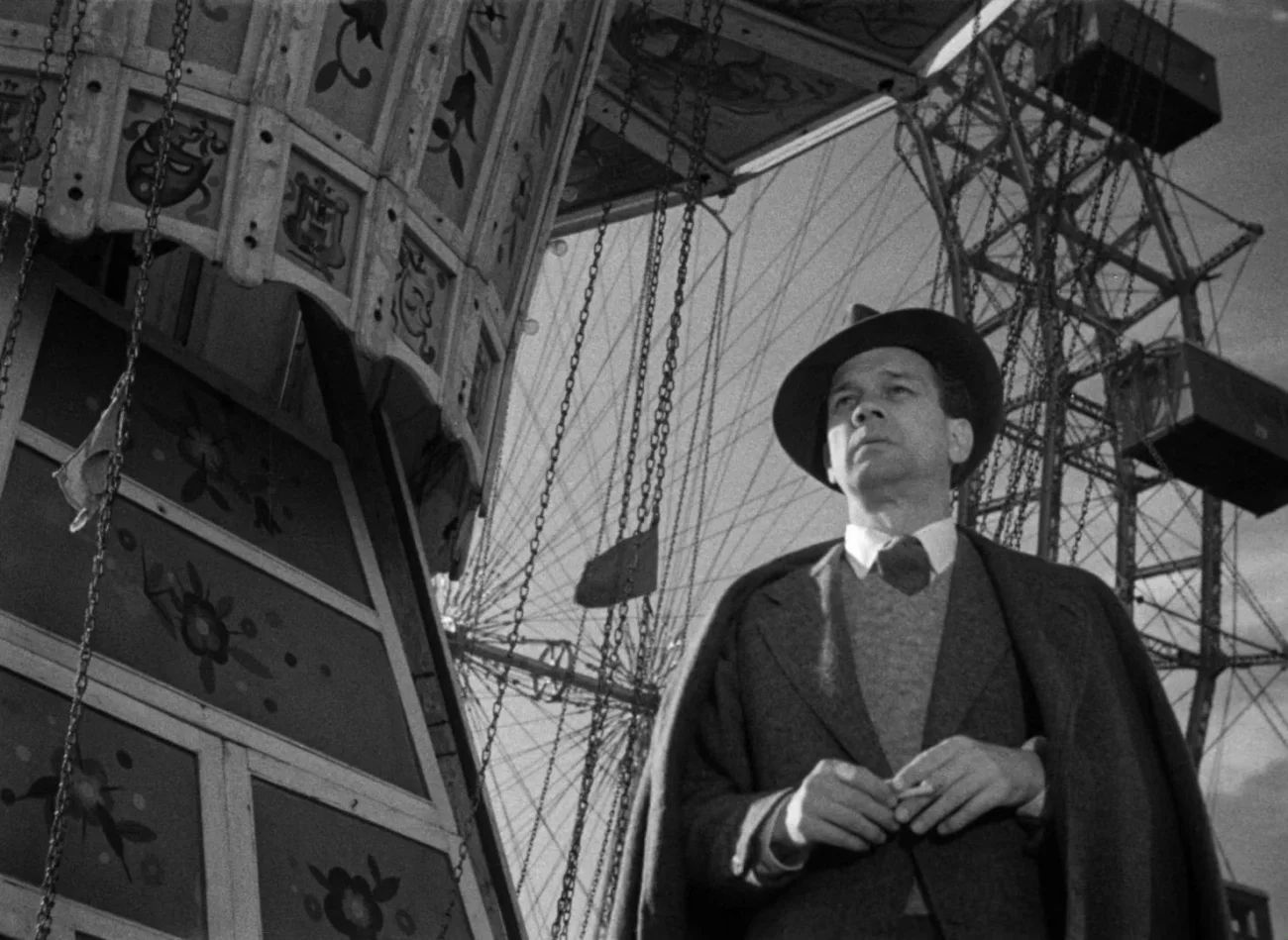
Reed's directorial choices reinforce the theme of a world off-kilter. The infamous Dutch angles are not mere stylistic flourishes; they visually represent a reality where traditional morals have collapsed. As Reed later said, "I shot most of this project with a wide-angle lens that distorted the buildings and emphasized the wet streets." Robert Krasker's cinematography uses hard light and deep shadows to create psychological landscapes, with characters often emerging from or retreating into darkness, mirroring their moral ambiguity. Shot in the Academy ratio (1.37:1), the cinematography uses tight framing to heighten claustrophobia, with every composition reinforcing the noir theme of entrapment. Krasker won the 1951 Academy Award for Best Cinematography for his work, a rare honor for a British production at the time.
Anton Karas' zither score is the project's secret weapon. Reed discovered Karas playing in a Vienna wine cellar and replaced the conventional orchestra Selznick wanted with this single, cynical instrument. The zither's twang, now iconic, avoids the sweeping sentimentality of typical Hollywood scores, instead matching the story's moral ambiguity note for note. As critic Norman Holland observes, the score "is cynical, and it embodies the moral ambiguity of this Vienna and this story." It is a perfect example of form following function, with the music telling the audience as much about the world of the story as the dialogue does.
This narrative also explores the limits of loyalty, a recurring theme in Reed's work. Martins' loyalty to Lime is tested as he grapples with the gap between his idealised memory of his friend and the person Lime has become. The story asks what we owe those we love when their choices clash with the greater good, a question that feels as relevant today as it did in 1949. Reed does not offer easy answers, instead leaving the audience to sit with the discomfort of Martins' choices, much like the characters sit with the ruins of Vienna.
The Third Man also subverts classic noir tropes at every turn. Unlike the standard noir template that centers on a hard-boiled detective, this story gives us a naive writer who can barely navigate the world he is in. The femme fatale is replaced by a survivor who defies easy categorization, and the crime at the center is not a simple murder but a systemic corruption that touches every level of society. This subversion keeps the narrative fresh decades later; it refuses to follow the formula, instead carving its own path through the noir landscape.
The Dutch angles, often criticized as gimmicks, serve a precise narrative purpose. They mirror the characters' internal instability, with each tilted frame reminding the audience that nothing in this world is as it seems. The angles are never used randomly; each tilt is calibrated to match the character's emotional state. When Martins feels most certain, the frame is level; when he doubts, the angles return. This consistency makes the visual language feel intentional, never gimmicky, a masterclass in using form to reinforce content. Krasker's lighting complements this perfectly, with characters often half-lit, their faces obscured by shadows that reflect their moral ambiguity. This visual language is so integral to the story that it is impossible to imagine the work without it. This visual consistency is a hallmark of Reed's directorial skill.
The zither score also subverts expectations, rejecting the lush orchestras typical of Hollywood noir. Karas' simple, repetitive melodies create a sense of unease that underscores every scene, never letting the audience relax into the story. Unlike typical film scores that tell the audience how to feel, the zither remains detached, much like the city itself. It never manipulates emotion, instead letting the scenes speak for themselves, a rarity in Hollywood scoring of the era. The score's cynicism matches the city's mood, with each note feeling like a comment on the corruption unfolding on screen.
The legacy of this masterpiece is as impressive as its craft. In 1999, the British Film Institute voted it the greatest British production of all time, a title it still holds. Peter Bogdanovich called it the greatest non-auteur work ever made, noting how every contributor from Reed to Greene to Krasker to Karas was at the height of their powers. It has influenced generations of directors, from the Coen Brothers to Christopher Nolan, who have cited its use of shadow and moral ambiguity as key inspirations.
The black-and-white morality Martins arrived with is replaced by a nuanced understanding of a broken world by the story's close. The Third Man does not offer redemption or punishment, only a clear-eyed look at people trying to survive in a city that no longer makes sense. It is this refusal to simplify that gives the story staying power, a masterclass in using noir tropes to explore profound human questions rather than just deliver thrills.
The film won the Palme d'Or at the 1949 Cannes Film Festival, cementing its status as a masterpiece of international cinema. Its influence on the noir genre is still felt today, with directors citing its innovative use of shadows and moral ambiguity as key inspirations.
Details reward attentive viewers: the recurring motif of rings (Lime's signet ring, the ring Martins throws into the sewer), the use of diegetic music (the zither heard in-universe before it becomes the score), and background actors whose glances and gestures enrich Vienna's lived-in feel. Viewers are trusted to notice these nuances, with symbolism never over-explained.
The People
Orson Welles wasn't the first choice for Harry Lime. Carol Reed initially wanted someone less iconic, fearing Welles' fame would distract from the story. Producer Alexander Korda even pushed for Cary Grant, believing his charm would make Lime more sympathetic, but Reed and Greene held out for Welles, knowing he could make evil feel magnetic. Grant later admitted he would have been too likable for the role, missing the necessary edge of amorality. Welles brought something irreplaceable to the role: the ability to make amorality feel charming. He reportedly based Lime's mannerisms on acquaintances who thrived in postwar chaos, opportunists who saw devastation as a market to exploit. His famous cuckoo clock speech was largely improvised; Greene later confirmed Welles added the Swiss analogy during filming, calling it "a line that needed timing only Orson could bring." Despite appearing in only 10 minutes of the film's runtime, Welles' Harry Lime looms over every scene, a testament to his magnetic screen presence.
Joseph Cotten nearly walked off the set over creative differences with Welles. Cotten, a straightforward leading man used to studio precision, found Welles' improvisational style chaotic and disruptive. Yet their off-screen tension translated into undeniable on-screen chemistry Holly Martins' growing frustration with Harry Lime feels authentic because the actors genuinely disagreed about their approach to the material. Cotten prepared for the role by reading Graham Greene's pulp Western novels, grasping Martins' black-and-white worldview to contrast with Lime's cynicism. As Cotten later recalled, "Playing Martins was easy because I didn't have to act naive; Orson made me feel that way every day on set."
Alida Valli, already a major European star, fought hard to play Anna Schmidt against Selznick's preference for Barbara Stanwyck. Valli brought haunted elegance to the role, informed by her own wartime experiences in Italy under fascist rule. She insisted Anna's loyalties remain ambiguous until the film's final moments, arguing that a woman in her position would prioritize survival over ideals. Her quiet strength in scenes where she watches Martins from afar speaks louder than any dialogue could. Valli later said, "Anna wasn't a heroine; she was a survivor, and I wanted to play her that way, not as a damsel waiting to be saved."
The sewer chase sequence nearly didn't happen as filmed. Welles disliked shooting in Vienna's actual sewers, complaining about the cramped conditions and foul air, so Reed used doubles for wide shots and filmed Welles' close-ups on soundstages in the UK. Assistant director Guy Hamilton recalled Welles' reluctance: "He wasn't afraid of the sewers; he just hated the discomfort. We spent half our time finding him when he wandered off set." Yet the final sequence blends location and studio work seamlessly, a testament to the crew's ingenuity. Hamilton later became a James Bond director, crediting his time on The Third Man with teaching him how to shoot action on a budget.
Graham Greene's involvement was as unusual as the film itself. He wrote the novella as a pre-production treatment, blurring the line between literature and cinema, and based Martins' pulp writing career on his own early work as a journalist. Greene drew inspiration for the black market plot from stories British intelligence officers told him about Vienna's postwar underworld. He later said, "I wrote Holly Martins as a man who believed in stories, only to find himself inside one that had no happy ending."
Anton Karas' journey to the film is a story in itself. Reed discovered him playing the zither in a Vienna wine cellar, hired him to score the film, and changed the movie's musical landscape forever. Karas, then a complete unknown, wrote the iconic title theme in a single night, using a zither he had played in taverns for years. The theme later topped international music charts in 1950, making Karas a star overnight. He later said, "I didn't know anything about film scores; I just played what the film felt like."
The film's finance story is equally compelling. Alexander Korda needed to use up money locked in postwar Europe due to wartime currency controls, choosing Vienna as a setting to free those funds. He made a deal with David O. Selznick for American distribution, but Selznick's interference nearly derailed the project. He wanted to cut 11 minutes for the American release, sanitizing the film's cynicism, but Reed and Greene fought to keep the original cut. Selznick also wanted to change the ending, making Anna stay with Martins, but Reed held firm, knowing the original ending was essential to the film's moral weight.
The film premiered at the 1949 Cannes Film Festival, winning the Palme d'Or, cementing its status as a masterpiece early on. Its innovative use of location shooting and moral complexity were standout elements, with Welles' performance a career highlight despite limited screen time. The win was particularly meaningful for Reed, who had struggled to get the film made against studio pressure.
The film's impact on its cast was profound. Cotten's career shifted toward more complex, morally ambiguous roles, while Valli became a symbol of European resilience in postwar cinema. Welles, however, struggled to match Lime's iconic status in later roles, with many audiences unable to separate the actor from the character's magnetic amorality. For Karas, the experience was life-changing, transforming him from a tavern musician to an international star.
Restoration work in the 1990s revealed previously cut scenes, including extra dialogue between Martins and Calloway that further develops their rivalry. These scenes were restored for the film's 50th anniversary re-release, giving audiences a deeper look at the characters' dynamics. These restored scenes also reveal more of Greene's original dialogue, which was sharper than the final cut suggests.
By the time filming wrapped, the cast and crew had navigated clashing egos, studio interference, and postwar Vienna's challenges to create a masterpiece. The Third Man's enduring legacy is not just the film itself, but the stories of the people who refused to compromise their vision. The ensemble's chemistry was so strong that many cast members reunited for a 50th anniversary screening in 1999. Their collective performance remains a masterclass in understated noir acting.
The Craft
Anton Karas's zither score is inseparable from the film's identity. Reed discovered Karas by chance in a Vienna wine garden, where the musician's jangling melodies perfectly captured postwar Vienna's bittersweet mood. Karas, a virtual unknown who had played in taverns across Austria, composed and performed the entire score on a single zither a daring choice that rejected Hollywood's conventional orchestral scores. The "Third Man Theme" became an international hit in 1950, topping charts in the UK and US, making Karas a star overnight. The zither's brittle timbre mirrors the film's visual style: both seem fragile yet resilient, finding beauty in brokenness. As Reed later noted, "The zither isn't just music; it's the voice of Vienna's ruins."
Robert Krasker's cinematography is a masterclass in using light and shadow to convey theme. The hard light sources create elongated shadows that stretch across walls and streets, visually suggesting how the past reaches into the present. Krasker frequently places characters in partial darkness, their faces half-lit, half-hidden emphasizing the duality at the heart of the story. The Dutch angles, while controversial at the time, serve a clear purpose: they make Vienna feel unstable, as if the city itself might collapse under the weight of its secrets. This technique became so iconic that it's now referred to as the 'Third Man angle' in cinematography circles, a testament to Krasker's innovative eye.
Production design leaned heavily on location shooting. Vienna's bombed-out streets and actual sewer systems weren't sets; they were authentic backdrops that added texture no studio could replicate. The crew faced constant challenges: Allied patrols, power outages, freezing temperatures, and bureaucratic hurdles from four occupying powers. Even interior sets, like Anna's apartment, were furnished with period details sourced from Vienna's remaining shops, grounding the story in its specific moment. Costume designer Molly Arbuthnot dressed the cast in muted tones that matched the rubble-strewn streets, avoiding the glamour of typical Hollywood noir. The result is a film that feels palpably real, as if the audience is walking through Vienna's ruins alongside the characters.
Oswald Hafenrichter's editing is often overlooked but essential to the film's tension. The sewer chase sequence, blending location shots and studio work, uses cross-cutting between Martins and Lime to build suspense without relying on rapid cuts. Hafenrichter paces the film deliberately, letting scenes breathe, with long takes that highlight the actors' performances. The famous Ferris wheel scene uses careful editing to contrast the vast Vienna skyline with the intimate, tense conversation between Martins and Lime. The film's runtime of 104 minutes feels taut, with no extraneous scenes, a testament to Hafenrichter's disciplined approach to cutting.
The film's practical effects, led by special effects supervisor Wally Veevers, were groundbreaking for the time. The sewer sets, built on soundstages in the UK, used forced perspective and clever lighting to mimic the vast Viennese underground. The Ferris wheel exterior was a practical location, with the interior cabin shot in studio, blending seamlessly to create one of cinema's most iconic scenes. There are no CGI or digital effects here, only skilled craftsmen using practical techniques to create a world that feels both real and nightmarish.
Sound design by John Dennis enhanced the zither score, balancing the instrument's twang with the ambient noise of Vienna's streets. Every footstep, every distant siren was placed to heighten the noir atmosphere, never overwhelming the dialogue or score.
The film's restoration in the 1990s revealed new details in Krasker's cinematography, enhancing its visual depth. The 4K restoration project uncovered subtle shadow details that had been lost in previous prints due to fading and poor storage. Viewers can now see nuances in the Dutch angles and lighting that confirm Krasker's meticulous planning in every frame.
Every technical choice in The Third Man serves the story, never showboating for its own sake. The craft elements work in harmony to create a unified vision of postwar Vienna, where every frame, note, and cut reinforces the film's central themes of ambiguity and survival.
The Trivia
-
The famous cuckoo clock speech was not in Graham Greene's original script. Orson Welles improvised the line during filming, and Greene later claimed it came from "an old Hungarian play," though its true origins remain debated. Welles attributed it to a vague "old Hungarian play" to justify its inclusion, but historians note the analogy predates Welles by centuries.
-
Joseph Cotten was so dissatisfied with the American version's added narration (by himself, as Holly Martins) that he refused to watch it for years. He preferred Carol Reed's original British opening, which he felt better captured the film's moral ambiguity.
-
The sewer chase scene required over a week to film, despite being only a few minutes of screen time. Crew members had to navigate actual Vienna sewers, coordinating with sanitation workers who controlled access to the tunnels. Welles' doubles performed most of the location work due to his discomfort with the environment.
-
Anton Karas was discovered by Reed after he played at a Heuriger (wine garden) in Grinzing. Reed was so struck by his performance that she hired him on the spot, despite having no prior film-scoring experience. Karas went on to tour internationally after the film's release.
-
The film's production was nearly halted due to disagreements between Reed and producer David O. Selznick. Selznick wanted a more conventional Hollywood noir; Reed insisted on location shooting and a morally complex ending. Their compromise resulted in two versions: the British original and the American edited version.
-
Orson Welles' screen time totals approximately 32 minutes, yet his performance ranks among the most iconic in cinema history. His ability to command presence with limited time speaks to his mastery of economical acting.
-
The zither theme spent 11 weeks at number one on the Billboard Best Sellers in Stores chart in 1950, from April 29 to July 8. This made Anton Karas an international star and cemented the association between the instrument and the film.
-
The British Film Institute voted The Third Man the greatest British film of all time in 1999, ahead of classics like Lawrence of Arabia and Brief Encounter. In 2021, it ranked third in the BFI's updated list.
-
The film's title derives from the phrase "the third man," referring to the mysterious figure seen helping carry Harry Lime's body after his accident. This plot device drives Martins' initial investigation and introduces the theme of hidden truths.
-
The film was nominated for three Academy Awards (Best Director, Best Actor, Best Cinematography) and won for Best Cinematography (Robert Krasker), making it one of the few film noir films to win an Oscar in a technical category. Krasker's innovative use of extreme angles and deep shadows set a new standard for the genre. His work on The Third Man proved that black-and-white cinematography could be as visually stunning as any Technicolor production.
-
The sewer scenes were shot using a combination of location doubles and studio sets. Due to Welles' reluctance to film in actual sewers, many of his close-ups were filmed later at Shepperton Studios in the UK, with wider shots using location doubles in Vienna.
-
The film's depiction of postwar Vienna's black market was so accurate that Austrian authorities reportedly used it for training purposes in the years following its release. The attention to detail extended to the currency used in scenes, with authentic occupation-era banknotes and stamps that had only recently fallen out of circulation. Greene's background research into the illegal trade networks operating in the city ensured that every transaction depicted on screen rang true to contemporary observers.
-
Graham Greene wrote a novella version of the story as a film treatment, which he later published. The novella differs significantly from the film, particularly in its ending, which Reed changed to be more ambiguous.
-
The character of Harry Lime was later revived in a radio series, The Adventures of Harry Lime, with Welles reprising the role. The series served as a prequel to the film, exploring Lime's earlier escapades.
-
The film's use of Dutch angles was so pronounced that some viewers at the time complained they caused motion sickness. Reed defended the choice as essential to conveying the story's disorienting tone.
The Verdict
The Third Man endures because it refuses easy answers. It's a film where charm masks cruelty, friendship collides with conscience, and a city's ruins mirror the fractured souls inhabiting it. What makes it special isn't just its technical brilliance though the cinematography, score, and performances are all top-tier but how every element serves a deeper moral inquiry. We watch not just to solve a mystery but to wrestle with questions that linger long after the credits roll: How well do we ever really know our friends? What compromises justify survival? And when loyalty curdles into complicity, where do we draw the line?
Its endurance lies in its adaptability to each generation's anxieties. Postwar audiences saw a cautionary tale about black-market exploitation; Cold War viewers read allegories of ideological division and espionage; modern audiences recognize timeless truths about how crisis corrupts opportunity. The film doesn't preach; it illustrates, letting us draw our own conclusions from the evidence before us. That trust in the viewer's intelligence is rare and precious, a hallmark of Reed and Greene's collaborative vision. It also avoids the trap of nostalgia, never romanticizing the ruin it depicts, instead finding humanity in the broken places.
I first saw The Third Man on a rainy afternoon in a repertory theater, expecting a clever thriller and encountering something far more haunting. The zither score stayed with me for days, not as a tune to hum but as a mood to inhabit a reminder that beauty and decay often coexist. I return to it whenever I need a reminder that great cinema doesn't just entertain; it complicates, forcing us to sit with discomfort rather than offering easy resolution.
"In Italy, for thirty years under the Borgias, they had warfare, terror, murder, and bloodshed; but they produced Michelangelo, Leonardo da Vinci and the Renaissance. In Switzerland, they had brotherly love; they had five hundred years of democracy and peace and what did that produce? The cuckoo clock!"